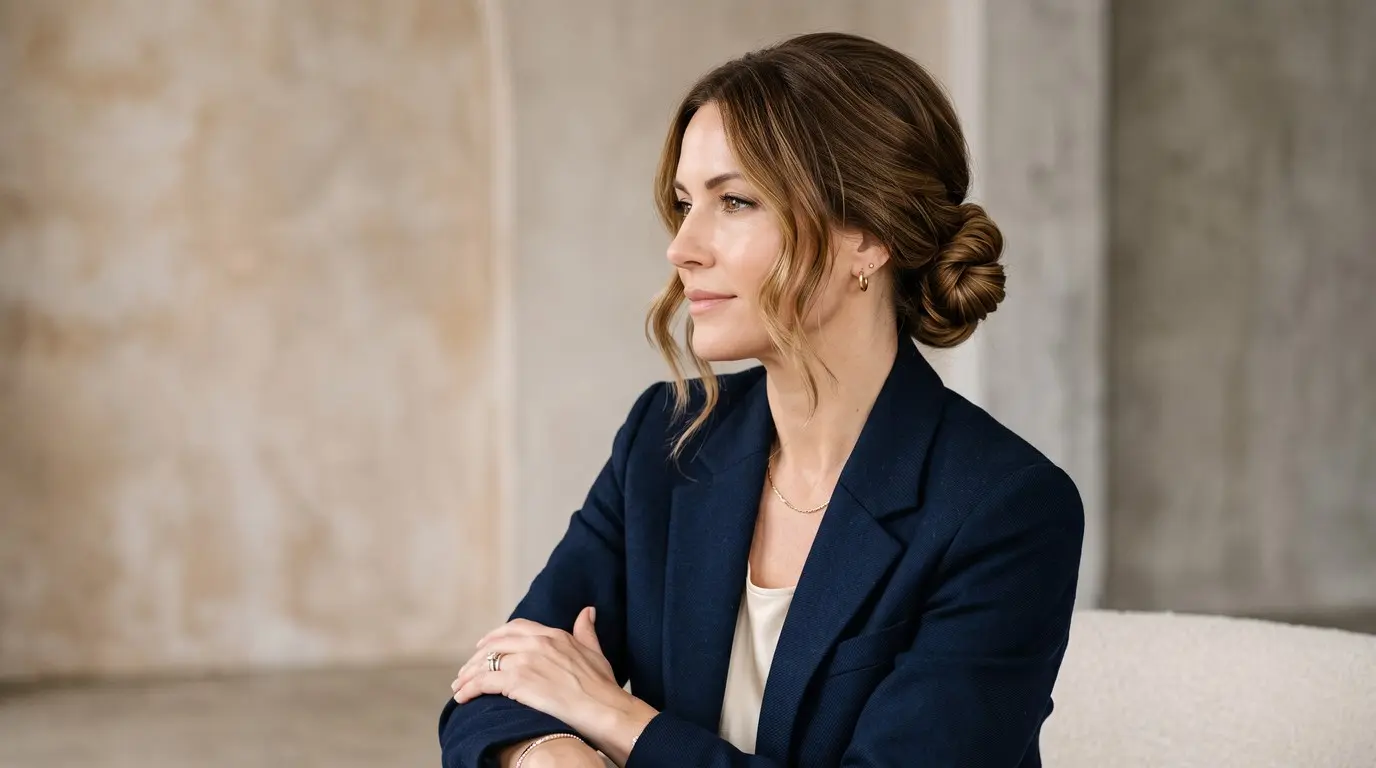
The most flattering low buns for women over 40 are soft, slightly loose styles—like a textured chignon or a low bun with face-framing pieces—that soften the jawline and photograph better than a tight, severe knot.
The low bun has quietly become the most requested updo for women over 40, and it’s not hard to see why. Pulled back but never severe, it sits at the nape of the neck where it softens the jawline, shows off good bone structure, and reads as effortless rather than overdone. Unlike a high, tight bun that can pull at the hairline and expose every fine line at the temples, a low bun leaves a little movement around the face—exactly the kind of imperfect polish that reads as confidence rather than trying too hard.
What makes the style so versatile is how many ways it can be worn. A sleek chignon takes a blazer from office-ready to elegant in seconds, while a loosely twisted knot with a few face-framing pieces feels right for a weekend brunch or a wedding. Below are 20 low bun variations—sleek, textured, braided, and more—built around what flatters mature hair, from fine strands that need volume to thick hair that holds shape all day.
1. Sleek Low Chignon

Hover on images and discover how pinning can transform your collection of favorites!
This is the most polished version of the low bun: hair smoothed flat against the scalp, gathered low at the nape, and wrapped into a tight, glossy knot. It reads as boardroom-ready and works well for fine to medium hair since there’s little bulk to hide. Set the smoothness first with a comb and light gel, then mist with hairspray after pinning so flyaways stay down through a full day. It pairs especially well with statement earrings since the neckline is left completely open.
2. Textured Low Bun with Face-Framing Pieces

Hover on images and discover how pinning can transform your collection of favorites!
Instead of scraping every strand back, this version leaves soft pieces loose around the temples and cheekbones to soften the transition from hairline to bun. The bun itself is left slightly loose rather than pulled tight, which adds movement without looking undone. It’s a flattering middle ground for anyone unsure whether a fully sleek or fully messy bun suits them. Finish the loose pieces with a light texturizing spray so they hold soft waves instead of falling flat.
3. Braided Low Bun

Hover on images and discover how pinning can transform your collection of favorites!
A three-strand or fishtail braid is gathered into a low bun instead of a plain twist, adding visible texture and a slightly more formal finish without extra product. Thick or long hair holds this shape especially well since there’s enough length to braid before coiling it under. It’s a sturdy option for humid weather or long days since braided hair resists frizz better than a smooth twist. Loosen the braid slightly with your fingers before pinning for a fuller, less rigid look.
4. Low Bun with Deep Side Part

Hover on images and discover how pinning can transform your collection of favorites!
Shifting the part from center to deep side changes the whole feel of a low bun, drawing a diagonal line across the crown that adds asymmetry and a slightly more editorial look. It works particularly well for anyone who already parts their hair deeply for volume, since the bun continues that same line down to the nape. A side part also means one side of the face gets more coverage than the other, which some readers find more flattering than a fully symmetrical style. Smooth the part with a fine-tooth comb before gathering the rest back.
5. Messy Low Bun for Fine Hair

Hover on images and discover how pinning can transform your collection of favorites!
Fine hair often looks thin in a tight, glossy bun, but a deliberately undone version—pulled loosely, twisted once, and pinned without smoothing every strand—reads as full rather than thin. Teasing just the crown section before gathering the rest adds lift at the root that a bun alone can’t provide. This style is forgiving of second- or third-day hair, since some natural oil actually helps the loose pieces hold their shape. A few bobby pins placed at angles, rather than straight in, keep a loose bun from sliding out over the day.
6. Twisted Low Bun

Hover on images and discover how pinning can transform your collection of favorites!
Two sections of hair are twisted separately from the crown down before being wound together into one bun at the nape, creating visible spiral texture instead of a plain knot. It suits medium to thick hair that holds a twist without needing extra pins to keep the shape defined. This version photographs well from every angle since the twists give it dimension even from the back. Secure each twist with a single pin before wrapping so the shape doesn’t unravel as you pin the final bun.
7. Low Bun with Curtain Bangs

Hover on images and discover how pinning can transform your collection of favorites!
Curtain bangs left out and parted around the face soften a low bun considerably, framing the forehead while the rest of the hair stays pulled back and tidy. It’s a good option for anyone who already wears curtain bangs day to day and doesn’t want to pin them back with everything else. The bangs can be worn straight for a sleeker overall look or left with a soft bend for something more relaxed. Keep a small round brush on hand to redirect the bangs if they start falling flat by midday.
8. Gray-Blended Low Chignon

Hover on images and discover how pinning can transform your collection of favorites!
For hair that’s transitioning to or already fully gray, a smooth low chignon shows off the color itself rather than competing with texture or volume. The sleek finish gives silver and white tones a glossy, almost metallic look under good light. This style works at any stage of the gray-out process, since a low bun blends regrowth lines better than hair worn fully down. A shine serum smoothed over the surface after pinning enhances the natural sheen gray hair already has.
9. Low Bun with Silk Scarf Wrap

Hover on images and discover how pinning can transform your collection of favorites!
Wrapping a silk scarf around the base of a low bun turns a simple updo into a finished accessory piece, and it’s a practical way to disguise regrowth or a rough hair day underneath. The scarf can match an outfit or contrast with it, and knotting it off to one side keeps the look from feeling costume-y. This is an easy style to redo quickly since the scarf hides any unevenness in the bun itself. Choose a silk or silk-blend scarf rather than cotton so it slides smoothly without snagging strands.
10. Voluminous Low Bun for Thin Hair

Hover on images and discover how pinning can transform your collection of favorites!
A foam or mesh bun-shaped insert placed underneath the gathered hair gives thin hair a fuller, rounder shape than pinning it alone would produce. Hair is wrapped around the insert and pinned to cover it completely, so from the outside it looks like a naturally thick bun. This is one of the most reliable ways to make a low bun look substantial on hair that wouldn’t otherwise hold much shape. Choose an insert close to your hair color so any small gaps in coverage aren’t noticeable.
11. Low Bun with Side-Swept Bangs

Hover on images and discover how pinning can transform your collection of favorites!
Side-swept bangs left loose over the brow add softness to a low bun without fully framing the face the way curtain bangs do. It’s a lower-commitment option for anyone easing into face-framing pieces for the first time, since it’s just one section rather than two. The rest of the hair stays pulled back smoothly, so the bangs become the single focal point. Pin the bangs back loosely on humid days rather than letting them hang free, since fine hair loses its bend fastest in moisture.
12. Low Ballerina-Style Bun

Hover on images and discover how pinning can transform your collection of favorites!
Borrowed from classic ballet styling but worn lower at the nape instead of high on the crown, this version is tight, smooth, and completely symmetrical. It’s the most formal option on this list and suits occasions like weddings or performances where hair needs to stay put for hours without touch-ups. Because every strand is pulled back, it also works well for showing off drop earrings or an open-neckline dress. Use a firm-hold gel rather than a light serum so the shape holds through movement.
13. Low Bun with a Statement Hairpin

Hover on images and discover how pinning can transform your collection of favorites!
A single decorative hairpin or comb placed at an angle across the bun turns a plain low bun into a finished look without needing a scarf or extra styling. It works especially well on a simple, unadorned twist or knot, since the accessory becomes the visual detail. Metallic pins read more formal, while pearl or fabric-covered pins feel more everyday. Slide the pin in at a slight diagonal rather than straight across so it catches the light and stays visible from the front.
14. Wavy Low Bun

Hover on images and discover how pinning can transform your collection of favorites!
Loose waves are set through the hair before it’s gathered, so instead of a smooth twist, the finished bun has visible texture and a slightly undone edge even though it’s fully secured. This version tends to look fuller than a bun made from straight hair, since wavy strands take up more visual space. It’s a versatile choice that moves easily from daytime to evening without needing to be redone. Pin loosely and let a few waved ends peek out at the edge of the bun rather than tucking everything flat.
15. Low Bun for a Wedding Guest

Hover on images and discover how pinning can transform your collection of favorites!
This version is built to hold through a full day of events: hair is smoothed, sectioned, and pinned in layers rather than gathered all at once, so the shape doesn’t loosen during a ceremony and reception. A few soft face-framing curls are left out to keep the style from looking too severe for a celebration. It photographs well from the back as well as the front, which matters for a day with this much documentation. Ask your stylist for extra pins at the nape specifically, since that’s where a bun loosens first over a long day.
16. Low Bun for the Office

Hover on images and discover how pinning can transform your collection of favorites!
Built for speed as much as polish, this is a low bun that can be done in under five minutes: gather, twist once, pin, done. It’s deliberately simple rather than heavily textured, since the goal is a neat, professional look rather than a statement style. Fine to medium hair holds this shape well through a full workday without needing a midday touch-up. Keep a small clear elastic and two extra bobby pins in a desk drawer so it’s easy to refresh after a video call or a windy commute.
17. Low Bun with a Knit Headband

Hover on images and discover how pinning can transform your collection of favorites!
A wide knit or fabric headband worn just behind the hairline adds texture and covers regrowth or roots while the rest of the hair is gathered into a simple low bun underneath. It’s a practical cold-weather pairing since the headband doubles as light ear coverage. The look works especially well with a slightly undone, non-glossy bun, since the headband already adds enough polish on its own. Push the headband back slightly from the hairline rather than pulling it tight across the forehead to avoid an obvious line.
18. Double-Twist Low Bun

Hover on images and discover how pinning can transform your collection of favorites!
Two separate low buns—one stacked slightly above the other—are created by twisting hair in two horizontal sections before pinning each into its own small knot. It reads as more architectural than a single bun and suits thick hair that would otherwise make one large bun feel heavy. This is a style best practiced a few times before an occasion, since keeping the two sections separated as you twist takes a bit of coordination. Pin the lower bun first, then the upper one, so the top slightly overlaps and hides the seam between them.
19. Low Bun with Loose Tendrils

Hover on images and discover how pinning can transform your collection of favorites!
A handful of thin pieces are pulled out around the hairline and left completely straight rather than curled, giving a low bun a softer, more romantic edge without changing its shape. It’s a subtle variation that works on almost any low bun base, from sleek to textured. Because the tendrils are straight rather than waved, this version tends to look a little more modern than a curled face-framing style. Use a fine-tooth comb to pull just a few strands loose rather than a whole section, so the bun still reads as intentional.
20. Low Bun for Second-Day Hair

Hover on images and discover how pinning can transform your collection of favorites!
Unwashed hair actually holds a low bun better than freshly washed hair, since the natural oils give strands more grip and prevent the bun from sliding loose. A light dusting of dry shampoo at the roots before gathering hides any oiliness while adding texture that helps the twist hold its shape. This is the easiest low bun on the list to execute well, since you’re working with hair that already wants to stay in place. Focus the dry shampoo at the roots only, since applying it to lengths can leave hair looking dull instead of textured.
You Might Also Like
- pixie cuts for women over 40
- lob haircut for women over 40
- curly pixie cuts for women over 40
- shaggy lob styles over 40
- gray blending ideas for dark hair
Whichever version you choose, the low bun’s real advantage over 40 is flexibility: it works with fine or thick hair, straight or wavy, gray or color-treated, and it dresses up or down depending on how tight you pull it. The styles that photograph best usually aren’t the tightest—leaving texture at the crown and a few loose pieces around the face reads as intentional, not undone.
If you smooth flyaways with a flat iron or add soft waves with a curling wand before pinning, use a heat protectant first, keep the iron under about 180-200°C (355-390°F) for coarse hair or closer to 150°C (300°F) for fine or color-treated hair, and only run it over completely dry hair—wet strands under an iron cause the real damage. A blow-dryer or diffuser is for damp hair, not dry.
Frequently Asked Questions
Does a low bun suit round faces?
A low bun with soft face-framing pieces is often flattering on rounder faces because the loose strands break up width at the cheekbones, while a very tight, scraped-back version can emphasize roundness instead. If you have a rounder face, ask your stylist to leave a few pieces out rather than pulling everything back completely.
How often do I need a trim to keep a low bun looking neat?
A low bun hides length well, so you can usually stretch trims to every 10-12 weeks. What you're maintaining is the shape around your face—face-framing layers and bangs lose their definition faster than the rest of the style as they grow out, so those may need a touch-up sooner.
Is a low bun a good option for thinning or fine hair?
Yes—a slightly loose, textured low bun disguises fine hair better than a tight, glossy one, since a little volume at the crown and gathered-back sections both add the illusion of density. Backcombing the crown lightly before gathering, or using a bun-shaped foam insert as a base, gives fine hair more visual thickness without extra product weight.
Will the low bun trend still be relevant in a few years?
The low bun isn't a trend so much as a classic updo that cycles in and out of the spotlight every few seasons—it's been a red-carpet and bridal staple for decades. What changes season to season is the finish: sleeker some years, looser and more textured in others, making it a safe long-term style to learn.
What's the easiest way to style a low bun at home?
Gather hair at the nape, twist it once, and wrap it around itself before securing with bobby pins pointed toward the center of the bun for hold. Second-day or slightly unwashed hair holds a low bun better than freshly washed hair, since it has more grip and won't slide loose as quickly.