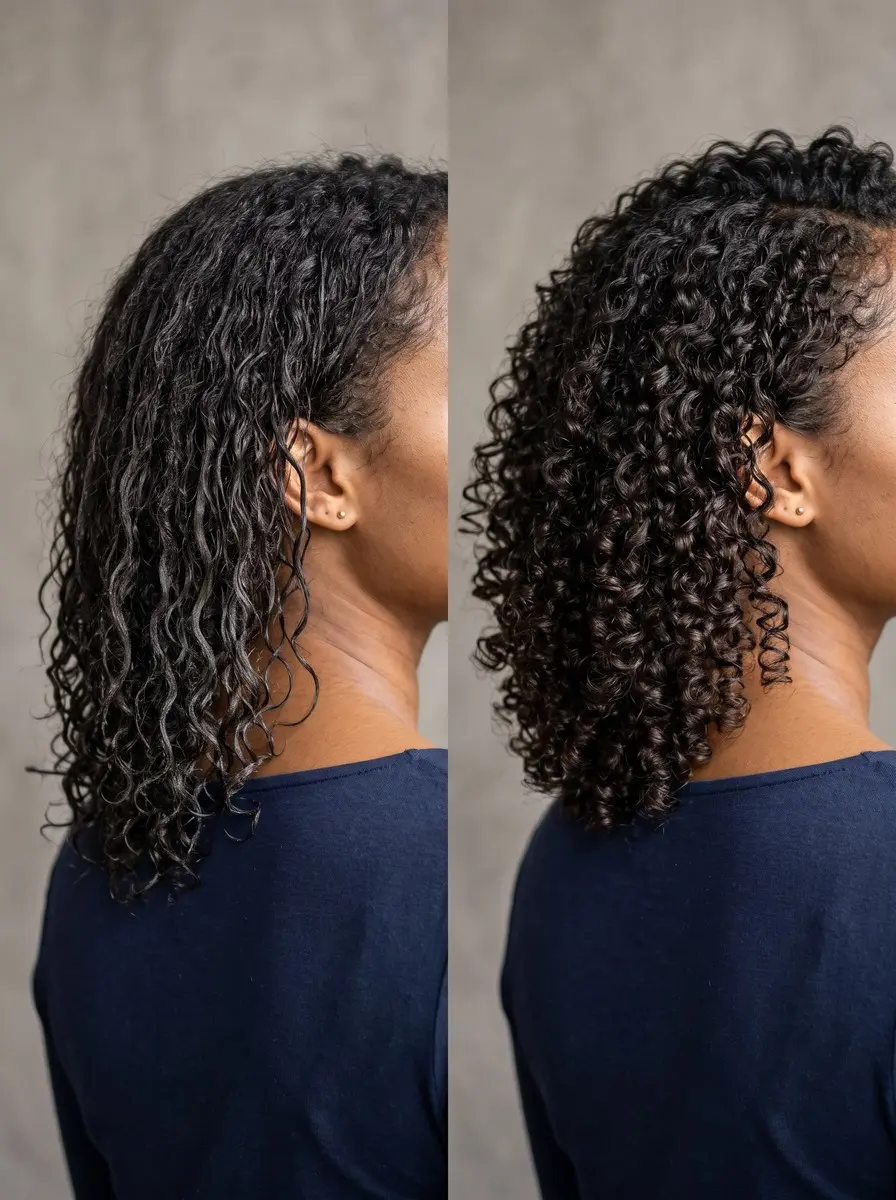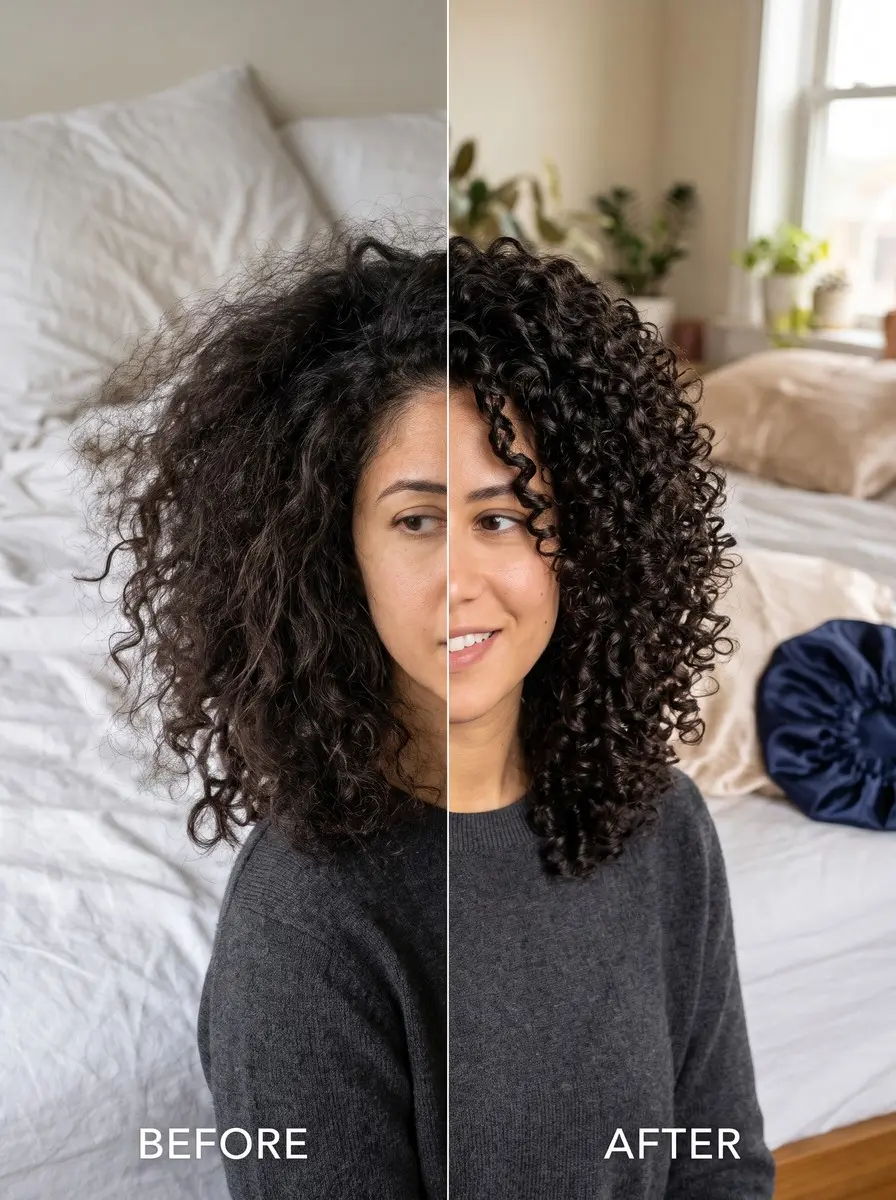
Quick answer To sleep with curly hair, let it get mostly dry and gather it into a loose high pineapple with a satin scrunchie. Use mini pineapples or a bonnet if it's short, and sleep on satin or silk. In the morning, mist your curls, add a little leave-in and shake them out.
You spend an hour on wash day getting every curl to clump, then wake up to one flat side, a halo of frizz and a knot at the back of your neck. Most of a curl set is lost at night, not during the day. Cotton bedding pulls moisture out and drags curls apart. Damp hair sets in whatever shape the pillow presses into it. Turning over all night grinds the nape into tangles.
The fix is a routine, not a product: to sleep with curly hair well, use satin or silk, go to bed with your curls mostly dry, protect the nape, and choose a sleep style that fits your length.
That means a loose pineapple for long curls, mini pineapples or a bonnet for short ones, and loose twists or braids when you’d rather stretch. The guide ends with a morning refresh that brings curls back without a full wash.
Time 5-10 minutes at bedtime, about 5 minutes in the morningDifficulty BeginnerSteps 7
Night-Time Method by Curl Length
| Your hair | Night method | Morning result |
|---|---|---|
| Shoulder length or longer | Loose pineapple at the crown | Pattern intact; fluff the roots |
| Chin to shoulder length | A few loose mini pineapples | Small bends; mist them out |
| Too short to gather | Satin bonnet or scarf | Curls held; fluff the roots |
| Fading set or tight coils | Loose twists or braids | Stretched, less defined |
What You’ll Need
As an Amazon Associate, HairAide earns from qualifying purchases. Product links in this guide are affiliate links: they cost you nothing extra and help keep these tutorials free.
- Satin or silk pillowcase Gives curls a smooth, less absorbent surface, so they glide instead of frizzing and drying out the way they do on cotton.
- Satin-lined bonnet Covers the whole head, nape included, and has room to sit over a pineapple without crushing it.
- Oversized satin or silk scrunchies Hold a pineapple or mini pineapples loosely, without the dents and breakage a tight elastic causes.
- Continuous-mist spray bottle Gives a fine, even mist for the morning refresh, so curls get damp without getting soaked.
- Lightweight leave-in conditioner for curly hair A pea-size amount keeps nape ends sliding past each other instead of knotting, and smooths frizz during the morning refresh.
Step-by-Step
Step 1 Swap cotton for satin or silk
Replace your cotton pillowcase with satin or silk, or cover your hair with a satin-lined bonnet or scarf. Cotton absorbs moisture and has a slightly rough surface, so it pulls moisture out of your curls and drags across them every time you turn over.
That friction roughs up the outer cuticle layer into frizz and pulls curl clumps apart. Satin and silk are smooth and absorb far less, so curls glide over them instead of catching, which is why curl specialists consistently recommend them.
A pillowcase suits you if you can’t stand anything on your head, while a bonnet or scarf protects your whole head, nape included, however much you toss and turn.
Step 2 Get curls mostly dry first
Plan wash day for the morning or early evening so your curls are mostly dry by bedtime. The roots should be dry and the lengths only slightly cool to the touch.
Wet hair is heavier and stretchier, so a soaking head sets in whatever shape the pillow presses it into, leaving one side flat and kinked, and wet hair at the nape tangles faster as you move. To speed things up, blot with a microfiber towel or an old T-shirt instead of rubbing, then air-dry or diffuse on low heat and low speed until your styler has set.
If your hair is still damp at lights-out, put it in a loose pineapple (a high ponytail at the crown; see the pineapple step below) and cover it with a bonnet so it can finish drying without being crushed.
Step 3 Protect the nape from matting
Before you put your hair up, give the nape (the hair at the back of your neck) a minute of attention, because that is where tangles and mats form most often. This hair is usually shorter than the rest and gets rolled between your neck and the pillow all night, so loose strands wrap around each other and knot.
Gently finger-detangle the section and smooth a pea-size amount of leave-in conditioner over the ends so they slide past each other instead of catching. Then either sweep it up into your pineapple or put it in one loose two-strand twist. You’re done when no hair is lying flat against your neck.
Step 4 Pineapple long curls at the crown
If your curls reach your shoulders or longer, flip your head forward and gather everything into one loose ponytail at the crown, the very top of your head. Wrap a satin or silk scrunchie around it once or twice.
Because the curls are lifted up and away from the pillow, your head rests on the pillow instead of the lengths, so the curl pattern and root volume survive the night.
Keep it loose: a tight elastic grips one spot hard, which leaves a dent that won’t shake out and can snap strands at the tie point. The cue is a ponytail that flops forward like a pineapple top and a scrunchie you can slide two fingers under.
Step 5 Use mini pineapples for short curls
If your curls are too short to reach the crown (roughly chin to shoulder length), divide them into three to five sections: front, two sides and back. Make a small, loose pony on top of each section with a mini satin scrunchie or a soft fabric tie.
Each mini pineapple lifts its own section off the pillow, so you get the same protection as a full pineapple without dragging short hair into a painful, high-tension pony.
If your hair is too short even for that, skip the ties and wear a satin bonnet or scarf, which holds curls in place without pulling on them at all. Expect a small bend where each tie sat; a mist in the morning relaxes it.
Step 6 Stretch with loose twists or braids
Use twists or braids when you want length more than tight definition. That might be on the third day or later, when your wash-day set is fading, or with tight coils that shrink a lot. Divide mostly dry hair into four to eight sections and make loose two-strand twists or plaits, working a little leave-in through each one.
Grouping curls into a few large sections shrinks the surface area that rubs against the bedding, and the gentle tension elongates the pattern, so you wake up with a stretched twist-out or braid-out.
The trade-off is that you lose your original curl pattern: the result is a new, longer texture, not your wash-day curls. Keep the sections large and the twists loose at the root so they don’t pull on your hairline, and twirl the ends around a finger so they don’t unravel.
Step 7 Refresh curls in the morning
Take down your pineapple, mini pineapples or twists and mist your curls with water from a continuous-mist bottle until they’re lightly damp, not dripping. The water softens yesterday’s styler and lets flattened curls swell and re-clump, so the shape comes back without a full wash. Smooth a pea-size amount of leave-in over frizzy patches with flat palms and scrunch upward.
Then flip your head and fluff the roots with your fingertips to lift any flat spots and relax the bend from the scrunchie. Don’t brush or rake your fingers through, which breaks clumps into frizz; let it air-dry for about ten minutes, and you’re done when the clumps have re-formed.
Common Mistakes to Avoid
- Tying a pineapple or bun with a tight elastic, which dents the hair and breaks strands at the tie point.
- Going to bed with soaking-wet curls, which flattens the pattern on one side and makes the nape tangle.
- Leaving the nape down under a pineapple, so the shortest, most-rubbed hair mats against the pillow.
- Brushing or raking your fingers through your curls in the morning instead of misting and scrunching, which breaks the clumps into frizz.
- Wearing a bonnet too small for your volume, which crushes the pineapple and presses a line into your hairline.
Pro tip Use a bonnet and a satin pillowcase together: bonnets slip off overnight more often than people realize, and the pillowcase protects your curls when that happens. Choose a bonnet big enough for your hair’s volume, not just your head, so it sits over a pineapple without squashing it.
The Bottom Line
The whole routine comes down to four things: a smooth satin or silk surface, mostly dry hair, a protected nape and a loose sleep style that fits your length.
Do it every night and most mornings you’ll only need a mist, a little leave-in and a shake at the roots. Switch to twists or braids later in the week when definition is fading, and wash again when a refresh no longer brings the clumps back.
If you still wake up to mats every night, or keep finding broken strands in the same spot, book a stylist who specializes in curls. They can trim the split ends that catch and knot, check for damage and fine-tune your routine. If you notice shedding or thinning at your hairline, show it to a dermatologist.
Frequently Asked Questions
Is it bad to go to sleep with wet curly hair?
Sleeping on soaking-wet curls won't ruin them, but it usually costs you the style. Wet hair sets in whatever shape the pillow presses it into, and a damp nape tangles faster. Aim for dry roots before bed. If you speed things up with a diffuser on damp hair, apply a heat protectant first and keep it on low heat.
Is a bonnet or a satin pillowcase better for curly hair?
Both reduce friction and moisture loss compared with cotton. A bonnet or scarf protects your whole head, including the nape, and holds curls in place. A pillowcase protects only the hair touching it, but it suits people who can't sleep in a head covering. Many people with curly hair use both, because bonnets often slip off during the night.
Can sleeping in a pineapple damage curly hair?
A loose pineapple tied with a satin or silk scrunchie is one of the gentlest ways to sleep with curls. Damage comes from tension: a tight elastic, or a high pony pulled taut every night, can dent the hair and cause breakage at the tie point and along the hairline. Keep it loose, and shift its position slightly from night to night.
How do I stop the back of my curly hair from matting overnight?
Before bed, finger-detangle the nape and smooth a little leave-in conditioner over the ends. Then lift that section into your pineapple or one loose twist and cover it with a bonnet so it can't roll against the pillow. If a mat does form, don't pull it apart dry. Soak it with conditioner and work it loose from the ends upward.
Do twists or braids at night ruin curl definition?
They change your curls rather than ruin them. Twists and braids stretch your curls and group them together, so you wake up with a longer, wavier twist-out or braid-out instead of your wash-day pattern. That's a useful trade later in the week when definition is already fading, or when you want to show more length. On the night after wash day, a pineapple keeps the original pattern better.
Keep Reading
Sources
- How to sleep with curly hair curlcentric.com
- How to sleep with curly hair 5 tips and tricks perfectlocks.com
- How to sleep with curly hair de.curlsmith.com
- How to sleep with curly hair to avoid matting naturallycurly.com