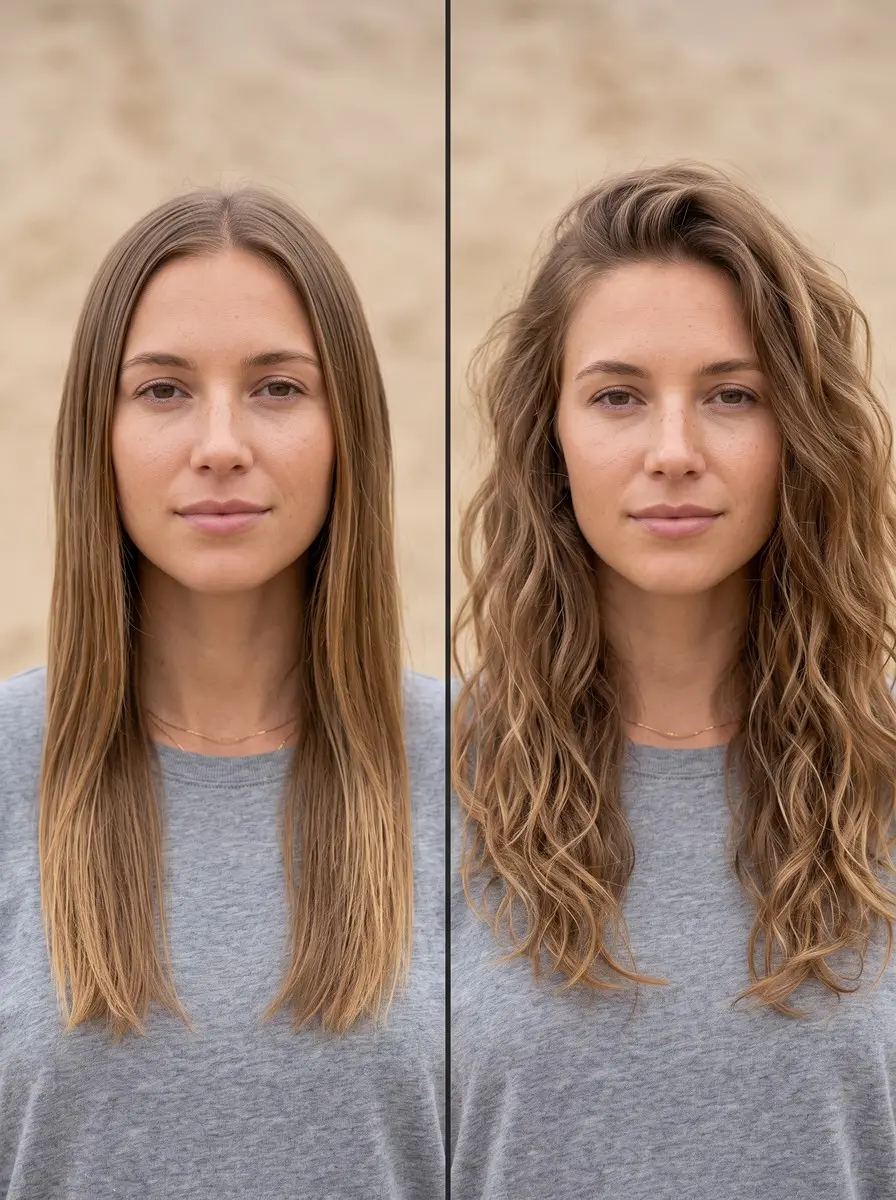
A butterfly cut works on thin hair when it is softened to two tiers: short face-framing layers starting around the chin over long layers, with a blunt perimeter and no razoring. Shoulder length or longer holds the shape most reliably.
The butterfly cut is everywhere because it promises blowout-level movement from the cut alone. On fine or low-density hair, that promise comes with a warning. L’Oréal Paris cautions that too many layers can make strands look sparse, and the salon group Rush notes the cut can remove too much weight from fine hair and leave the ends stringy. Add a razor or thinning shears and the hemline turns wispy instead of full.
The fix is a softer brief, not a different haircut. Rush describes the butterfly as a two-tier structure: short face-framing layers over longer ones. For thin hair, stop there. Start the short tier around the chin, keep the perimeter blunt, and let the styling supply the lift. The 20 versions below each state the layer count, the length and the exact words to give your stylist, and the last one is for anyone who should skip the cut altogether.
1. Two-Tier Soft Butterfly with a Blunt Perimeter

Hover on images and discover how pinning can transform your collection of favorites!
This is the fine-hair baseline: one short tier of face-framing layers starting at the chin, one long tier, and a hemline cut straight across. It suits straight or slightly wavy hair that goes stringy when layered all over. Ask for ‘a soft butterfly, two tiers only, blunt perimeter, no razor and no thinning shears.’ Book a trim every six to eight weeks, because split ends show sooner on fine strands and a frayed hemline undoes the fullness.
2. Collarbone Butterfly with a Chin-Length Face Frame

Hover on images and discover how pinning can transform your collection of favorites!
Collarbone length is about as short as the two-tier structure goes before the tiers merge, which makes it a practical choice for low-density hair that thins out past the shoulders. The short tier starts at the chin and the long tier sits just an inch or two below it. Ask for ‘collarbone length, blunt line, face-framing pieces from the chin, nothing shorter at the back.’ Trim every six to eight weeks to keep the line crisp.
3. Curtain-Bang Butterfly on a One-Length Base

Hover on images and discover how pinning can transform your collection of favorites!
Here the fringe does the butterfly’s work and the rest of the hair stays almost solid. It is the version L’Oréal Paris points fine-haired readers towards: face-framing curtain bangs with a blunt or minimally layered cut. It suits anyone whose ends already look see-through. Ask for ‘curtain bangs that blend into one chin-length face-framing layer, and keep everything else one length.’ The bangs need a quick tidy between appointments; the base can wait six to eight weeks.
4. Mid-Back Butterfly with Front-Only Layers

Hover on images and discover how pinning can transform your collection of favorites!
Long fine hair can carry a butterfly shape if every layer stays in front of the ears. The back remains a single blunt length, so the density at the hemline is untouched, while chin-to-collarbone pieces sweep away from the face. It suits straight hair with a healthy, even hemline. Ask for ‘front-only layers from the chin down, back left one length, cut blunt.’ Keep to a six-to-eight-week trim, since long fine ends split and fray visibly.
5. Shoulder-Skimming Butterfly with Flipped-Out Ends

Hover on images and discover how pinning can transform your collection of favorites!
A blunt shoulder-length hem flicks outwards when it meets the shoulders, and this version uses that kick as built-in movement instead of cutting more layers. It suits fine, straight hair that falls flat by midday. Ask for ‘shoulder length, blunt, with two soft face-framing layers starting at the chin.’ Turn the ends out over a round brush while blow-drying. The flip depends on a sharp line, so keep trims at six to eight weeks.
6. Long Butterfly with Hidden Interior Layers

Hover on images and discover how pinning can transform your collection of favorites!
A few long layers are cut underneath the top section, so the surface looks solid and the movement comes from inside. This suits hair with fine strands but plenty of them, since it needs some density to hide the layers; truly sparse hair should choose a blunter option. Ask for ‘two or three long internal layers, point-cut lightly, nothing shorter than the collarbone except the face frame, and a blunt perimeter.’ Trim every six to eight weeks.
7. Deep Side-Part Butterfly

Hover on images and discover how pinning can transform your collection of favorites!
Flipping the part to one side stacks more hair over the crown, which gives the short tier something to sit on. The face-framing layer is cut from the chin on the heavy side, and shorter pieces are skipped on the light side. It suits hair that looks thin through the top or at a centre part. Ask for ‘a butterfly cut for a side part, two tiers, blunt ends.’ Show the stylist where you part before the first snip, and re-trim every six to eight weeks.
8. Fine-Wave Butterfly with Scrunched Mousse

Hover on images and discover how pinning can transform your collection of favorites!
Loose natural waves give a soft butterfly more apparent body than straight hair can, provided the layers stay long enough for the wave to complete a full bend. It suits fine, wavy hair that goes limp under heavy creams. Ask for ‘two tiers, shortest layer at the chin when dry, blunt hemline, no thinning.’ Scrunch a lightweight volumising mousse into damp hair and leave it to air-dry. Trim every six to eight weeks, when the ends begin to look frizzy.
9. Dry-Cut Butterfly for Fine Curls

Hover on images and discover how pinning can transform your collection of favorites!
Fine curls spring up after cutting, so a face frame aimed at the chin on wet hair can land much higher once dry. Cutting curl by curl on dry hair avoids the surprise. It suits loose-to-medium curls with low density. Ask for ‘a dry cut, two tiers, face-framing curls that sit at the chin when dry, and a full, even perimeter.’ Diffuse damp curls on low with mousse, and book a reshape every six to eight weeks.
10. Lob-Length Butterfly That Leans on the Fringe

Hover on images and discover how pinning can transform your collection of favorites!
A lob that sits between chin and shoulder is shorter than the butterfly usually goes, so there is no room for a second tier at the back. The body comes from a curtain fringe and one face-framing layer instead. It suits very fine hair that looks thicker when worn short. Ask for ‘a blunt lob, curtain bangs, and a single face-framing layer that meets the hemline; no layers behind the ears.’ The fringe loses its shape first, so expect a trim every six weeks.
11. Bottleneck-Fringe Butterfly

Hover on images and discover how pinning can transform your collection of favorites!
A bottleneck fringe is narrow at the centre of the forehead and widens as it curves past the cheekbones, so it borrows less hair from the top than a full fringe does. That matters when there is not much to spare. It suits fine hair with a reasonably dense front hairline. Ask for ‘a slim bottleneck fringe blending into chin-length face-framing layers, blunt perimeter.’ Blow-dry it forward, then sweep it apart. Tidy the fringe between six-to-eight-week trims.
12. Round-Brush Blowout Butterfly

Hover on images and discover how pinning can transform your collection of favorites!
The cut is the plain two-tier shape; the styling is what sells it. A round-brush blow-dry bends each tier away from the face, which is how the layers become visible on fine hair. It suits straight hair and anyone willing to spend ten minutes with a dryer. Ask for ‘two tiers, with enough length in the short one to wrap around a medium round brush.’ Apply root-lift spray to damp roots first. Trims every six to eight weeks keep the ends bending cleanly.
13. Soft-Bend Butterfly with a Medium-Barrel Iron

Hover on images and discover how pinning can transform your collection of favorites!
For days without a blowout, a medium-barrel curling iron gives the tiers a loose bend. Start each section a few inches below the root and leave the last inch out, so the blunt hemline still reads as thick. It suits fine hair that drops a tight curl within the hour. Ask for ‘two tiers, blunt ends, no texturising, so the ends hold a bend.’ Finish with texturising spray instead of oil. Keep the six-to-eight-week trim; frayed ends will not hold a curve.
14. Shadow-Root Butterfly with Face-Framing Brightness

Hover on images and discover how pinning can transform your collection of favorites!
Colour can add the dimension that extra layers would otherwise supply. A root kept a shade or two deeper can make the scalp less noticeable at the part, and finer, lighter pieces through the short tier draw the eye to the face frame. It can be adapted to most natural shades. Ask for ‘a soft two-tier butterfly, blunt hem, with a soft root and babylights around the face.’ Lightened fine hair is more fragile, so do not stretch trims past eight weeks.
15. Half-Up Butterfly

Hover on images and discover how pinning can transform your collection of favorites!
Clipping the top tier up at the crown stacks the shortest layers over the longest, which fakes a thicker silhouette and leaves the blunt hemline on show. It suits fine hair on day two, when the roots have dropped. Ask for ‘a short tier long enough to reach a clip at the crown, about chin length, over a blunt long tier.’ Mist the roots with texturising spray for grip before clipping. The usual six-to-eight-week trim applies.
16. Grown-Out Bob Butterfly

Hover on images and discover how pinning can transform your collection of favorites!
A bob on its way to shoulder length is already blunt, which makes it a ready-made base. The stylist adds only the short tier, so no length is lost at the back. It suits anyone growing out a bob who wants some shape during the in-between months. Ask for ‘keep my length and my blunt line, just add face-framing layers from the chin.’ Dust the hemline every six to eight weeks so the ends stay solid while you add length.
17. Soft-Square Butterfly with Rounded Corners

Hover on images and discover how pinning can transform your collection of favorites!
A perfectly straight hem can look severe, and a V-shaped one removes the very ends that make thin hair look full. The middle ground is a square line with the front corners rounded off just enough to meet the face frame. It suits fine, straight hair worn long. Ask for ‘a blunt square perimeter, corners softened, two tiers, and please no V or deep U shape.’ Trim every six to eight weeks to hold the line.
18. Grey-Blending Soft Butterfly

Hover on images and discover how pinning can transform your collection of favorites!
Hair commonly loses some density with age, and grey strands can sit differently from the rest, so the two-tier rule matters even more here. A chin-length face frame adds movement around the cheekbones while the blunt hem keeps the length looking substantial. It suits women over 50 with fine or thinning hair. Ask for ‘a soft butterfly, layers at the front only, blunt ends.’ Trim every six to eight weeks and keep conditioner light and on the ends only.
19. Upside-Down-Dried Butterfly

Hover on images and discover how pinning can transform your collection of favorites!
Finishing a blow-dry with the head tipped forward lifts the roots away from the scalp, and a two-tier cut gives that lift somewhere to show. It suits fine hair that lies flat at the crown. Ask for the standard soft butterfly: ‘chin-length face frame, long layers, blunt perimeter.’ Work mousse into damp roots, rough-dry upright until mostly dry, then flip over for the last minute. Use a clarifying shampoo when the lift stops coming, since buildup weighs fine hair down, and trim every six to eight weeks.
20. The Almost-Butterfly: Blunt Cut with Curtain Bangs

Hover on images and discover how pinning can transform your collection of favorites!
Some hair is better off skipping the butterfly: very low density, ends that are already see-through, or lengths thinned by breakage. Layers remove weight this hair cannot spare. A one-length blunt cut with curtain bangs gives a similar face-framing sweep and keeps every strand at the hemline. Ask for ‘one length, cut blunt, with curtain bangs that sweep to either side.’ Trim every six to eight weeks, and revisit the two-tier version once the ends look solid.
You Might Also Like
- curtain bangs for thin hair
- featherlight layers for thin hair
- butterfly cut ideas for round faces
- how to get rid of fine hair frizz without weighing it down
- fullness-faking ponytails for thin hair
The pattern across all twenty is the same: two tiers, a face frame that starts around the chin, a blunt perimeter, and a firm no to razors and thinning shears. Shoulder length or longer gives the shape room, and shorter cuts let the fringe do the lifting. If your ends are already sparse, the blunt cut with curtain bangs is the better call.
One styling note covers every look here. Apply a heat protectant before any hot tool. Blow-dry damp hair over a round brush for lift, and use a curling iron only on completely dry hair, kept to about 150C/300F for fine or bleached hair (coarse hair can take 180-200C/355-390F). A lightweight mousse at the roots will do more for fullness than another layer ever could.
Frequently Asked Questions
Is a butterfly cut good for thin hair?
It can be, in a softened form. The full version with many layers can remove too much weight and leave fine ends looking stringy. A two-tier version, with face-framing layers from the chin, long layers behind and a blunt perimeter, keeps density at the hemline and still gives movement around the face.
What should I tell my stylist to get a butterfly cut on fine hair?
Ask for a soft butterfly with two tiers only: short face-framing layers starting around the chin and long layers behind them. Request a blunt perimeter and say clearly that you do not want a razor or thinning shears, because heavily thinned ends make fine hair look wispy.
How often does a butterfly cut on thin hair need trimming?
Plan on a trim every six to eight weeks. Split ends show up faster on fine hair, and once the blunt hemline frays the cut loses its shape and starts to look thinner. Curtain bangs and the shortest face-framing pieces lose definition first and may need a quick tidy in between.
How do I style a butterfly cut so thin hair looks fuller?
Work a lightweight volumising mousse or root-lift spray into damp roots, then blow-dry over a round brush, turning each tier away from the face. Finish with your head tipped forward for extra lift and a mist of texturising spray. Use a clarifying shampoo periodically, since product buildup flattens fine hair.
Who should skip the butterfly cut, and is it a lasting style or a passing trend?
Skip it if your hair is very low in density or the ends already look see-through; a blunt, minimally layered cut with curtain bangs gives a fuller result. As for longevity, the name is new but the structure is long-standing face-framing layering, so the soft version grows out gracefully and is unlikely to date.
Sources
- L'Oréal Paris warns that too many layers can make strands look sparse, and suggests face-framing curtain bangs with a blunt or minimally layered cut to give fine hair a fuller look. lorealparisusa.com
- Rush describes the butterfly cut as a two-tier structure of short face-framing layers over longer layers. It says the cut can remove too much weight from fine or low-density hair and leave ends stringy, and that split ends show up faster on fine hair. rush.co.uk