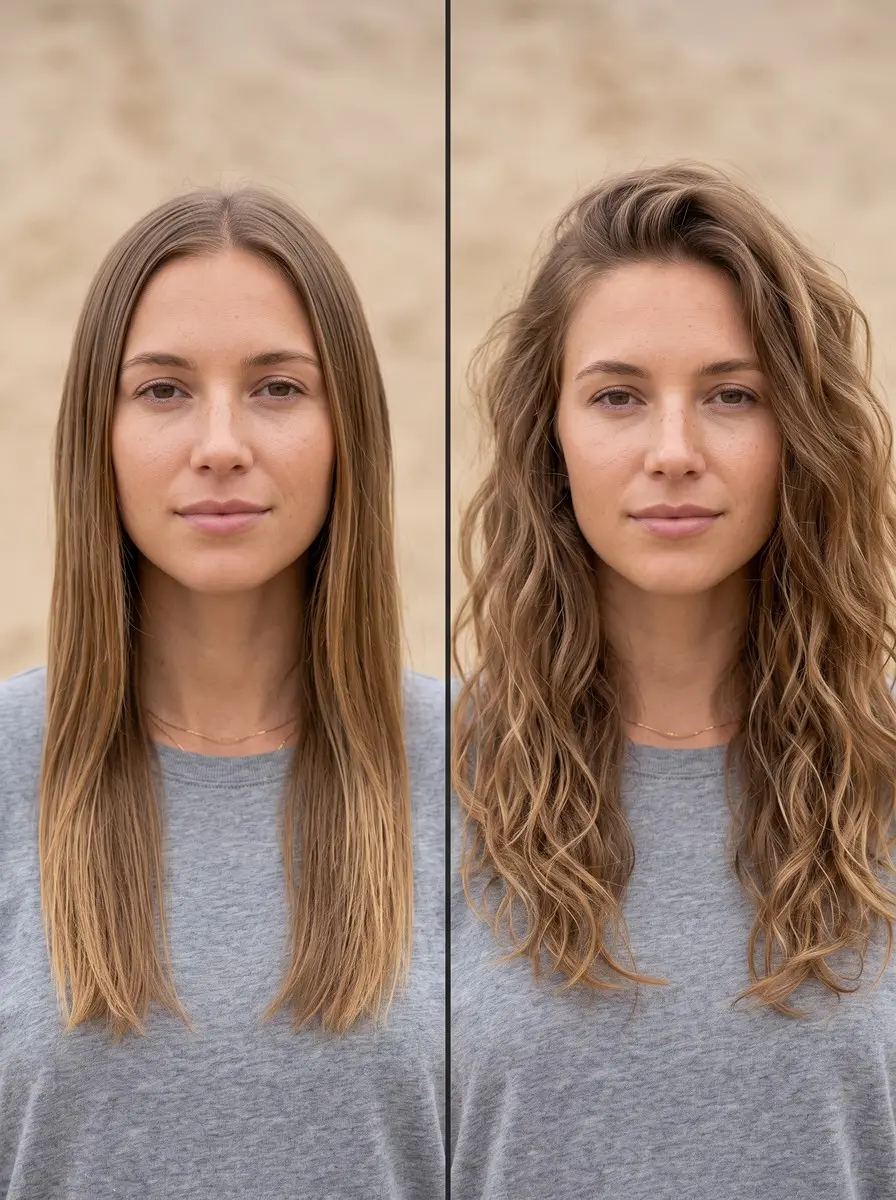
To get beachy waves without heat on fine hair, twist dry hair, lightly misted with texturizing spray, into a low bun, leave it for a few hours or overnight under a satin scarf, then finger-comb the waves apart and finish with a light mist of sea salt spray.
Fine hair is a strange mix of easy and stubborn. Each strand is narrow and flexible, so it takes on a new shape quickly, and loses it just as quickly. Add a rich cream or an oil to help it hold and the waves stretch flat under the weight before lunch. That is why routines that work on thicker hair so often leave fine hair either limp or oddly dented.
The good news: you can get beachy waves without heat on fine hair, and the fix is not more product or more time. It is the right method, the right level of dampness and the lightest products that still give grip. Below, five methods are ranked for fine hair, from a twisted low bun to a salt spray scrunch, with a damp-or-dry rule for each. Ten minutes of prep, a few hours of setting, and you get loose, tousled waves without any heat.
What You’ll Need
- Lightweight volumizing mousse — Gives fine hair lift at the roots and enough grip to hold a wave in the damp-hair methods without the weight of a cream or oil.
- Sea salt or texturizing spray — Adds the gritty, matte texture that makes waves look beachy and helps slippery fine strands cling to their new shape.
- Silk or satin scarf (or satin pillowcase) — Protects the set from friction while it dries, so waves come out smooth instead of frizzy.
- Satin heatless headband wrap — Needed for the headband method, and its soft surface avoids the dents a regular elastic band leaves in fine hair.
- Creaseless clips and satin scrunchies — Hold buns and pin-curl twists in place without pressing a hard line into fine strands.
As an Amazon Associate, HairAide earns from qualifying purchases. Some links above are affiliate links — they cost you nothing extra and help support free tutorials.
Step-by-Step
-
Start by getting the dampness right, because it decides everything that follows. Soaking wet hair takes far too long to set, and if you wrap it up overnight it can stay wet at the centre long enough to smell of mildew. Bone-dry hair, on the other hand, can dent or frizz in the tighter methods. For braids, pin-curl twists and the scrunch you want hair that is towel-dried and then air-dried until it feels cool but leaves no water on your palm. The exceptions are the twisted bun in step 3, which works best on fully dry hair, and the headband wrap in step 5, which wants hair that is almost dry.
-
Apply lightweight products only, and match them to your method. For braids, pin-curl twists and the salt spray scrunch, work a golf-ball-sized puff of volumizing mousse through the roots and mid-lengths of damp hair, where fine hair needs lift and grip, then mist four to six spritzes of sea salt or texturizing spray over the mid-lengths and ends from arm’s length so it lands as a veil. For the dry-hair bun and the almost-dry headband wrap, skip the mousse, which needs damp hair to spread evenly, and use only two or three spritzes of texturizing spray. Skip creams, butters and oils entirely: they coat a narrow strand heavily enough to pull the wave straight. Your hair should feel slightly gritty, never slick or sticky.
-
Try the top-ranked method first: the twisted low bun on dry hair. Stylists recommend this one for fine hair because dry hair in a loose twist takes a soft bend without the frizz or dented look that tighter sets leave behind. There is no mousse in this version: mist dry hair lightly with texturizing spray, gather it at the nape, twist the whole length in one direction and coil it into a loose bun secured with a scrunchie or a claw clip. For slightly more wave, split the hair into two low buns. It is ready when the light mist has dried completely and the bun feels relaxed to the touch, usually after two to three hours.
-
If you want more definition or crown volume, move to methods two and three. Second place goes to braids: on slightly damp, moussed hair, plait two to four braids, starting them as Dutch or French braids so the wave begins at the crown instead of at ear level. Fewer, fatter braids give looser waves, while four give a more crinkled texture. Third place goes to pin-curl twists: on slightly damp hair, twist two-inch sections away from the face, coil each one flat against the head and clip it. These give the most bounce, but they take the longest to put in. Both are ready when the ends and the thickest part of each braid or coil feel fully dry, with no cool, damp spots left when you press them.
-
Methods four and five suit specific situations. The satin headband wrap, where almost-dry hair is wound loosely around a soft band worn like a crown, gives even waves from ear level down, but fine hair can slip out of it overnight, so it ranks fourth. It is ready when the wound hair feels dry all the way through, with no coolness near the band. The salt spray scrunch ranks fifth for hold but first for speed: towel-dry until slightly damp, apply mousse and sea salt or texturizing spray, scrunch upward in handfuls, then keep your hands off until it is completely dry, which on fine hair is often under an hour. It only enhances a bend your hair already has, so very straight fine hair will get texture more than true waves. There is nothing to take down afterwards, so scrunchers can skip ahead to step 8.
-
Give the set enough time, and protect it while it works. A dry-hair bun or an almost-dry headband wrap needs about two to three hours, while slightly damp braids and pin-curl twists are better left overnight so the centre of each section dries completely. Hair only holds a new shape once it is fully dry, so taking it down early is the most common reason fine waves collapse. If you are sleeping on it, tie a silk or satin scarf over the set or use a satin pillowcase, which lets hair glide instead of roughing up into frizz.
-
If you used a bun, braids, pin-curl twists or a headband wrap, take the set down gently, in the reverse order you put it up. If you did the salt spray scrunch, there is nothing to release, so go straight to step 8. Remove clips and ties, then let each section unwind on its own before you touch it. Separate the waves with your fingers only, raking from underneath and starting at the ends. A brush pulls fine waves straight and turns them into fluff within a few strokes, so leave it in the drawer. Stop as soon as the waves look loose and piecey, because every extra pass through fine hair removes a little more shape.
-
Finish with a light mist and fix any trouble spots. Spritz sea salt or texturizing spray once or twice over the lengths from arm’s length, then scrunch upward to wake the pattern. If you see a sharp kink where a clip or elastic sat, dampen just that spot with a water mist, wrap it around your finger and let it dry for a few minutes. If the ends hang limp and straight, twist the last two inches around a finger with a touch of mousse and let them dry. The look is done when the waves move freely and feel matte, not crunchy.
Common Mistakes to Avoid
- Setting hair while it is soaking wet: it takes too long to dry, can smell of mildew if left wrapped overnight, and falls flat when you take it down still damp in the middle.
- Using creams, oils or heavy leave-in conditioners for hold: on fine hair they add weight that pulls the wave straight within hours.
- Brushing the waves out: a brush stretches fine waves into fluff, so separate with your fingers only.
- Twisting or braiding too tightly: high tension on fine hair leaves sharp dents and crimped lines instead of loose, tousled bends.
- Taking the set down before it is fully dry: hair only keeps a new shape once it has dried in that shape.
Pro Tip
Twist the sections on either side of your face away from it, and alternate the direction of any sections behind them. Waves that all turn the same way merge into one big curl on fine hair, while alternating directions keeps them separate, fuller and more convincingly undone.
Frequently Asked Questions
Should fine hair be wet or dry for heatless beach waves?
It depends on the method, but never soaking wet. A twisted low bun works best on dry hair, which avoids frizz and a dented look. Braids, pin-curl twists and a salt spray scrunch work best on hair that is towel-dried and only slightly damp. Soaking wet hair takes too long to set and can develop a mildew smell if left wrapped overnight.
Why do my heatless waves fall out so fast on fine hair?
The usual causes are taking the set down before it is completely dry, using a product that is too heavy, or over-handling the waves afterwards. Fine strands are narrow and flexible, so they drop a shape easily. Use mousse and a salt or texturizing spray instead of creams, wait until every section is dry, and separate with your fingers only.
How long should I leave a heatless set in fine hair?
A low twisted bun on dry hair needs a few hours, and two to three is usually enough for a soft bend. Slightly damp braids or pin-curl twists are better left overnight so the centre of each section dries fully. Whatever the method, the test is the same: the hair should feel completely dry before you release it.
Is sea salt spray bad for fine hair?
Used lightly, it is one of the most useful products for fine hair because it adds grip and texture without weight. Salt can leave hair feeling dry if you layer it on daily, so keep it to a few spritzes on the mid-lengths and ends, avoid soaking the hair with it, and condition your ends as usual on wash day.
Can I speed things up with a diffuser?
Yes. After a salt spray scrunch, diffuse damp hair on a low setting instead of air-drying, which also adds volume. That is no longer heat-free, so apply a heat protectant first. If you touch up a stray piece with a curling iron, use it on completely dry hair only and stay near 150C/300F for fine or bleached hair (180-200C/355-390F for coarse hair).
You Might Also Like
- featherlight layered haircut ideas for thin hair to inspire your next look
- volume-building curtain bang ideas for thin hair to pair with your waves
- how to get rid of fine hair frizz without weighing it down
- heatless curls on thick hair
- fullness-faking ponytails for thin hair
- volume-faking updos for thin hair
- low maintenance haircuts that air-dry well
Heat-free beachy waves on fine hair come down to three decisions: the right dampness for the method, products light enough to hold without flattening, and the patience to let the set dry fully. Start with the twisted low bun on dry hair, then try braids or pin-curl twists when you want more definition. On day two, re-twist dry hair into a loose bun for an hour and mist lightly to revive the shape.
If your waves still drop within an hour no matter what you try, the cut may be working against you. Long, one-length fine hair is heavy at the ends, and a stylist can add soft, light layers that help it hold movement. It is also worth booking in if your ends look thin or see-through, since a trim makes any wave look fuller.
Sources
- Stylists recommend a low twisted bun on dry hair for fine hair, left in for a few hours or overnight, to avoid frizz or a dented look. makeup.com
- Towel-dry until slightly damp, apply sea salt or texturizing spray, scrunch and air-dry, or diffuse for volume. behindthechair.com