The most comfortable ponytail styles for thick hair spread the weight instead of fighting it: a two-tier stacked ponytail, a low nape ponytail, and braided, bubble or wrapped tails. Use doubled or spiral elastics for grip, and never tighten for height.
Thick hair turns a simple ponytail into an engineering problem. The tail is heavy, the elastic slides, and by mid-afternoon the base has dropped and your scalp is aching. Heavier hair is more likely to irritate scalp tissue when it is pulled tight, which is why a ponytail that feels fine on a friend can leave you with a headache.
The fix is rarely a tighter tie. The best ponytail styles for thick hair share the load instead of fighting it, with better weight distribution, more grip, and less bulk at the base. The 20 styles below are organised around that idea: split and two-tier ponytails that share the load, low placements that ease strain on the scalp, braided, bubble and wrapped tails that compress the width, and half-up options that carry only part of the hair. Each entry also covers what to ask your stylist for, including de-bulking cuts that lighten the tail without creating frizz.
1. Two-Tier Stacked Ponytail

Hover on images and discover how pinning can transform your collection of favorites!
Split the hair from ear to ear, tie the lower half at the nape, then tie the upper half directly above so it drapes over and hides the first elastic. Two anchors share the weight, and you can loosen the bottom tie the moment your scalp starts to ache. It suits long, dense, straight-to-wavy hair. Ask your stylist for long internal layers so the top tier blends into the bottom. Move the split line up or down a little each time you wear it.
2. Low Sleek Nape Ponytail

Hover on images and discover how pinning can transform your collection of favorites!
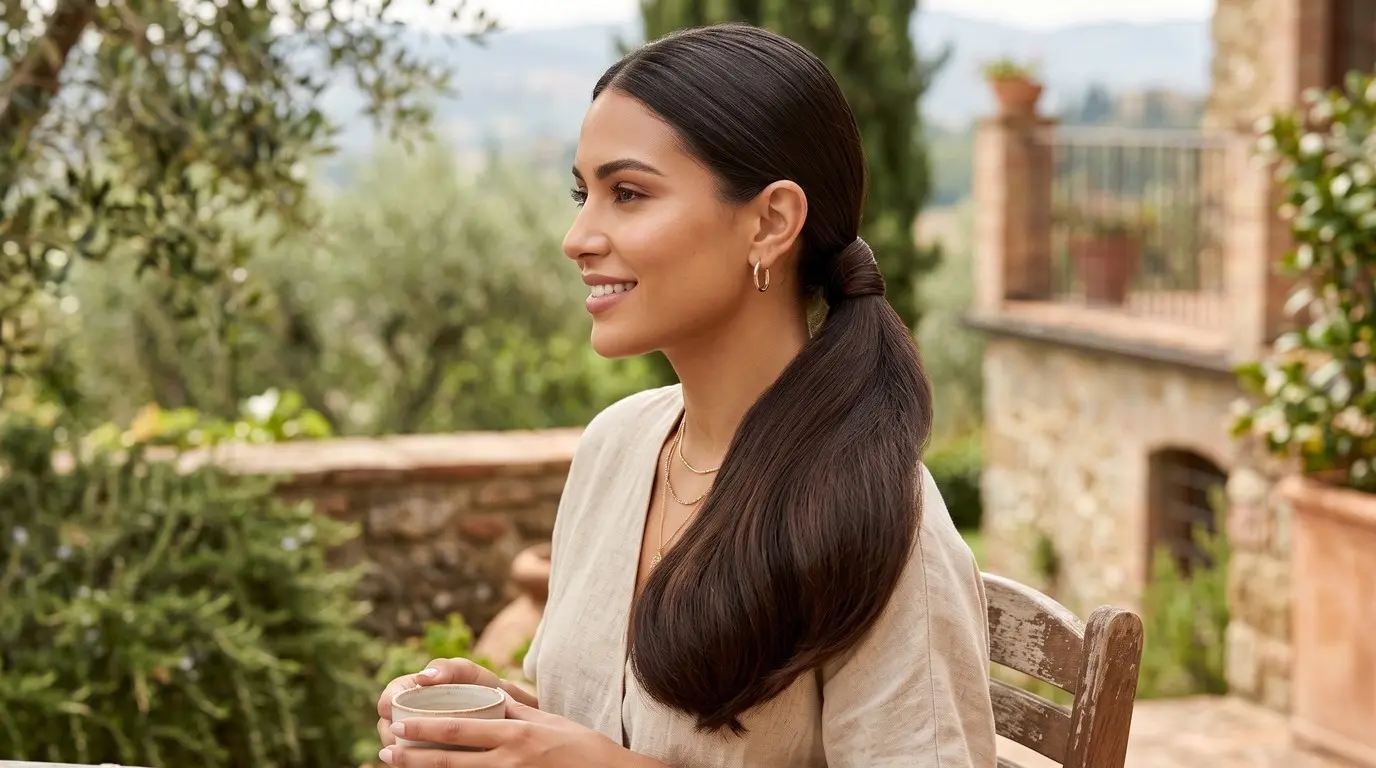
Sitting at the nape, this ponytail lets the length hang down your back instead of pulling against the crown, which puts less strain on the scalp than a high tie. It is a strong choice for heavy, straight or blown-out hair and for anyone prone to ponytail headaches. Ask your stylist to remove weight from the underside at the nape, with scissors rather than a razor, so the base lies flat. Smooth a pea-sized amount of cream over the surface and re-tie it slightly looser by midday.
3. Braid-Wrapped Low Ponytail

Hover on images and discover how pinning can transform your collection of favorites!
Tie a low ponytail with a thick elastic, then braid a pencil-width strand from the underside and wind it around the base until the elastic disappears. The wrap adds a second layer of hold and turns a bulky tie into a detail. It flatters dense hair past the shoulders, straight or wavy. Ask your stylist to keep the underneath layers long so the wrapping strand reaches around twice. Secure the end with a bobby pin pushed upward into the base, and re-pin after a few hours.
4. Long Bubble Ponytail

Hover on images and discover how pinning can transform your collection of favorites!
Elastics placed every three to four inches divide one long, swinging tail into short, contained sections, so it moves less and feels more controlled. Gently tug each section outward to round it. It suits very long, thick hair that is straight or loosely wavy. Ask your stylist for blunt ends softened with point cutting so the final bubble looks full instead of stringy. Use snag-free elastics and remove them from the bottom up, which avoids tearing through tangles at the end of the day.
5. Rope-Twist Ponytail

Hover on images and discover how pinning can transform your collection of favorites!
Split a mid-height ponytail in two, twist both halves clockwise, then wrap them around each other anticlockwise so the rope locks instead of unravelling. Twisting compacts a wide tail into one neat cord that stays off your neck. It is a good match for thick hair that slides out of three-strand braids. Ask your stylist for long layers that start low, since short layers poke out of the twist. Finish the ends with a drop of serum and retwist once during the day.
6. Half-Up Crown Ponytail

Hover on images and discover how pinning can transform your collection of favorites!
Only the top third of the hair goes into the tie, so the elastic carries a fraction of the weight while the rest hangs free. That makes it one of the gentlest options for anyone who gets a headache from every full ponytail. It works on shoulder-length to long hair of any texture. Ask your stylist for face-framing pieces that begin around the cheekbone to soften the pulled-back section. Shift the tie slightly higher or lower each wear so the tension never lands on the same spot.
7. Spiral-Tie High Ponytail

Hover on images and discover how pinning can transform your collection of favorites!
A high ponytail is the most demanding placement, so the grip has to come from the tie, not from tightness. Stack two spiral coil ties, which hold dense hair without being cranked tight, and get your lift by lightly backcombing the crown before you gather. It suits thick, straight hair with some layering. Ask your stylist for shorter crown layers to lighten the top of the tail. Treat it as a few-hours style and take it down as soon as your scalp feels sore.
8. Loose Curly Pineapple Ponytail

Hover on images and discover how pinning can transform your collection of favorites!
Gather thick curls loosely at the very top of the head and loop a satin scrunchie around once, with no doubling. The curls spill forward and keep their pattern because nothing is stretched tight. It is made for dense wavy, curly and coily hair, especially on day two or three. Ask your stylist for a dry, curl-by-curl cut with a rounded outline so the curls stack instead of forming a shelf. Refresh with water and a little leave-in, then re-fluff the top with your fingers.
9. Low Banded Coily Puff

Hover on images and discover how pinning can transform your collection of favorites!
Instead of forcing coils through a small elastic, wrap a long stretchy tie or adjustable hair band around the nape and tighten it only until the puff holds. You set the tension, so the hairline is never strained. It suits thick, tightly coiled hair at any length that reaches a ponytail. Ask your stylist to shape the ends into a rounded silhouette so the puff looks even from every side. Lay the edges with a small amount of edge control and loosen the band before bed.
10. Knotless Braid Low Ponytail

Hover on images and discover how pinning can transform your collection of favorites!
Box braids add their own weight, so the tie sits low and loose: gather the braids at the nape and bind them with a long fabric tie, or with one braid wrapped around the rest. It suits anyone wearing thick hair in a protective style. Ask your braider for medium knotless braids at mid-back length, since extra length means extra weight on the roots. Keep the scalp moisturised with a light oil, and alternate between wearing the braids down and tied back through the week.
11. Fishtail Braided Ponytail

Hover on images and discover how pinning can transform your collection of favorites!
Tie a mid-height ponytail, split the tail in two and cross thin outer strands over to the opposite side until you reach the ends. The weave flattens a thick, round tail into a tidy plait that stays out of the way at the gym. It suits long, dense hair with few layers. Ask your stylist to keep the length mostly at one level so the braid does not shed short pieces. Mist with a light hairspray and expect to redo it once on an active day.
12. Side-Swept Shoulder Ponytail

Hover on images and discover how pinning can transform your collection of favorites!
Tie the hair just behind one ear and bring the tail forward over the shoulder, where part of its weight rests on your collarbone instead of hanging from your scalp. It is a comfortable pick for long, heavy hair and for desk days. Ask your stylist for a long side-swept fringe or a few loose front pieces to balance the off-centre shape. For a soft finish, curl just the ends of the tail with a wand. Switch sides from one wear to the next.
13. Cord-Wrapped Long Ponytail

Hover on images and discover how pinning can transform your collection of favorites!
Secure a low ponytail with a thick elastic, then wind a leather cord or velvet ribbon down the first four to six inches of the tail and knot it. The binding keeps a wide tail narrow and controlled without any extra pull at the scalp. It suits very long, thick, straight or wavy hair. Ask your stylist for a blunt perimeter so the free ends below the wrap look deliberate. Unwind the cord at night, because sleeping in a bound tail can cause breakage.
14. Silk Scarf Low Ponytail

Hover on images and discover how pinning can transform your collection of favorites!
Let two stacked elastics do the holding and a silk scarf do the decorating: tie the ponytail low, then knot the scarf over the elastics and let the ends trail. A scarf alone slips on dense hair, which is why the hidden double elastic matters. It suits every texture of thick hair, from pin-straight to curly. Ask your stylist for soft layers through the ends so the tail tapers beside the scarf. Hand-wash the scarf regularly, since it picks up styling product.
15. Dutch Braid Into Ponytail

Hover on images and discover how pinning can transform your collection of favorites!
A raised braid runs from the hairline back along the crown and feeds into a mid-height ponytail. The braid holds the top section in place by itself, so the elastic only has to manage the tail and can sit looser. It suits thick hair with long layers or a grown-out fringe that keeps escaping. Ask your stylist to blend any short front layers into the lengths as they grow. Smooth flyaways along the braid with a little cream, and undo it before sleeping.
16. Hidden Nape Undercut Ponytail

Hover on images and discover how pinning can transform your collection of favorites!
A hidden undercut at the nape removes a whole panel of density, so the ponytail that remains is slimmer and lighter. It is for very thick hair whose owner is happy to commit, because the clipped section shows whenever the hair is up. Ask your stylist for a nape undercut that stops below the occipital bone, clipped to a guard length you choose. As it grows out the edge loses its crispness, so book a clipper tidy-up every three to four weeks.
17. Jumbo Claw-Clip Ponytail

Hover on images and discover how pinning can transform your collection of favorites!
Twist the gathered hair once at the back of the head, clamp a jumbo claw clip over the twist and let the ends fan over the top like a ponytail. The clip’s teeth spread their grip across a wide area instead of cinching one tight ring. It suits thick, shoulder-length to long hair. Ask your stylist for long layers so the fanned ends fall at different lengths. Choose a clip at least four inches wide, and reposition it whenever it starts to drag.
18. Double Low Ponytails

Hover on images and discover how pinning can transform your collection of favorites!
Part the hair down the centre and tie one ponytail behind each ear, low on the neck. Each elastic holds half the hair, so neither side is heavy enough to drag. It suits very thick hair at collarbone length or longer, and works on straight, wavy and curly textures alike. Ask your stylist for a clean centre part and even length on both sides. Wrap each base with a strand of hair for a grown-up finish, and keep the parting moisturised if your scalp runs dry.
19. Bouncy Blowout Ponytail

Hover on images and discover how pinning can transform your collection of favorites!
Rough-dry damp hair, then smooth it in sections with a blow-dryer and a large round brush, turning the ends under before tying at mid-height. Pre-smoothed hair gathers into a slimmer, glossier tail than hair tied straight from air-drying. It suits thick, straight-to-wavy hair that puffs at the ends. Ask your stylist for long layers with point-cut ends, which help the tail curve instead of flaring. A blowout usually carries the style for a couple of days, so sleep with it loose.
20. Flip-Through Low Ponytail

Hover on images and discover how pinning can transform your collection of favorites!
Tie a low ponytail a little loosely, open a gap in the hair just above the elastic and pull the tail up and through it. The flip hides the elastic inside a soft roll and lets the twist share some of the hold. It suits thick hair with enough length to pass through, roughly collarbone and longer. Ask your stylist for long layers so the roll looks full, not lumpy. Slide the elastic back up once the flip is done, and smooth the sides with cream.
You Might Also Like
- ponytails for thin hair
- slip-proof updos for thick hair
- bulk-busting layered haircuts for thick hair
- how to get rid of thick hair frizz
- heatless curls on thick hair
The pattern across all 20 styles is the same. Lower placements are kinder to the scalp than high ones, two anchors hold better than one, and grip should come from the elastic, not from tightness. Braids, bubbles, twists and wraps compress a wide tail, while smart layering or a hidden undercut removes bulk before you ever pick up a hair tie.
One habit makes every ponytail hold better: prep before you gather. Work a pea-sized amount of smoothing cream or serum through the mid-lengths and ends, brush the hair back in the direction of the ponytail, then tie it. Move the placement from day to day, and take the ponytail down before bed so the same strands are not under tension around the clock.
Frequently Asked Questions
Why do ponytails give me a headache when I have thick hair?
Heavier hair is more likely to irritate scalp tissue when it is pulled tight, and a thick ponytail is both heavy and usually tied tightly to stop it slipping. Wear the ponytail lower and looser, or split it into two tiers so you can loosen the bottom tie as soon as the ache starts.
How do I stop a ponytail from slipping in thick hair?
Add grip instead of tension. Doubling up elastics gives thick hair extra support, and spiral coil ties hold dense hair without being cranked tight. A two-tier ponytail, with the lower half tied separately under the upper half, also stops the base from sliding because each elastic holds less hair.
What should I ask my stylist for to make my ponytail less bulky?
Ask for internal layers or point-cut weight removal through the mid-lengths and ends, rather than heavy thinning near the roots. Short hairs cut close to the scalp can stick out through the surface and look like frizz. For very dense hair, a hidden nape undercut removes a whole panel of bulk.
Can wearing a ponytail every day damage thick hair?
Repeated tension in the same spot risks breakage where the elastic sits and along the hairline. Vary the height and position from day to day, choose fabric-covered or spiral ties over thin rubbery elastics, keep the tie only as tight as it needs to be, and take the ponytail down before you sleep.
Do I need heat tools to style a ponytail in thick hair?
No, most of these styles work on air-dried hair. If you blow-dry or curl the tail, apply a heat protectant first. Blow-dryers are used on damp hair, but curling wands and flat irons go on completely dry hair only. Keep irons around 150C/300F for fine or bleached strands and 180-200C/355-390F for coarse ones.
Sources
- Dividing hair into a lower and upper section so the upper pony covers the lower one lets you loosen the bottom pony if a headache starts. paulmitchell.edu
- Heavier hair is more likely to irritate scalp tissue when pulled tight, causing ponytail headaches. marieclaire.co.uk
- Doubling up elastics gives thick hair extra support. birchbox.com