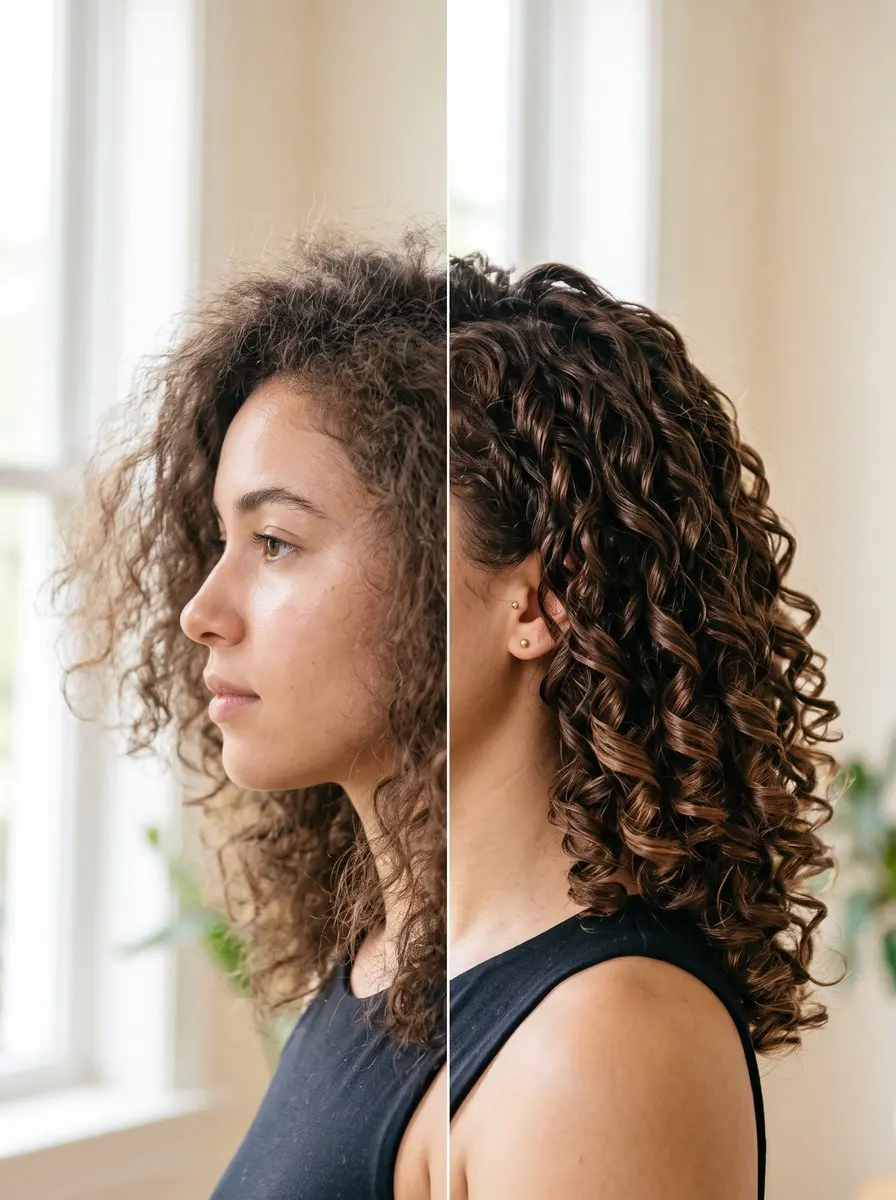
To get rid of curly hair frizz, wash less often with a gentle cleanser. Layer leave-in, cream and oil (LOC or LCO) onto soaking-wet hair to suit your porosity, and set the curls with gel. Plop, then diffuse or air-dry without touching. Sleep in a satin bonnet.
Curly hair frizz can make a great curl day look like a bad one. The pattern blurs, the ends puff into a halo, and every product seems to work for about an hour. The frustrating part is that frizz usually isn’t a sign that anything is wrong with your hair. It’s a moisture and technique problem, which means you can fix it at home without a salon treatment.
This guide takes you through the routine that curl specialists and dermatologists recommend, in order. You’ll learn how to tell frizz from damage, how to read your porosity and how often to wash. You’ll also learn how to layer products with the LOC or LCO method, and how to plop, diffuse and sleep so your definition lasts. Expect one wash day to learn the routine and a couple more to get your product amounts right.
What You’ll Need
- Sulfate-free curl cleanser (gentle shampoo) — Cleans the scalp without stripping the oils that help curls clump, so each wash adds less frizz.
- Water-based leave-in conditioner — The ‘L’ in LOC/LCO: it puts even moisture into the strand before you seal it with cream and oil.
- Curl-defining gel — Forms the light cast that holds clumps together while hair dries, which is the main defense against frizz in humid air.
- Microfiber hair towel or plopping T-shirt — Blots water without the snagging loops of terry cloth that break curl clumps apart.
- Satin bonnet — Keeps curls on a smooth, low-friction surface all night so you wake up with definition instead of a frizzy halo.
As an Amazon Associate, HairAide earns from qualifying purchases. Some links above are affiliate links — they cost you nothing extra and help support free tutorials.
Step-by-Step
-
Start by ruling out damage, because frizz and damage are not the same thing. Frizz happens when proteins in the hair’s cortex absorb moisture unevenly, so parts of each strand swell and bend in different directions and the curl pattern loses definition. Healthy curls can look rough when they simply need more even moisture and hold. Check your ends on wash day. If they snap, split or feel gummy and overstretched when wet, treat breakage first. If a stretched curl springs back, your hair is healthy and this routine is the fix.
-
Next, work out your porosity, because it decides which products will actually sink in. Watch your hair on wash day. Low-porosity hair takes a while to get fully wet, leaves product sitting on the surface and dries slowly. High-porosity hair soaks up water almost instantly, drinks product and dries fast, but feels dry again soon after. Medium porosity falls in between. Note which description fits you best. You’ll use it in step four to choose between LOC and LCO, and to decide how rich your cream and oil should be.
-
Wash less often and condition every time. The American Academy of Dermatology recommends washing curly hair at least every two to three weeks rather than daily, because frequent shampooing strips the natural oils that help curls clump and stay smooth. Focus a gentle, sulfate-free cleanser on the scalp. Then apply conditioner generously from mid-lengths to ends and detangle with your fingers or a wide-tooth comb while the conditioner gives slip. Detangling while the hair is wet and conditioned works through knots instead of tearing them, and torn strands add frizz on top of breakage. If your scalp gets oily or itchy sooner, wash more often. The goal is to stop daily stripping, not to push past comfort.
-
While your hair is still soaking wet, ideally before you leave the shower, layer your products with the LOC or LCO method. LOC means liquid (a water-based leave-in), then oil, then cream. LCO swaps the last two, so the oil goes on over the cream. Many curl stylists start high-porosity hair on LOC, with a richer cream last to cushion the strand. They start low-porosity hair on LCO or cream alone, because oil applied first can sit on top and block the cream. Applying to wet hair matters because products spread evenly and hold in the water already in the strand, which means less uneven swelling as the hair dries.
-
Now set your curl pattern so strands dry in clumps rather than as separate fuzzy hairs. For looser waves and curls, rake product through with spread fingers and scrunch upward toward the scalp. For tighter curls and coils, finger-coil small sections by twisting each one into a smooth spiral. Smooth a gel or mousse over the top while your hair is still dripping. Clumped curls frizz less because strands grouped together are less exposed to humid air than loose single hairs. The gel also forms a light cast that holds the shape while the hair dries.
-
Plop to remove excess water without disturbing the pattern. Lay a microfiber towel or a smooth cotton T-shirt flat, lower your hair onto it so the curls pile on top of your head, and wrap the fabric, securing it at the nape or forehead. Leave it for 10 to 20 minutes. Rough terry-cloth loops catch on strands and break up clumps, which is one of the most common causes of frizz. Smooth fabric blots the water while your curls keep their shape. You’re done when the hair is damp but no longer dripping.
-
Dry without touching. To diffuse, set the dryer to low speed so the airflow doesn’t blow your curls apart. Cup sections into the diffuser bowl, lift them toward the scalp and hold for about 30 seconds before moving on. Take the hair to roughly 80 percent dry and let the rest air-dry. If you’re air-drying, simply leave it alone. Either way, keep your hands out until your hair is completely dry, because touching damp curls breaks the gel cast and ruffles strands before they’ve set. Once it’s dry, scrunch upward with a drop of oil on your palms to break the cast and bring out soft, defined curls.
-
Protect your curls overnight so tomorrow starts smooth. Gather your hair loosely at the very top of your head with a scrunchie (the ‘pineapple’) or plait it into a loose braid. The American Academy of Dermatology notes this reduces the pillow friction behind overnight frizz. Then cover it with a satin or silk bonnet, or sleep on a satin pillowcase. Cotton’s rougher weave grabs strands and absorbs product as you move, while a smooth surface lets hair glide. In the morning, mist with water or a diluted leave-in, scrunch, and let the curls reset instead of brushing them.
Common Mistakes to Avoid
- Brushing or combing curls once they’re dry, which separates every clump into a frizzy halo. Detangle only when hair is wet and full of conditioner.
- Rough-drying with a terry-cloth towel, whose loops catch on strands and break up the curl pattern before it sets.
- Touching, scrunching or re-arranging curls while they’re still damp, which breaks the gel cast and ruffles strands that haven’t set yet.
- Applying styling products to damp-dry hair instead of soaking-wet hair, which locks in frizz that has already formed.
- Loading heavy oil onto low-porosity hair first, where it sits on the surface and leaves curls greasy and still frizzy.
Pro Tip
Always apply styler to soaking-wet hair. If your sections have started to dry while you work, re-wet them with a spray bottle before the gel goes on. Curls clump on water, and a lot of ‘my products don’t work’ complaints really mean ‘my hair was too dry when I put them on.’
Frequently Asked Questions
Does frizzy curly hair mean my hair is damaged?
Not necessarily. Frizz happens when proteins inside the hair's cortex absorb moisture unevenly, bending the strand irregularly and blurring the curl pattern. Healthy curls can frizz simply because they lack even moisture and hold. Damage looks different: split ends, strands that snap, or hair that feels gummy and overstretched when wet.
How often should I wash curly hair to reduce frizz?
The American Academy of Dermatology recommends washing curly hair at least every two to three weeks rather than daily, since frequent shampooing strips the oils that keep curls smooth. Condition every time you wash. If your scalp gets oily or itchy sooner, wash more often with a gentle cleanser. The aim is to avoid daily stripping.
Should I use the LOC or LCO method for my curls?
Treat it as a starting point, not a rule. Many stylists suggest LOC (liquid, oil, cream) for high-porosity hair that loses moisture fast. For low-porosity hair, they suggest LCO (liquid, cream, oil) or cream alone, because oil applied first can block the cream. Try one method for two wash days and switch if your curls feel greasy or dry by day two.
Is a satin bonnet better than a satin pillowcase for frizz?
Both cut the friction a cotton pillowcase causes. A bonnet keeps hair contained, so your curls stay on smooth fabric all night however much you turn over. A pillowcase is the easier choice if bonnets slip off. For the most protection, pineapple or loosely braid your hair first and then use either one.
You Might Also Like
- 20 curly halo haircut ideas to inspire your next look
- how to find your hair porosity
- build a hair wash routine that suits your hair
- how to stop hair breakage at home
- remove hard water buildup from hair
- repair heat-damaged hair
Frizz-free curls come from a sequence, not a single product. Know your porosity, wash less, layer moisture onto soaking-wet hair, set the pattern with gel, then leave it alone until it’s dry. Repeat the full routine each wash day and refresh with water between washes. Give yourself two or three wash days to get your product amounts right. If you diffuse, apply a heat protectant to damp hair first and keep the dryer on low speed.
If your ends still feel rough, snap or won’t hold a curl even with good technique, you’re dealing with damage rather than frizz. A curl-specialist stylist can remove the compromised length and shape the cut so your curls stack together instead of fighting each other.
Sources
- The American Academy of Dermatology recommends washing curly hair a minimum of every 2-3 weeks, not daily, to control frizz. aad.org
- Loosely braiding hair or 'pineappling' it before bed reduces pillow friction that causes overnight frizz. aad.org
- Frizz is caused by cortex proteins absorbing moisture unevenly and bending the hair shaft irregularly; hair with an undefined curl pattern is often mistaken for 'damaged' when it isn't. en.wikipedia.org