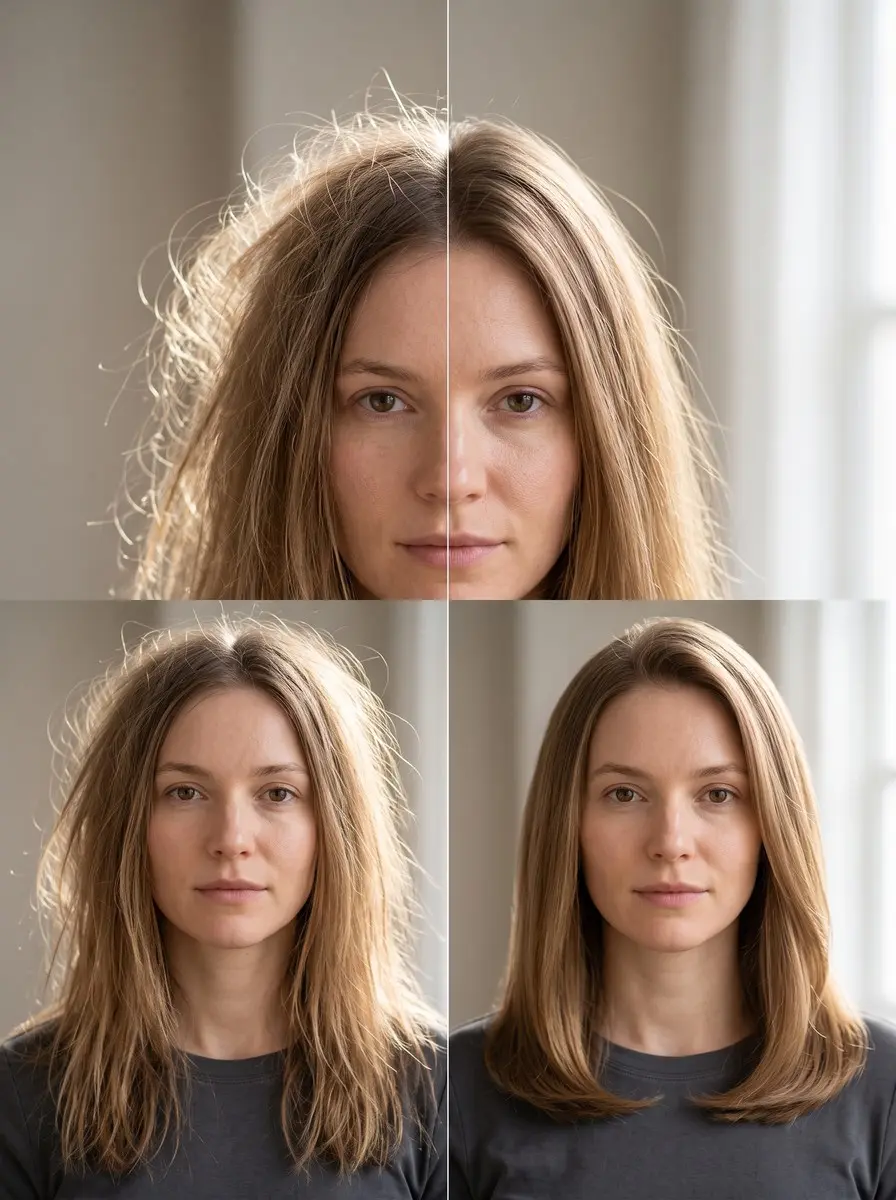
The most flattering curtain bangs for a long face are cut longer than usual, from the cheekbone to the chin. Wear them from a side part and pair them with waves or layers at the sides, so they add width and visually shorten the face instead of adding height.
Most curtain bang advice is written for round faces: keep it short at the cheekbone, part it down the center, and add height to lengthen. If your face is long or oblong, that advice works against you. A center-parted, cheekbone-length fringe with a lifted crown draws the eye straight up and down, which is the one direction you don’t want to emphasise.
The fix is the opposite approach. Cut the bangs longer, from the cheekbone to the chin, so the fringe crosses the face horizontally. Wear them from a side part so the weight falls heavier on one side. Push the volume out to the sides rather than up onto the crown. That’s why curtain bangs for long faces look so different from the round-face version. Below are 20 variations, from sleek side-swept sweeps and outward-flipped seventies fringes to curly and coily shapes, chin-length bobs and waist-length hair. Each one comes with the exact words to use with your stylist.
1. The Cheekbone-to-Chin Classic

Hover on images and discover how pinning can transform your collection of favorites!
This is the standard long-face version: a soft fringe that starts at the cheekbone and blends down to the chin, so the eye travels across the face instead of down it. It suits medium-to-thick straight or wavy hair. Ask for curtain bangs cut longer than the round-face version, with the shortest point at the cheekbone and the longest at the chin, worn from a slight off-center part. Plan a fringe trim every four to six weeks, once the ends drift past the jaw and the shape blurs.
2. Deep Side-Part Curtain Sweep

Hover on images and discover how pinning can transform your collection of favorites!
A deep side part makes the fringe fall heavier on the side opposite the part, creating a deliberate diagonal that interrupts the vertical line of a long face. It flatters high foreheads and narrow cheekbones. Ask your stylist to cut the curtain bangs with your side part already in place, so the weight lands where you’ll actually wear it. Keep the part at least two inches off center, and refresh the fringe every five to six weeks, before the heavier side starts covering your eye.
3. Chin-Grazing Bangs with Collarbone Waves

Hover on images and discover how pinning can transform your collection of favorites!
Here the fringe runs all the way to the chin and melts into loose, collarbone-length waves that bend outward at cheek and jaw level. That puts width right where it balances a long face. It suits wavy hair of medium density. Ask for chin-length curtain bangs blended into long layers that start at the cheekbone. Scrunch a light sea-salt spray into damp hair and diffuse on low, pointing the diffuser at the sides rather than the crown so the volume builds outward, not upward.
4. Curtain Bangs with a Flat-Crown Lob

Hover on images and discover how pinning can transform your collection of favorites!
A sleek collarbone lob with curtain bangs shows that a long face doesn’t need crown height. In fact, volume on top tends to add vertical length. The fringe sits at mid-cheek, and the lob keeps its fullness at jaw level. It suits thick, straight hair that naturally falls flat. Ask for a blunt lob with curtain bangs and no short crown layers. Blow-dry the roots flat against the head, direct the brush out to the sides, and trim the ends every eight weeks.
5. Outward-Flipped Seventies Curtain Bangs

Hover on images and discover how pinning can transform your collection of favorites!
The seventies version flips each side of the fringe away from the face, which reads as width at the temples and cheeks. It suits thick, wavy hair with natural body. Ask for feathered curtain bangs with point-cut ends so they flick outward easily. To style, roll a round brush under and out toward your ears, horizontally rather than up and back, so the bend moves sideways instead of adding lift. Trim every five weeks to keep the flick crisp.
6. Curtain Bangs with Cheek-Level Layers

Hover on images and discover how pinning can transform your collection of favorites!
Pairing curtain bangs with a second tier of layers starting at the cheekbone doubles the horizontal emphasis, because the fringe and layers stack into one wide frame around the midface. It suits long, heavy, straight-to-wavy hair that hangs straight down and makes a long face look longer. Ask for chin-length curtain bangs plus face-framing layers starting at the cheekbones, with the overall length kept below the shoulders. Refresh the layers every eight to ten weeks, when they flatten and lose their shape.
7. Curly Curtain Bangs with Side Volume

Hover on images and discover how pinning can transform your collection of favorites!
With curly curtain bangs, the curl pattern supplies the width. Each spiral springs outward, so the fringe naturally sits wider than a straight one would. It suits type 3 curls of medium-to-high density. Ask for a dry, curl-by-curl cut with the fringe cut longer than you want it to sit, since curls shrink, so it lands at the cheekbone once dry. Pick out volume at the sides, not the top, and reshape the fringe every six to eight weeks.
8. Asymmetric Off-Center Curtain Bangs

Hover on images and discover how pinning can transform your collection of favorites!
An asymmetric curtain fringe keeps one side at the cheekbone and lets the other fall to the chin. That slight mismatch breaks up the long vertical symmetry of an oblong face. It suits straight or wavy hair with a cowlick that already pushes the fringe one way. Ask your stylist to cut with your off-center part in place and to follow the cowlick rather than fight it. Trim the shorter side every four weeks, because it loses definition first.
9. Chin-Length Bob with Curtain Bangs

Hover on images and discover how pinning can transform your collection of favorites!
A chin-length bob with curtain bangs places two horizontal lines across the lower half of the face, the fringe and the bob’s hem, which visually shortens it. It suits fine-to-medium straight hair that holds a clean line. Ask for a blunt bob at the chin, not the jaw, with curtain bangs blended into the front corners. Build fullness at the sides with volumizing mousse on damp hair, and book trims every six weeks to keep the hem crisp.
10. Heavy-Edged Curtain Bangs for High Foreheads

Hover on images and discover how pinning can transform your collection of favorites!
Thicker curtain bangs with a heavier edge carry more visual weight across the forehead. They shorten the stretch from hairline to brow on a long face with a high forehead. They suit thick, straight hair. Ask for a curtain fringe taken from a deeper triangle section at the front hairline, with minimal thinning so the edge stays solid. Blow-dry the bangs as soon as you step out of the shower, before they air-dry in the wrong direction, and trim every four weeks.
11. Wispy Curtain Bangs for Fine Hair

Hover on images and discover how pinning can transform your collection of favorites!
Fine hair can still get the widening effect from a wispy curtain fringe cut from a narrow section, so it doesn’t take density from the lengths. The ends sit near the cheekbone and lightly overlap the temples. It suits fine, straight hair on long faces with a narrow forehead. Ask for a shallow, narrow curtain section with softly texturized ends. A dry texture spray at the sides keeps it airy, and a trim every five weeks stops the wisps from turning stringy.
12. Curtain Bangs with Bouncy Face-Framing Butterfly Layers

Hover on images and discover how pinning can transform your collection of favorites!
Butterfly layering, meaning short face-framing layers stacked over long lengths, pairs naturally with curtain bangs. For a long face, keep the shortest layers at cheek level instead of on the crown. It suits thick, medium-to-long hair. Ask for curtain bangs to the cheekbone, face-framing layers from cheek to collarbone, and no short layers on top. Blow-dry each layer rolling outward toward the ears, and refresh the layering every eight weeks, before the tiers blur into one length.
13. Coily Curtain Bangs on a Wide Rounded Shape

Hover on images and discover how pinning can transform your collection of favorites!
On coily hair, curtain bangs are part of a rounded silhouette that’s widest at the ears and cheeks, so the whole shape reads horizontal rather than tall. It suits type 4 coils of high density. Ask for a dry cut shaped wider than it is tall, with the front sculpted into a parted fringe that curves to each side at the cheekbone. Don’t pick the crown upward; shape the sides instead. Reshape every eight to ten weeks, when the silhouette loses its outline.
14. Low Side Ponytail with Loose Curtain Bangs

Hover on images and discover how pinning can transform your collection of favorites!
Curtain bangs solve the updo problem for long faces. A slicked-back ponytail exposes the full length of the face, but leaving the fringe out keeps a horizontal frame in place. It suits medium-to-long hair of any texture. Tie the ponytail low at the nape and off to one side, never high on the crown, and pull the bangs forward to fall at cheek level. Ask for bangs long enough to tuck behind your ears on off days, and trim them every six weeks.
15. Long-Crown Shag with Curtain Bangs

Hover on images and discover how pinning can transform your collection of favorites!
A shag with curtain bangs spreads choppy layers around the sides, adding movement and width at the cheeks and jaw. The one change for a long face is to keep the crown layers long and heavy, so the shag doesn’t pile height on top. It suits wavy, medium-density hair. Ask for a shag with curtain bangs, layers concentrated from cheekbone to collarbone, and the crown left long. Refresh the cut every eight weeks, before the layers lose their shape.
16. Tucked Grow-Out Curtain Bangs

Hover on images and discover how pinning can transform your collection of favorites!
If you’re growing bangs out, chin-length curtain bangs are the most wearable stage: long enough to tuck behind your ears, short enough to keep framing your cheeks. Tucking one side and leaving the other loose gives a long face the same asymmetric balance as a side part. It suits anyone mid-grow-out. Ask your stylist to dust only the ends of the fringe rather than cut length, and to blend the front pieces into layers so they keep moving as they lengthen. Dust every six to eight weeks.
17. Curtain Bangs with Face-Framing Babylights

Hover on images and discover how pinning can transform your collection of favorites!
Colour can also add width. Soft, lighter ribbons placed in the curtain bangs and cheek-level pieces draw the eye outward to the sides of the face. Keep the crown and roots at your natural depth, since bright colour on top reads as extra height. It suits light-brown to dark-blonde hair. Ask for face-framing babylights through the fringe and sides only, with no heavy highlights at the crown. Book a gloss every six to eight weeks to keep the brightness soft rather than brassy.
18. Curtain Bangs for Glasses Wearers

Hover on images and discover how pinning can transform your collection of favorites!
Curtain bangs and glasses pair well on a long face, because the frames add one horizontal line and the fringe adds another. Ask for the center of the fringe to sit just below the top of your frames, sweeping outward to the cheekbone so it never catches on the lenses. It suits straight or softly wavy hair of medium density. Bring your glasses to the appointment, and trim every four to five weeks, since bangs resting on frames look heavy once they lose their shape.
19. Brushed-Out Side Waves for Evening

Hover on images and discover how pinning can transform your collection of favorites!
For events, curl the lengths from ear level down, then brush the curls out into soft, wide waves. The volume sits at the cheeks and jaw, where it adds width, while the crown stays smooth. Wrap each section horizontally and curl away from the face. It suits medium-to-long straight hair that drops curls quickly. Ask your stylist for long layers starting at the chin so the waves stack at the sides. Set with flexible hairspray, and trim every eight weeks.
20. Waist-Length Hair with Chin-Length Curtain Bangs

Hover on images and discover how pinning can transform your collection of favorites!
Very long hair can drag a long face longer, but chin-length curtain bangs and a few heavy layers at the jaw break the line in two. The fringe carries width near the cheekbones, and the jaw-level layers catch the light below it. It suits thick, healthy hair of mid-back length or longer. Ask to keep your length, add curtain bangs to the chin, and cut a layer at the jaw only. Dust the ends every ten to twelve weeks and the fringe every five.
You Might Also Like
- curtain bangs for round faces
- bob haircuts for long faces
- bixie cut ideas for long faces
- how to ask your stylist for the haircut you want
- round brush blowout at home
The rules for a long face are few and consistent. Cut the bangs to land between the cheekbone and chin, not above it. Choose a side part for asymmetric weight. Put volume and waves at the sides, and keep the crown smooth and flat, since height there adds length. When the fringe drops past the jaw and loses its shape, book a trim, usually every four to six weeks.
My styling tip: always direct your bangs outward toward your ears, never up and back. A round brush rolled horizontally out to the sides gives width, while lifting at the root only adds height. If you use heat, apply a heat protectant first. Blow-dryers and diffusers go on damp hair, but flat irons and curling wands go on completely dry hair only, at about 150°C/300°F for fine or bleached hair and 180–200°C/355–390°F for coarse hair.
Frequently Asked Questions
What length should curtain bangs be for a long face?
Curtain bangs for a long face usually sit between the cheekbone and the chin. That's longer than the cheekbone-length version often suggested for round faces. At this length the fringe crosses the widest part of the face horizontally, which adds visual width and makes the face read shorter. Ask your stylist to make the shortest point the cheekbone and the longest the chin.
Should I wear curtain bangs with a side part or a center part if I have a long face?
A side part is usually the more flattering choice for a long face. It makes the bangs fall heavier on the side opposite the part, creating a diagonal that breaks up the vertical line. A center part can still work if the bangs are long and the sides are full, but a strict center part tends to emphasise symmetry and length.
How do I style curtain bangs to make a long face look wider?
Blow-dry the bangs while they're damp with a round brush rolled outward toward your ears, so the bend moves sideways rather than up. Add waves or texture at cheek and jaw level, and keep the crown smooth. Avoid teasing or lifting the roots on top, because crown height makes a long face look longer.
How often do curtain bangs need to be trimmed?
Most curtain bangs need a trim every four to six weeks. Once the ends slip past the chin, the fringe loses its shape and stops framing the cheeks. Many salons offer quick fringe trims between full haircuts. Curly and coily bangs can often go six to ten weeks, because the curl pattern hides small changes in length.
Are curtain bangs a lasting classic or a passing trend?
Curtain bangs are a lasting classic. The soft, parted fringe has come back again and again since the late 1960s and 1970s, because it's easy to grow out and suits many hair textures. The details change, such as how feathered or wispy the fringe is, but the basic shape keeps returning, which makes it a low-risk cut to commit to.
Sources
- For long/oblong faces, curtain bangs should sit at cheekbone-to-chin length to add horizontal width and visually shorten the face. spbeauty.co.uk
- A side part causes bangs to fall heavier on the side opposite the part, useful for deliberate asymmetric balance on a long face. therighthairstyles.com