Quick answer Curtain bangs flatter a round face when they're cut to hit the cheekbone, parted in the center and blown back away from the cheeks, with face-framing layers starting 1-2 inches below the jawline. Skip blunt, heavy fringes and bangs that lie flat against the cheeks.
Curtain bangs have become the fringe people actually trust enough to try. They part in the middle, sweep to either side and grow out without the awkward phase a blunt bang puts you through, which is why they keep showing up in salon chairs.
But curtain bangs for a round face live or die on the details. If the ends land at the cheekbone, the fringe pulls the eye up and outward along diagonal lines. If they drop to the fullest part of the cheek, they add width instead.
Below are 20 ways to get it right, from wispy center-part fringes on long layers to curly bangs cut dry, bottleneck shapes and blown-back feathered flips. Each entry covers who the look suits, exactly what to ask your stylist for and how much upkeep it takes. You’ll also get the round-brush technique that keeps bangs lifted off the cheeks, the trim schedule that holds the shape and the bang styles to skip.
Jump to a look (20)
- Classic Cheekbone-Length Curtain Bangs
- Curtain Bangs With a Collarbone Lob
- Wispy Center-Part Bangs on Long Layers
- Curly Curtain Bangs Cut Dry
- Shaggy Curtain Bangs With Crown Layers
- Blown-Back Feathered Curtain Bangs
- Off-Center Curtain Bangs
- Curtain Bangs on an A-Line Long Bob
- Butterfly-Layered Curtain Bangs
- Debulked Curtain Bangs for Thick Wavy Hair
- Airy Curtain Bangs for Fine Hair
- Sleek Curtain Bangs on Long Straight Hair
- Coily Curtain Bangs on a Tapered Shape
- Curtain Bangs With a High Ponytail
- Half-Up Curtain Bangs
- Bottleneck Curtain Bangs
- Curtain Bangs With Money Piece Highlights
- Curtain Bangs With a Sleek Low Bun
- Air-Dried Wavy Curtain Bangs
- Curtain Bangs That Clear Your Glasses
1. Classic Cheekbone-Length Curtain Bangs

Hover on images and discover how pinning can transform your collection of favorites!
This is the standard version: a center-parted fringe that is shortest at the bridge of the nose and gets longer until it lands exactly on the cheekbone. It draws the eye up and out instead of across the widest part of the face.
It suits straight to wavy hair of medium density. Ask your stylist for curtain bangs cut to the top of the cheekbone, point-cut rather than blunt, with the longest piece blending into your layers. Trim every 6-8 weeks, before the shape drops toward the cheeks.
2. Curtain Bangs With a Collarbone Lob

Hover on images and discover how pinning can transform your collection of favorites!
A lob that ends at the collarbone puts its hemline well below the fullest part of a round face, and cheekbone bangs keep the front lifted. It’s a low-risk first step for straight or slightly wavy hair when you want a change without losing much length.
Ask for a collarbone lob with face-framing layers starting 1-2 inches below the jawline and curtain bangs that connect into them. Rough-dry the lengths, smooth only the bangs with a round brush, and trim every 6-8 weeks.
3. Wispy Center-Part Bangs on Long Layers

Hover on images and discover how pinning can transform your collection of favorites!
Long hair adds vertical length to a round face, but only if the front has movement. Here, sparse, see-through bangs part in the center and blend into long layers, so skin shows through and the fringe never sits like a solid band.
It suits fine-to-medium hair that grows past the shoulders. Ask for a light, wispy fringe with slide-cut ends instead of a full, dense bang section. Keep a dry texture spray on hand to separate the pieces, and trim every 6-8 weeks.
4. Curly Curtain Bangs Cut Dry

Hover on images and discover how pinning can transform your collection of favorites!
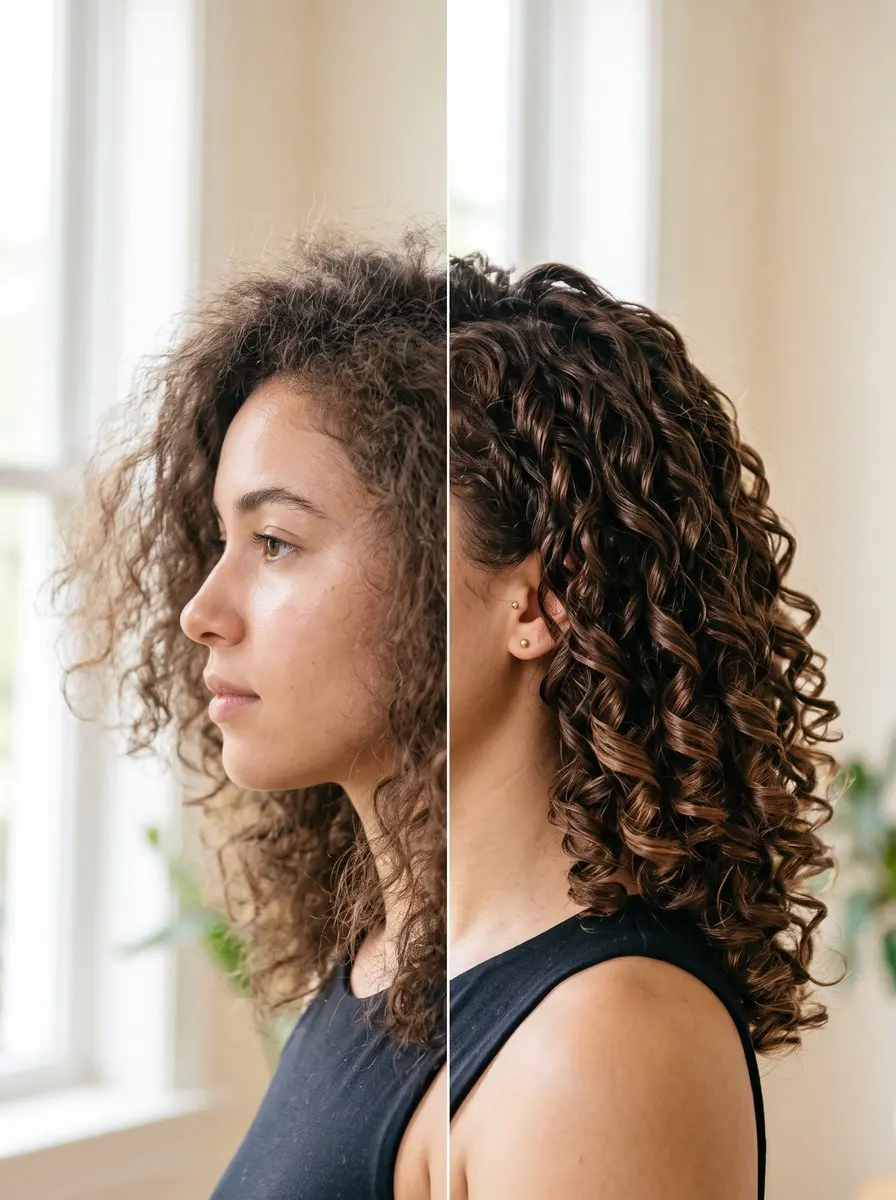
Curls shrink, so a curly curtain bang has to be cut dry, curl by curl, or it springs up far shorter than planned. The goal is ringlets that land at the cheekbone and fan outward, building height instead of a round frame around a round face.
It suits 3A-3C curls with enough density to hold a shape. Ask for a dry, curl-by-curl cut with the bangs sitting at the cheekbone once curled. Refresh with water and a light cream, diffuse upward at the roots, and reshape every 6-8 weeks.
5. Shaggy Curtain Bangs With Crown Layers

Hover on images and discover how pinning can transform your collection of favorites!
Short layers at the crown build height, which makes a round face look longer, while choppy bangs split at the cheekbone keep the front open. It suits medium-to-thick wavy hair with some natural bend, and it holds up on rushed mornings.
Ask for a shag with shorter crown layers, face-framing pieces starting 1-2 inches below the jaw and textured curtain bangs made with razor or point-cutting. Scrunch in sea-salt spray, and trim every 6-8 weeks, before the crown layers flatten and the shape loses definition.
6. Blown-Back Feathered Curtain Bangs

Hover on images and discover how pinning can transform your collection of favorites!
This is the most glamorous version of the core technique. The bangs are blown up and back with a large round brush so each side flips outward, lifting the frame away from the cheeks entirely. It suits medium-to-long hair with some body and anyone who enjoys a daily blowout.
Ask for curtain bangs cut to the cheekbone with feathered layers behind them that flip the same way. Dry the fringe first, while it’s still damp, rolling the brush away from your face, and trim every 6-8 weeks.
7. Off-Center Curtain Bangs

Hover on images and discover how pinning can transform your collection of favorites!
A slightly off-center part, not a deep side part, adds asymmetry that breaks up the circular outline of a round face while keeping the split shape of curtain bangs. The longer side sweeps past the cheekbone toward the temple instead of lying on the cheek.
It suits straight or wavy hair with a cowlick that pushes the fringe one way. Ask your stylist to cut the bangs on your natural part so they fall correctly without fighting it. Blow-dry each side away from your face, and trim every 6-8 weeks.
8. Curtain Bangs on an A-Line Long Bob

Hover on images and discover how pinning can transform your collection of favorites!
An A-line bob that is slightly longer in front and ends 1-2 inches below the jawline gives a round face a downward diagonal, and cheekbone curtain bangs add an upward one. It suits straight, medium-density hair that holds a clean line.
Ask for an A-line long bob with the front ending below the jaw, never right at it, plus point-cut curtain bangs at the cheekbone. The bob’s line blurs as it grows out, so trim every 6-8 weeks to keep the angle sharp.
9. Butterfly-Layered Curtain Bangs

Hover on images and discover how pinning can transform your collection of favorites!
Butterfly layering stacks short face-framing layers over long hair, so a blowout looks like a shorter cut without giving up length. With cheekbone bangs on top, the volume starts above the cheeks instead of at them. It suits long, medium-to-thick hair that can carry several layers.
Ask for long layers with a shorter face-framing tier starting 1-2 inches below the jaw and curtain bangs blended into it. Roll the front sections back with a round brush, and trim every 6-8 weeks to keep the tiers distinct.
10. Debulked Curtain Bangs for Thick Wavy Hair

Hover on images and discover how pinning can transform your collection of favorites!
Thick hair can make curtain bangs puff out sideways, adding exactly the width you’re trying to avoid on a round face. The fix is removing weight from underneath the fringe, so it sits close to the temples and flicks outward at the cheekbone instead of bulging.
It suits dense, wavy hair. Ask for curtain bangs with weight taken from the underside and point-cut ends, and no thinning shears on the surface, which can cause frizz. Smooth with a light cream, and trim every 6-8 weeks.
11. Airy Curtain Bangs for Fine Hair

Hover on images and discover how pinning can transform your collection of favorites!
Fine hair can’t spare much density for a fringe, so this version takes only a narrow triangle of hair from the front hairline and leaves the rest of the length full. The bangs stay light enough to lift off the forehead and angle outward to the cheekbone.
It suits fine, straight hair. Ask for a narrow bang section cut dry at the cheekbone, so the length is predictable, and blended into face-framing layers. Use volumizing mousse at the roots, and trim every 6-8 weeks.
12. Sleek Curtain Bangs on Long Straight Hair

Hover on images and discover how pinning can transform your collection of favorites!
A glossy curtain bang against sleek straight hair looks polished and deliberate, and the center part runs a vertical line down the face. The risk is flatness, so the bangs need an outward bend at the cheekbone to keep them off the cheeks.
It suits long, straight, medium-to-thick hair. Ask for long layers starting below the jaw and curtain bangs cut to the cheekbone. Once your hair is completely dry, a quick outward bend with a flat iron sets the fringe for the day. Trim every 6-8 weeks.
13. Coily Curtain Bangs on a Tapered Shape

Hover on images and discover how pinning can transform your collection of favorites!
Coily bangs form a soft, springy fringe that frames the eyes, and a tapered shape (fuller on top, closer at the sides) puts the volume in height instead of width. It suits 4A-4C hair with healthy ends.
Ask for a dry cut shaped around your curl pattern, with the bangs landing at the cheekbone after shrinkage and the sides kept narrower than the crown. Define with a curl cream on wet hair, pick the crown for lift, and reshape every 6-8 weeks.
14. Curtain Bangs With a High Ponytail

Hover on images and discover how pinning can transform your collection of favorites!
Pulling hair into a ponytail at crown height lifts the whole silhouette, and leaving the curtain bangs out keeps your face framed instead of fully exposed. It suits medium-to-long hair of any texture and is one of the fastest second-day styles.
Ask for curtain bangs cut to the cheekbone, plus a couple of face-framing layers below the jaw that fall out of the ponytail on purpose. Tease the crown lightly before tying, and trim the bangs every 6-8 weeks.
15. Half-Up Curtain Bangs

Hover on images and discover how pinning can transform your collection of favorites!
A half-up style gathers the top section at the crown for height, while the bangs and face-framing layers stay loose around the face. It suits wavy or curly medium-to-long hair and works for events when a full updo feels too formal.
Ask for cheekbone-length curtain bangs with face-framing layers starting 1-2 inches below the jaw, so the loose sections fall at flattering points. Secure the top section high with a claw clip, and stick to a 6-8 week trim schedule.
16. Bottleneck Curtain Bangs

Hover on images and discover how pinning can transform your collection of favorites!
Named for its shape, the bottleneck bang is short and narrow between the brows, then widens and lengthens to the cheekbone at the sides. Because the flare sits high, it frames the eyes and cheekbones instead of the lower cheeks.
It suits straight to wavy hair of medium density. Ask for a bottleneck fringe that is short and narrow at the center and reaches the cheekbone at the sides. Blow-dry it over a small round brush, and trim every 6-8 weeks so it doesn’t lose its shape.
17. Curtain Bangs With Money Piece Highlights

Hover on images and discover how pinning can transform your collection of favorites!
Two bright ribbons of color along the front hairline follow the outward sweep of the bangs, pulling focus to the eyes and cheekbones. It suits brunettes and dark blondes who want brightness without a full head of highlights.
Ask your colorist to place the money piece along your part, and ask your stylist for cheekbone-length curtain bangs, so the brightest color sits above the cheeks instead of on them. If the blonde turns yellow, a purple shampoo cancels it. Trim every 6-8 weeks.
18. Curtain Bangs With a Sleek Low Bun

Hover on images and discover how pinning can transform your collection of favorites!
A low bun on its own can leave a round face looking exposed, but cheekbone curtain bangs soften the frame while a smooth crown adds polish. Set the bun just above the nape rather than at it, and keep a little lift on top.
It suits medium-to-long hair and works for weddings and offices. Ask for curtain bangs cut to the cheekbone, plus a couple of longer face-framing pieces that can hang loose. Style the bangs with a round brush before tying up, and trim every 6-8 weeks.
19. Air-Dried Wavy Curtain Bangs

Hover on images and discover how pinning can transform your collection of favorites!
No-heat curtain bangs depend on the cut and your wave pattern: the fringe is cut on its natural fall, then air-dried pinned back with two flat clips so it sets away from the cheeks. It suits 2A-2C waves and anyone skipping daily heat styling.
Ask for curtain bangs cut dry at the cheekbone so the wave doesn’t surprise you. Work a lightweight mousse into damp bangs, clip each side back until dry, then release and loosen with your fingers. Trim every 6-8 weeks.
20. Curtain Bangs That Clear Your Glasses

Hover on images and discover how pinning can transform your collection of favorites!
Frames add a horizontal line across the face, so the bangs need to clear them. Cheekbone-length curtain bangs split above the frames and sweep past the temples instead of catching on the lenses.
They suit anyone who wears glasses daily, and many stylists pair them with angular frames for extra contrast on a round face. Ask for bangs that clear the top of your frames at the center and reach the cheekbone at the sides, and bring your glasses to the appointment. Trim every 6-8 weeks.
The Bottom Line
All 20 looks follow the same rules: bangs that end at the cheekbone, layers that start 1-2 inches below the jaw and volume that goes up and back instead of out.
Skip blunt, heavy fringes and any bang that lies flat against your cheeks, since both draw a horizontal line across the widest part of the face. Trim every 6-8 weeks, before the fringe grows past the cheekbone and loses its lengthening shape.
The styling habit that matters most is to blow-dry the bangs first, while they’re still damp. Use a medium round brush and roll each side up and away from your face, then finish with a dry texture spray.
Mist on a heat protectant before blow-drying. If you add a flat-iron bend, use the iron only on completely dry hair. Keep it around 150C/300F for fine or bleached hair and 180-200C/355-390F for coarse hair.
Frequently Asked Questions
Do curtain bangs suit a round face?
Yes, when they're cut to hit the cheekbone and styled away from the face. The split center and outward sweep create diagonal lines that make a round face look longer. Most stylists pair them with face-framing layers that start 1-2 inches below the jawline. Problems start when bangs are heavy, blunt or lie flat against the cheeks.
How long should curtain bangs be for a round face?
Aim for the longest pieces to land on the cheekbone, with the center shortest around the brow or the bridge of the nose. Longer layers should then start about 1-2 inches below the jawline. Bangs that stop at the fullest part of the cheek, or layers that end right at the jaw, put a horizontal line where the face is widest.
What bangs should you avoid if you have a round face?
Most stylists steer round faces away from blunt, straight-across bangs and heavy full fringes, because they draw a horizontal line across the forehead. Also avoid bangs that rest flat against the cheeks or end at their fullest point, since they frame the width instead of breaking it up. Choppy, point-cut ends that sweep outward are the safer choice.
Should curtain bangs be center-parted or swept to the side on a round face?
A center part is the classic choice because it adds a vertical line and splits the fringe evenly toward the cheekbones. A slight off-center part can also flatter by adding asymmetry. Either way, sweep the bangs back and away from the cheeks instead of letting them fall forward. That lift matters more than where the part sits.
How often do curtain bangs need a trim?
Every 6-8 weeks. Hair grows about half an inch a month, so within two months the fringe falls past the cheekbone and the lengthening shape loses its definition. Ask whether your salon offers a quick bang trim between full appointments. That keeps the fringe precise without cutting the rest of your hair.
Keep Reading
Sources
- Curtain bangs for round face shapes latest-hairstyles.com
- Curtain bangs for round face therighthairstyles.com