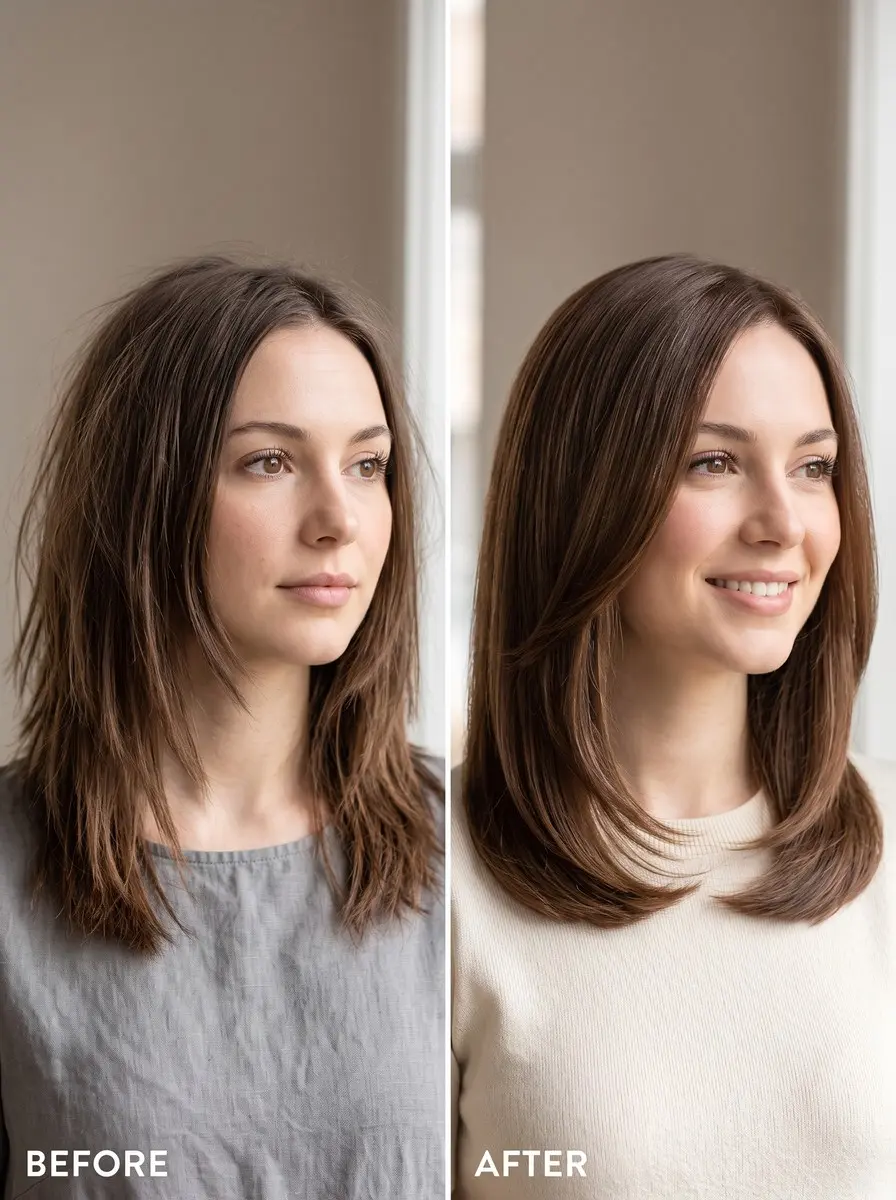
Thin or fine hair looks fuller with a few long layers that start mid-shaft or below the cheekbones, cut over a blunt, point-cut perimeter. Skip razors, heavy thinning shears and short choppy layers, which strip away the weight that makes ends look dense.
The biggest worry about layers for thin hair is that they will make it look even thinner. They can, if the layers are cut too short, if there are too many, or if a razor shreds the ends into wisps. Placed well, layers do the opposite. A few long layers that start mid-shaft or below the cheekbones give flat strands room to move, and from across a room, movement reads as volume.
The trick is what stays the same: a strong, blunt perimeter that keeps your ends looking dense. Every bob and longer cut below follows that rule. The pixies and the stacked A-line are different on purpose: they put their short layers at the crown or nape, where lift matters more than length. The 20 looks run from a blunt bob with barely-there layers and a lifted pixie to a curtain fringe over mid-length layers and long, soft lengths. Each one says where its layers sit, what to tell your stylist and how to style it for lift.
1. Blunt Bob with Barely-There Layers

Hover on images and discover how pinning can transform your collection of favorites!
This chin-to-jaw bob keeps nearly all its weight at a blunt hemline. A few subtle, point-cut layers near the ends let the edge swing instead of sitting like a shelf. It suits straight, fine hair that looks sparse past the shoulders, and it works with most face shapes. Ask for a one-length bob with light point-cutting just inside the perimeter, and no thinning shears. Book a trim every six to eight weeks, when the line starts to look soft and uneven.
2. Crown-Lifting Layered Pixie

Hover on images and discover how pinning can transform your collection of favorites!
A pixie layered through the crown puts its shortest pieces where fine hair lies flattest, so the roots stand up instead of hugging the scalp. Because the whole cut is short, there are no long ends to show low density. It suits fine, straight to slightly wavy hair and anyone who wants a true wash-and-go. Ask for textured, point-cut crown layers and a soft, tapered nape. Pixies lose their shape sooner, so plan on a trim every four to six weeks.
3. Curtain Fringe over Mid-Length Layers

Hover on images and discover how pinning can transform your collection of favorites!
A center-parted fringe that falls between the cheekbone and the jaw, paired with long layers that start mid-shaft, gives fine hair movement at the front and fullness at the back. Keep the fringe in that window, because much shorter or longer pieces struggle to hold their curve on fine hair. It often flatters oval and heart shapes at shoulder length or longer. Ask for a point-cut curtain fringe and mid-shaft layers over a blunt base. Trim the fringe every three to four weeks.
4. Chin-Length Face-Framing Layers

Hover on images and discover how pinning can transform your collection of favorites!
The only layering here is around the face: the shortest piece starts at the chin and steps down into a blunt, collarbone-length cut. Everything behind the ears stays one length, so the ends keep their density. It suits straight or wavy fine hair. Ask for point-cut face-framing from the chin, no layers through the back, and, if you color, a few fine babylights on those front pieces, since brighter strands add contrast that reads as depth. Refresh the front every six to eight weeks.
5. Long Soft Layers

Hover on images and discover how pinning can transform your collection of favorites!
For fine hair past the shoulders, a few long layers starting mid-shaft stop the length from hanging flat without taking density off the hemline. The layers are few, long and blended, so nothing looks stepped. It suits anyone growing their hair out who wants movement and a thick-looking bottom edge. Ask for long layers from mid-shaft down, point-cut, over a blunt perimeter. Trim every eight weeks, and if the ends start to look see-through, take off an extra half inch.
6. Collarbone Lob with Hidden Internal Layers

Hover on images and discover how pinning can transform your collection of favorites!
A few long internal layers are cut beneath the top section, so they push the outer hair up and out. The surface stays smooth and the hem stays heavy. On a collarbone lob this reads as body rather than visible layering. It’s a smart choice for straight, fine hair that goes flat by lunchtime and for anyone who dislikes choppy texture. Ask for a blunt lob with long internal layers under the crown and no thinning shears. Mist thickening spray at the roots, and trim every six to eight weeks.
7. Blunt Shoulder Cut with Flicked Ends

Hover on images and discover how pinning can transform your collection of favorites!
A one-length shoulder cut gets a handful of light layers in the last inch or two, just enough for the ends to flick outward after a round-brush blow-dry. The flip adds width at the hemline, which is where fine hair tends to look thinnest. It suits fine, straight hair and long faces that benefit from width at the jaw. Ask for a blunt shoulder cut with light point-cutting only at the very ends. Trim every six weeks, before the flip turns limp.
8. Bob-Pixie Hybrid with Layered Crown

Hover on images and discover how pinning can transform your collection of favorites!
Halfway between a bob and a pixie, this cut keeps length around the ears and nape while short crown layers build lift. Fine hair gets a pixie’s height with more coverage at the sides, which makes it a gentler step for anyone nervous about going very short. It suits fine, straight hair and oval or heart-shaped faces. Ask for an ear-length bob with a layered crown, soft pieces at the sideburns and a point-cut nape. The shape loses definition quickly, so book trims every five to six weeks.
9. Wavy Lob with Two Long Layers

Hover on images and discover how pinning can transform your collection of favorites!
Fine, wavy hair already has movement, so it needs even fewer layers than straight hair. Two or three long layers starting below the cheekbones let the waves separate. With too many, the waves collapse into frizzy wisps at the ends. This collarbone lob suits wavy, low-density hair and most face shapes. Ask for minimal long layers, point-cut or cut dry, with a solid perimeter. Scrunch sea-salt spray into damp hair for texture, and trim every eight weeks.
10. Deep Side-Part Layered Bob

Hover on images and discover how pinning can transform your collection of favorites!
A deep side part stacks more hair on one side, so the top of the head looks denser straight away. Pair it with a jaw-length bob and a few layers along the longer side, and the cut looks full with very little product. It suits fine, straight hair and round or square faces that like a little asymmetry. Ask for a bob shaped to fall on a deep side part, with point-cut layers from the cheekbone down. Trim every six to eight weeks.
11. Soft Shag Lob with Long Layers Only

Hover on images and discover how pinning can transform your collection of favorites!
A classic shag uses lots of short layers, which can hollow out fine ends. This version keeps the piecey, undone texture but starts every layer below the cheekbones and leaves a blunt collarbone hem, so the crown gets its lift from styling rather than from cutting. It suits fine hair with a slight natural wave. Ask for a soft shag with long layers only, point-cut, no razor, and a full perimeter. Trim every six to eight weeks.
12. Layered Pixie with Side-Swept Fringe

Hover on images and discover how pinning can transform your collection of favorites!
A longer, side-swept fringe on a layered pixie gives fine hair a focal point at the front and draws the eye to the brows and cheekbones. Crown layers keep the roots lifted while the fringe adds softness. It suits fine, straight hair and oval, heart or long faces. Ask for a pixie with point-cut crown layers and an eyebrow-length side fringe that sweeps cleanly to one side. Trim every four to six weeks to keep the fringe out of your eyes.
13. A-Line Bob with Gently Stacked Nape

Hover on images and discover how pinning can transform your collection of favorites!
Short, point-cut layers stacked at the nape push the back of the head up and out, and the front angles longer toward the chin. The graduation gives fine hair roundness at the back, where it often lies flat, and keeps a heavy, blunt front edge. It suits straight, fine hair and oval or long faces. Ask for an A-line bob with a gently stacked nape and a solid front line, and avoid over-stacking, which can look severe. Trim every five to six weeks.
14. French Bob with a Wispy Fringe

Hover on images and discover how pinning can transform your collection of favorites!
This jaw-skimming bob with a light, brow-grazing fringe keeps its weight low and blunt. A few point-cut pieces at the ends stop it from looking severe. The fringe takes only a narrow triangle of hair from the front, so the rest of the bob stays dense. It suits straight, fine hair and oval or long faces. Ask for a jaw-length bob with a wispy fringe cut from a small section. Trim the fringe every three to four weeks and the bob every six to eight.
15. Feathered Face-Framing Layers, Fine-Hair Edit

Hover on images and discover how pinning can transform your collection of favorites!
The full feathered, heavily face-framed cut stacks short layers around the face, which can leave fine ends wispy. The fine-hair edit starts its shortest layer at the chin and keeps the rest long, so a blow-out still gives that swooping, feathered front. It suits long, fine hair and faces that like width at the cheekbones. Ask for chin-length face-framing blended into long mid-shaft layers, point-cut, over a blunt hem. Trim every eight weeks.
16. Bevelled Jaw Bob with Round-Brush Bounce

Hover on images and discover how pinning can transform your collection of favorites!
A jaw-length bob with a soft interior bevel: the stylist cuts the under-section a touch shorter so the ends curve under on their own. That rounded, bouncy silhouette makes fine hair look denser at the hem than a straight line does, and a round-brush blow-dry exaggerates it. It suits straight, fine hair and oval or long faces. Ask for a jaw-length bob with a gentle bevel, point-cut, and no thinning shears. Trim every six weeks, before the curve drops.
17. Curl-by-Curl Layered Cut for Fine Curls

Hover on images and discover how pinning can transform your collection of favorites!
Fine curls look stringy at the ends when over-layered and flat on top when left one length. A few long layers cut curl by curl, starting below the cheekbones, let each ringlet spring up without removing the weight that keeps the shape full. It suits fine, low-density curly hair from chin to shoulder-blade length. Ask for dry, curl-by-curl cutting with minimal layering and a rounded perimeter. Define curls on damp hair with a light mousse, and refresh the cut every eight to ten weeks.
18. Blunt Asymmetrical Lob

Hover on images and discover how pinning can transform your collection of favorites!
This lob drops from chin length on one side to the collarbone on the other, with the perimeter cut blunt all the way round. The angle creates shape without much layering, so the ends keep their full density. A couple of long, point-cut pieces on the longer side add movement where it frames the face. It suits straight, fine hair and can flatter round or square faces. Ask for a blunt asymmetrical lob with minimal layering. Trim every six weeks, because the asymmetry blurs as it grows out.
19. Shoulder Cut with Full Brow-Grazing Bangs

Hover on images and discover how pinning can transform your collection of favorites!
Full, blunt bangs borrow hair from the top of the head and stack it at the brow, so the front looks thick even when the lengths are fine. Pair them with a shoulder-length cut and a few long layers starting below the cheekbones, and the whole shape reads as dense. It suits straight, fine hair and oval or long faces. Ask for brow-grazing bangs cut from a deep triangle section, point-cut into softness. Trim the bangs every three to four weeks and the lengths every eight.
20. Soft U-Shape Long Layers

Hover on images and discover how pinning can transform your collection of favorites!
A V-shaped back hem tapers fine hair into a thin point. A soft U-shape keeps far more hair at the bottom while still curving gently. Combine it with a few long layers from mid-shaft, and long, fine hair looks even and full from behind. It suits straight or wavy fine hair past the shoulder blades. Ask for a rounded U perimeter, not a V, with minimal point-cut layers. Trim every eight weeks, before the curve flattens into a straggly edge.
You Might Also Like
- round brush blowout at home
- fine hair frizz without weighing it down
- octopus haircut ideas for thin hair
- keep roots fresh and lifted between washes
- layered haircuts for round faces
For bobs and longer lengths, the formula holds: a blunt perimeter, layers from mid-shaft or below the cheekbones, and a shortest face-framing piece no higher than the chin. The pixies and the stacked A-line are the deliberate exception, with short layers at the crown or nape for lift. Ask for point-cutting, not a razor or thinning shears, and trim every six to eight weeks (sooner for the shortest cuts), when the shape starts to soften.
For lift, blow-dry damp roots upward with a round brush after misting a heat protectant and a thickening spray through them. If you finish with a curling wand or flat iron, use it only on completely dry hair, since an iron on wet hair is the genuinely damaging step. Keep it around 150C/300F for fine or bleached hair; 180-200C/355-390F is for coarse hair only.
Frequently Asked Questions
Do layers make thin hair look thinner?
They can if they are too short, too many or razor-cut, because each of those removes weight from the ends. A few long layers that start mid-shaft or below the cheekbones, over a blunt perimeter, add movement and make hair look denser while the hemline keeps its fullness.
Where should layers start on fine hair?
Most stylists start fine-hair layers mid-shaft or below the cheekbones and keep layering near the ends light, so the perimeter stays solid. For face-framing, the shortest piece usually sits at the chin. Anything much shorter tends to separate into wisps on low-density hair.
What cutting technique is best for layering fine hair?
Ask for point-cutting. The stylist snips vertically into the ends to soften hard lines but leaves most of the weight in place. Avoid razor cutting and heavy thinning shears, which taper each strand and can leave fine ends looking see-through.
How often should you trim a layered cut on fine hair?
Every six to eight weeks is typical for bobs and longer lengths, and pixies usually need a trim sooner. Hair grows about half an inch a month, so after that long the layers have dropped out of place and the blunt edge has started to fray. A trim brings back the shape before the ends lose their density.
Are layered cuts for fine hair a lasting classic or a passing trend?
They are a lasting classic. Long, soft layers on a blunt base have been a salon staple for fine hair for decades because they solve a structural problem, flat and weightless lengths, rather than chasing a look. Details like curtain fringes or flipped ends come and go, but the placement logic stays the same.
Sources
- John Frieda shows fine-hair layering as a blunt bob with subtle layers placed near the ends to preserve fullness, a layered pixie that lifts flat roots, and a curtain fringe with mid-length layers. It recommends thickening spray and a round brush, and trims every 6-8 weeks. johnfrieda.com
- Therighthairstyles says that on fine hair, layers should start midshaft and sit on a blunt perimeter base. It says to point-cut rather than razor, and that layers that are too short can thin the ends. It suggests the shortest face-framing layer at the chin and sea-salt spray for texture. therighthairstyles.com
- John Frieda says curtain fringe on fine hair should keep the fringe cheekbone-to-jaw length and use light layers for movement and fullness. It recommends a round brush, blow-dry or texturising spray, and says very short or very long curtain fringes may not hold their shape. johnfrieda.com