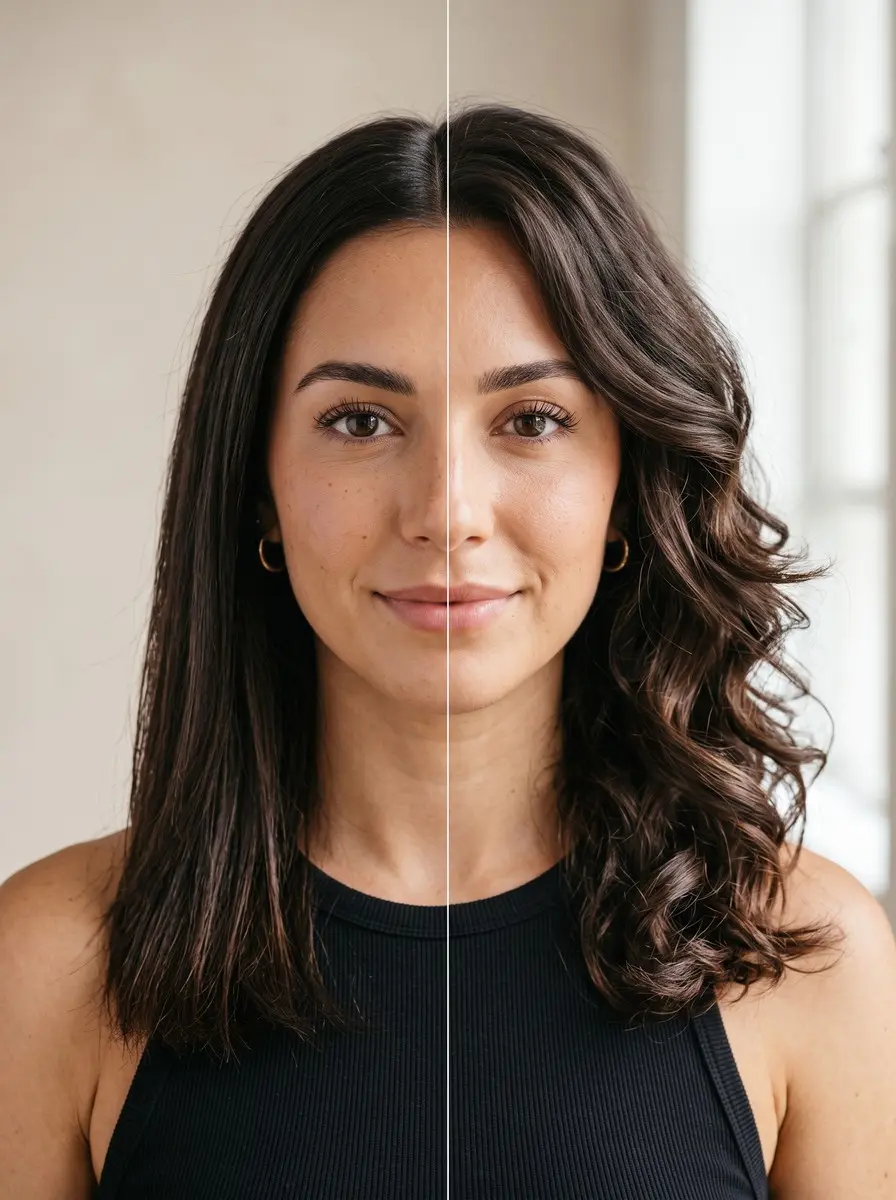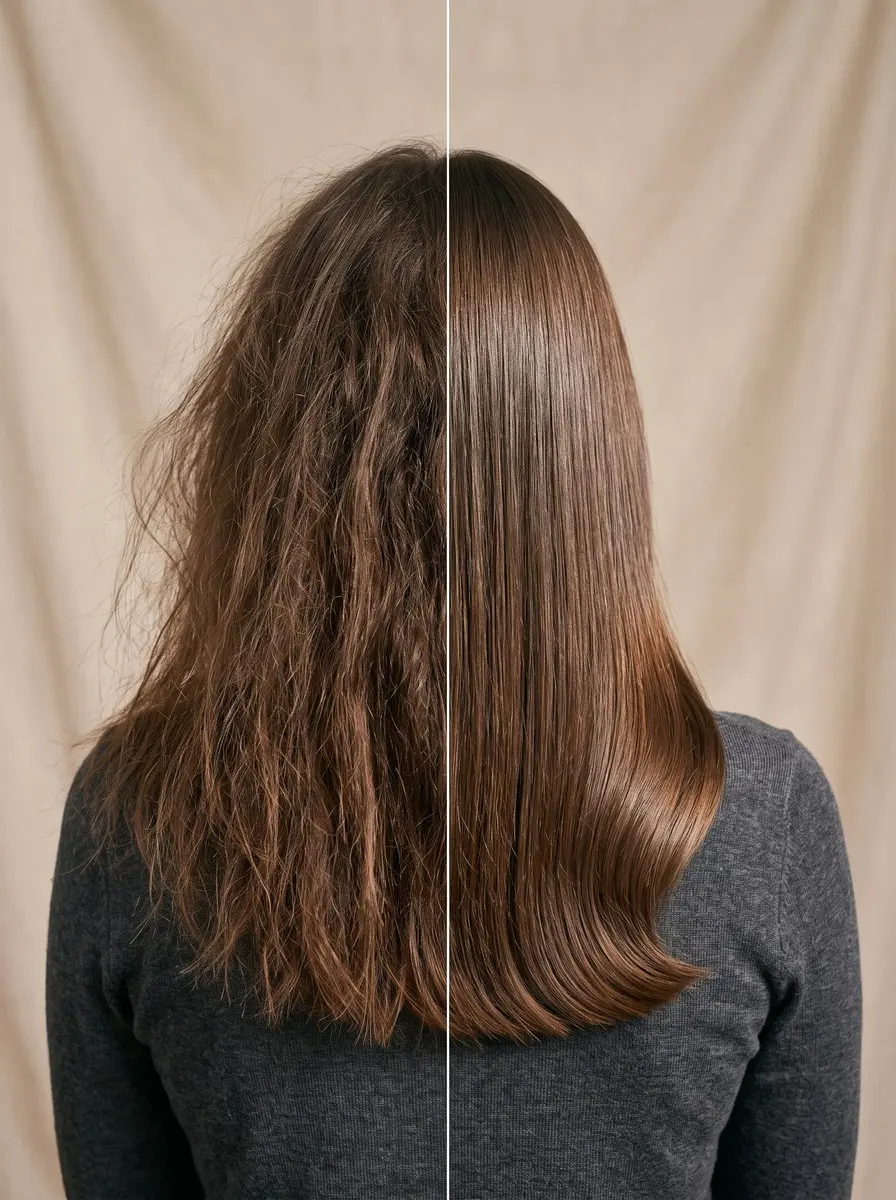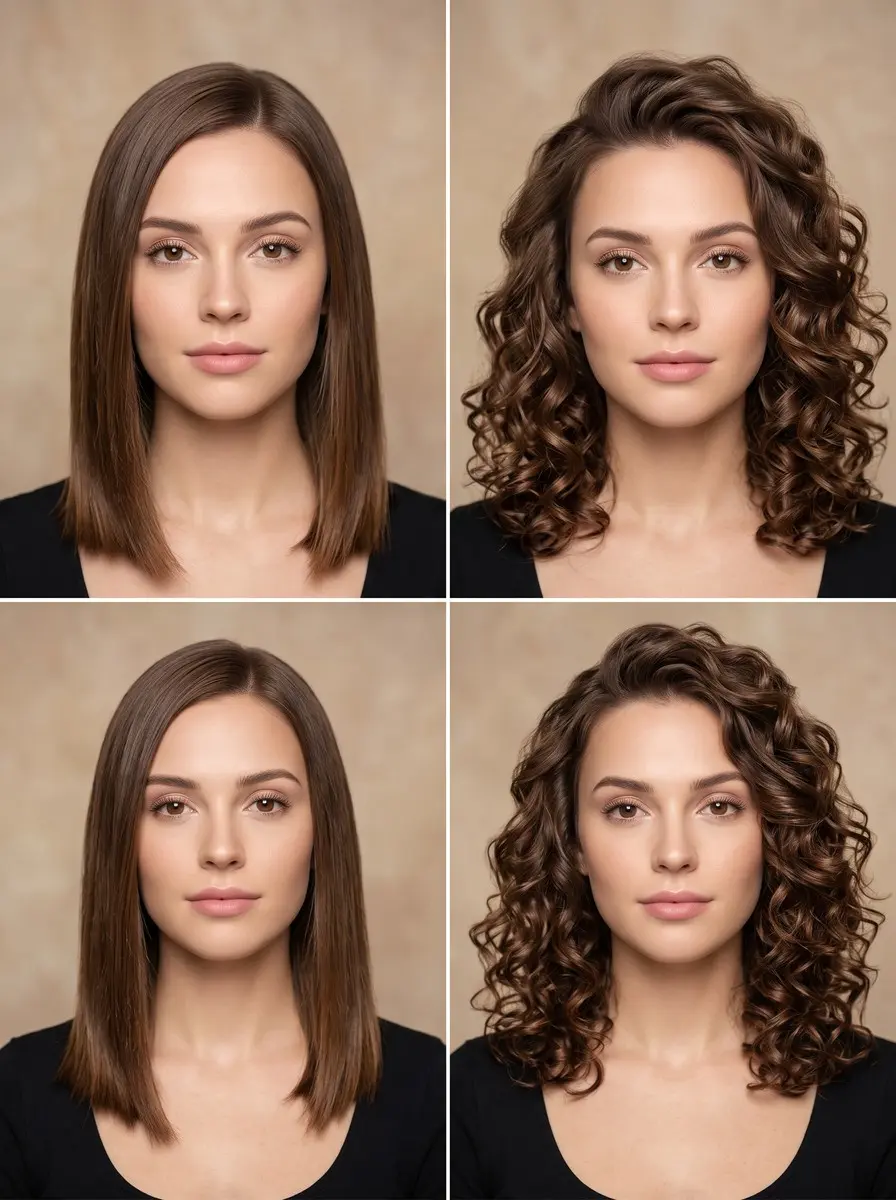
Choose a curling iron barrel by hair length and curl goal: 3/8 to 1/2 inch for tight spirals, 3/4 to 1 inch for defined curls and Hollywood waves, 1 1/2 to 2 inches for beach waves and volume. On long, heavy hair, size down one step for the same curl.
Ask three people which curling iron barrel size to buy and you can get three different answers. One swears a 1-inch barrel gives tight curls, another says it only makes loose waves, and both are right. A curl’s diameter is set by the barrel, but how many times your hair can wrap around it, and how much weight pulls on the curl afterwards, is set by your length and texture.
This guide breaks down every common size from 3/8 inch to 2 inches, shows what the same barrel does on short, shoulder-length and long hair, and explains when to reach for a clamp iron, a clampless wand or a tapered barrel. It also covers holding direction, wrap time and the cooling step most people skip. You don’t need a salon kit: one well-chosen barrel and the right technique do most of the work.
What You’ll Need
- 1-inch clamp curling iron — The one barrel size that works at every length, and the clamp holds the ends while you learn the wrap.
- Tapered (cone) curling wand — Gives a curl that is looser at the root and tighter at the ends for relaxed, natural-looking waves.
- Heat protectant spray — Misted through every section in the prep step, it buffers each strand from the barrel’s heat on every pass.
- Single-prong curl clips — Pin each warm curl in its coil so it sets as it cools instead of stretching under its own weight.
- Boar-bristle brush — Smooths curls set in one direction into the continuous S-shape of Hollywood waves.
As an Amazon Associate, HairAide earns from qualifying purchases. Some links above are affiliate links — they cost you nothing extra and help support free tutorials.
Step-by-Step
-
Measure the barrel you already own before you judge it, because the number on the box is a nominal size, and tapered or unusually shaped barrels make it unclear which part was measured. Hold a ruler across the middle of the barrel, not the clamp, to read the diameter, or wrap a strip of paper around it, mark where it overlaps and divide that length by 3.14. A barrel curls like the size it really is, so use your measured figure for every choice that follows. You’re done when you can name its true diameter to the nearest quarter inch.
-
Work out how many wraps your length allows, because this is why advice about 1-inch barrels seems to conflict. Measure the length you want to curl, from where the curl should begin (around chin level on longer hair, near the root on a bob) down to your ends, then divide that number by three times the barrel diameter, since each full wrap uses roughly that much hair: 9 inches of length gives about three wraps on a 1-inch barrel but only about one and a half on a 2-inch barrel. On a short bob, a 1-inch barrel fits only a couple of wraps and gives a bouncy, rounded curl; at shoulder length it fits several and gives classic defined curls; on long hair the extra length adds weight that stretches the same curl into a loose wave within hours. That arithmetic is also why short hair generally suits barrels under 1 inch, and why a 2-inch barrel on a bob gives a bend at the ends rather than a curl. You’re done when you know whether your length allows about two wraps, several or many.
-
Choose your size from this chart, then narrow it by the finish you want; across the whole range, smaller barrels make tighter curls and larger barrels make looser waves.
3/8 inch: tight spirals, for short or thin hair.
1/2 inch: ringlets, at any length.
5/8 inch: springy, defined curls, at any length.
3/4 inch: vintage curls and Hollywood waves, best at shoulder length.
1 inch: the most versatile size, suited to every length.
1 1/4 inches: soft, loose curls, on shoulder-length and longer hair.
1 1/2 inches: big volume and beach waves, at shoulder length or longer.
2 inches: blowout-style volume or relaxed waves, on medium to long straight hair.
The rows overlap because the barrel sets a curl’s size while your length and texture decide how long it holds, so most people shortlist two neighboring sizes whose length column matches theirs. Pick between them by your goal, remembering that curls relax as the day goes on. For ringlets, use 3/8 to 1/2 inch. For bends in short hair, use 3/4 inch or 1 inch with a single loose turn rather than a full wrap. For Hollywood waves, use 3/4 inch at shoulder length or 1 inch on long hair, where the extra weight opens the curl into a wave. For beach waves, use 1 1/4 to 1 1/2 inches, and for smooth blowout-style volume on medium to long hair, use 2 inches. If you’re torn between two sizes, choose the smaller one, because a slightly tight curl loosens into the look you wanted while a loose one only drops further. You’re done when you’ve picked one size that fits both your length and your goal. -
Choose the tool shape and adjust for your hair type, because both change the finish as much as the diameter does. A clamp iron grips the end of each section, so curls come out smoother and more uniform, which suits Hollywood waves, ringlets and formal looks; a clampless wand lets you leave the ends out, so the same diameter gives a more relaxed, lived-in curl for beach waves; and a tapered barrel, wider at the handle and narrower at the tip, gives a curl that is looser near the root and tighter at the ends, which reads as natural texture. Fine or thin hair drops a curl quickly, so go one size smaller than your goal, take sections about an inch wide and use a clamp iron for grip. Thick or coarse hair holds a curl well and can carry the 1 1/4- to 2-inch barrels that fall flat on finer hair, but it needs thinner sections so each one curls all the way through. On tightly curled or coily hair that has been stretched or silk-pressed, a 1/2- to 3/4-inch barrel gives defined, bouncy curls; to touch up a few natural curls that didn’t form, match the barrel to the diameter of your own curl. You’re done when you have one tool, one barrel size and a section width that fit your hair.
-
Prep your hair and the iron before the first section. Curl only completely dry hair: an iron on wet or damp hair is the most damaging mistake you can make with one, because the water inside the strand turns to steam under that heat and can blister the hair from within. Running the iron hotter than you need, or over unprotected sections, adds up to damage too, which is why the protectant and the temperature below matter just as much. Mist a heat protectant through every section, lifting the top layer so the underneath gets coated too, and comb it through so no section goes under the iron bare. Then set the iron by hair type: about 150°C/300°F for fine or bleached hair, 180-200°C/355-390°F for coarse hair, and somewhere in between for medium hair; no hair type needs 400°F. You’re done when your hair is dry and evenly coated and the iron has reached its target temperature.
-
Section your hair into top, middle and back zones, then choose how to hold the iron, since direction shapes the curl as much as size. Holding the barrel vertically, pointing down, gives spiral curls and beachy movement with less lift at the root; holding it horizontally gives rounder, bouncier curls with more volume, the classic blowout and retro shape. Turn face-framing pieces away from your face so they open up rather than closing in around it. For beach waves, alternate the direction section by section so the curls don’t merge into one block; for Hollywood waves, curl every section in the same direction so they brush out into one continuous S-wave. You’re done when each zone is clipped up and you know which direction you’ll hold the iron for each one.
-
Start with a test section at the shorter end of the hold-time range for your hair: roughly 3 to 5 seconds for fine hair, 5 to 8 for medium hair and 8 to 10 for thick or coarse hair. Wrap the section around the barrel with the ends tucked in the clamp, or with the last inch left out if you’re using a wand, hold it for the listed seconds, and add two or three seconds on the next section only if the test curl falls loose instead of holding its coil. Testing first works because the right hold is the shortest one that sets the curl, and every second beyond it is extra heat with no extra curl. Open the clamp or slide the barrel out and catch the curl in your palm instead of letting it drop and stretch under its own weight. The section is done when it springs back as a coil and feels warm all the way through, not just on the surface.
-
Let every curl cool completely in its coiled shape before you touch it, because heat temporarily breaks the hydrogen bonds that hold the hair’s shape, and they re-form in the new shape as the strand cools. Pin each warm curl flat to your head with a single-prong clip, or leave it alone for 5 to 10 minutes, until it feels cool to the touch. Then remove the clips and break the curls up to suit your goal: rake through with your fingers for beach waves, use a wide-tooth comb for soft curls, or brush with a boar-bristle brush for Hollywood waves. Finish with a light mist of flexible-hold hairspray from arm’s length so the shape holds without turning crunchy.
Common Mistakes to Avoid
- Trusting the label instead of measuring: a barrel that is smaller or larger than stated curls like its real size, so measure it before you blame your technique.
- Using a 1 1/2- or 2-inch barrel on chin-length hair and expecting curls; there isn’t enough length for a full wrap, so you get a bend or some volume instead.
- Curling sections much thicker than an inch, which leaves the middle of each section barely curled and makes the whole style drop within a few hours.
- Brushing curls out while they are still warm, before the new shape has set, so they relax into limp, flat waves almost immediately.
- Turning the temperature up to force a tight curl out of a big barrel: the barrel decides the curl’s size, and extra heat only adds damage.
Pro Tip
Curl for how you want the hair to look in four hours, not the moment you set the iron down. Curls relax as they settle, so stylists often curl one size smaller than the finished look; a 1 1/4-inch barrel, cooled and brushed out, gives the soft, wide wave most people picture when they buy a 1 1/2-inch iron.
Frequently Asked Questions
What size curling iron is best for beginners?
A 1-inch barrel is the easiest place to start because it works at every length: it gives bouncy curls on short hair, classic defined curls at shoulder length and loose waves on long hair. Choose one with a clamp so the iron holds the ends while you learn the wrap, then add a smaller or larger barrel once you know which way you lean.
What size curling iron do I need for beach waves?
For beach waves, use a 1 1/4- to 1 1/2-inch barrel on shoulder-length or longer hair, ideally a clampless wand so you can leave the last inch of each section straight. Alternate the direction section by section and rake the curls apart with your fingers once they have cooled. On short hair, a 1-inch barrel with fewer wraps gives a similar texture.
What's the difference between a 1-inch and a 1 1/4-inch curling iron?
A 1-inch barrel makes defined, classic curls at shoulder length and bouncy curls on short hair, while a 1 1/4-inch barrel makes softer, looser curls that open into waves once brushed out. On long, heavy hair, 1-inch curls relax toward that looser shape anyway, so the 1-inch is often the better buy there; choose 1 1/4 inches when you want soft volume more than definition.
Does a bigger curling iron barrel give more volume?
Yes, at shoulder length and longer: a 1 1/2- or 2-inch barrel creates lift and body rather than a defined curl, which is why it's the pick for a blowout look. Hold it horizontally and curl sections up and back from the root for the most lift. On very short hair, a large barrel can't complete a wrap, so it gives a bend at the ends instead.
How long do curling iron curls last?
Curls usually last from one day to a couple of days, depending on texture: thick or coarse hair can keep its shape until the next wash, while fine hair often relaxes into a loose wave within hours. To make them last longer, curl one size smaller than your goal, pin each curl while it cools, and finish with a flexible-hold hairspray.
You Might Also Like
- 20 whisper-soft hush cut ideas to inspire your next curled look
- 20 short balayage ideas that show off a curled bend
- how to use a curling wand step by step
- the start-low hot-tool temperature guide
- how to add volume at the crown
- how to do a silk press at home
- how to style a shag haircut
The right barrel comes down to three things: your length, your texture and the curl you want at the end of the day, not the moment you set the iron down. Measure what you own, count the wraps your length allows, and size down whenever hair is long, heavy or fine. Most people are well served by a 1-inch barrel plus one size either side of it.
Between washes, a few touch-up sections usually revive day-two texture without restyling the whole head. If your curls fall out within an hour whatever you try, or your hair is heavily bleached and snapping, book a stylist: they can assess the hair’s condition, suggest a cut that holds shape, and show you the wrap on your own head.
Sources
- Barrel sizes and what they suit: 3/8 inch gives tight spirals for short, thin hair; 3/4 inch gives vintage curls and Hollywood waves, best at shoulder length; 1 inch is the most versatile and suits all lengths; 1 1/2 inch gives big volume and beach waves, best at shoulder length or longer; 2 inch gives blowout volume or relaxed waves on medium to long straight hair. styleseat.com
- Use a heat protectant before styling, and keep tool temperature under 400°F. us.davines.com