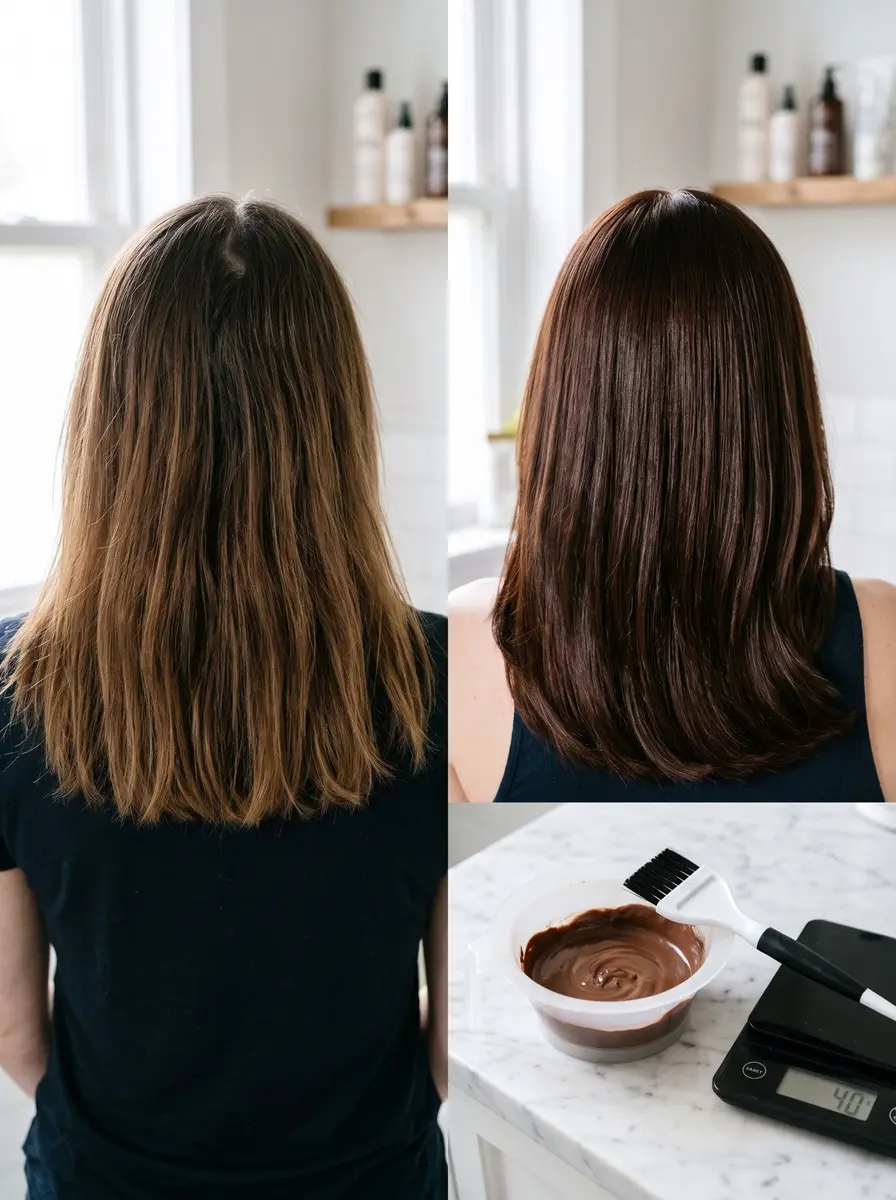
Quick answer To do a strand test, coat a hidden quarter-inch section near your ear with a little mixed dye, process it for the full time on the box, then rinse, shampoo, dry and judge it in daylight. Do a separate skin patch test 24 to 48 hours ahead to check for allergies.
The swatch on the box shows how the dye looked on someone else’s hair. Your hair has its own starting shade and its own history of color, sun and heat, and its own porosity, and any of those can push a dye darker, lighter or warmer than the picture. A strand test before dyeing lets you find that out on a quarter inch of hidden hair before you commit your whole head.
There are really two tests here, and most guides blur them together. The strand test shows the color result and how your hair responds to the processing time. The skin patch test checks whether you’re allergic to the product. Neither one replaces the other. Both are easy at home with what’s already in the box, a bowl, a brush and about an hour, plus a day or two of patience while the patch test develops.
Time About 1 hour, plus a 24-48 hour patch-test waitDifficulty BeginnerSteps 8
Strand Test Results and What to Change
| Strand result | Change this | Next step |
|---|---|---|
| Too dark | One shade lighter, or less time on demi/semi | Retest |
| Too light | Full box time, then one shade darker | Retest |
| Brassy or too warm | Ash or cool shade, or a toner | Retest |
| Didn’t lighten enough | Developer up one level (own mix only) | Retest; with box dye, see a colorist |
| Matches the box, feels intact | Nothing | Color the full head |
| Gummy, stretchy or snaps | Stop, don’t color | Book a colorist |
What You’ll Need
As an Amazon Associate, HairAide earns from qualifying purchases. Product links in this guide are affiliate links: they cost you nothing extra and help keep these tutorials free.
- Madison Reed Radiant Hair Color Kit A complete kit means your patch test and strand test use the exact color and developer you’ll put on your full head.
- ESalon custom hair color A custom-blended formula is still new to your hair, so you can strand-test it the same way before the first full application.
- Plastic tint bowl and applicator brush set Lets you mix a small, measured batch without metal and coat a single strand evenly from root to tip.
- Disposable nitrile gloves Protect your skin while you mix and apply the dye, and nitrile suits people who react to latex.
- Sectioning clips Hold the rest of your hair well out of the way so the dye only touches the test strand.
Step-by-Step
Step 1 Start the skin patch test early
Begin the skin patch test 24 to 48 hours before color day, following the box’s own directions. Many brands ask for the full 48 hours. Mix a tiny amount of the product as the box directs, dab a penny-sized patch behind your ear or inside your elbow, let it dry, and leave it unwashed and uncovered for the whole time.
This checks your skin for an allergic reaction, which a strand test can’t show you because it only tests your hair. If the patch turns red, itchy, burning, swollen or blistered, wash it off and don’t use that product at all.
Step 2 Pick a hidden strand by the ear
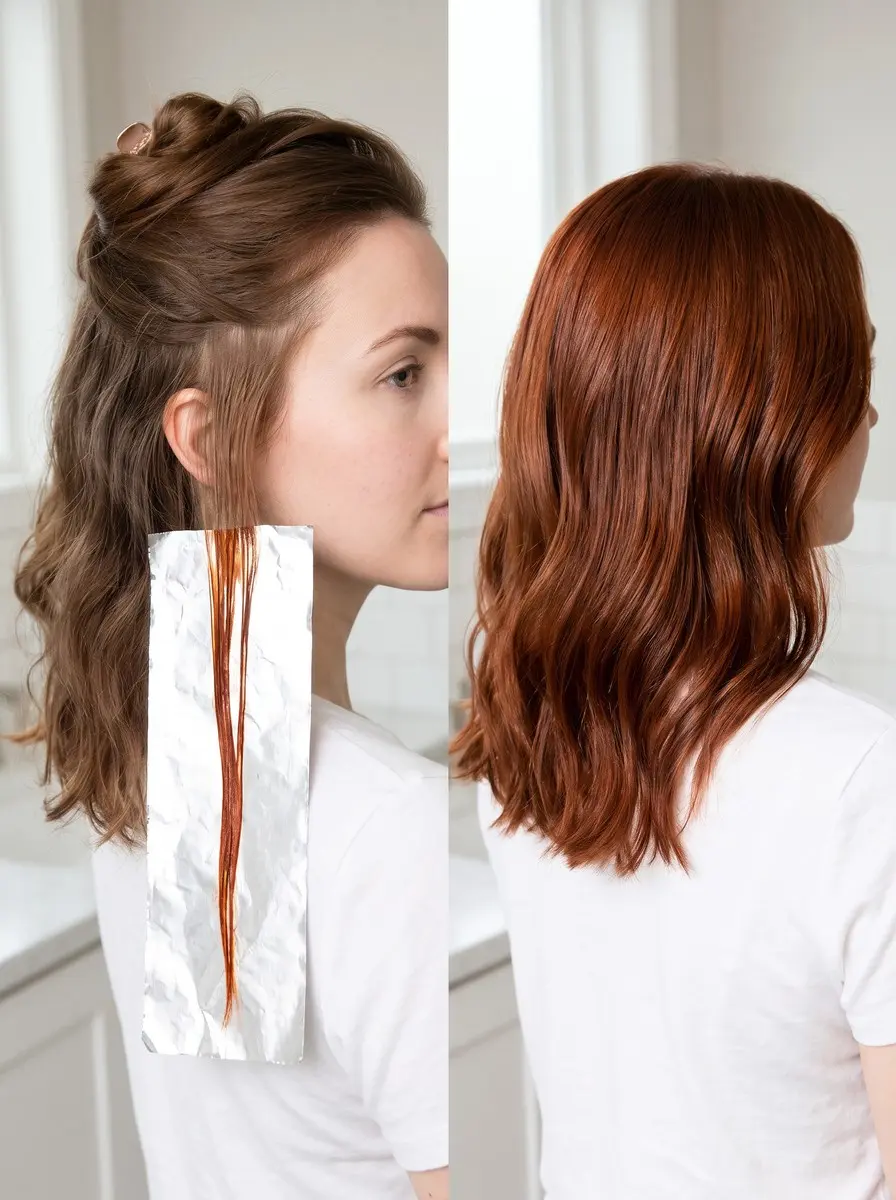
Choose a section about 1/4 inch wide from underneath, just behind or below your ear, where a surprise result won’t show. Avoid the hair at the back of your head: it’s often darker than the rest and can give you a misleading preview of how the color will look around your face.
Leave the strand attached instead of snipping it off. Cutting isn’t necessary, and a loose strand is harder to saturate evenly and misses the warmth of your scalp, so the result is skewed. Clip the rest of your hair away and lay the strand over a strip of foil or plastic wrap so the dye touches nothing else.
Step 3 Mix a small batch in plastic or glass
Put on gloves, then measure a small amount of color and developer into a plastic or glass bowl, keeping exactly the ratio printed on the box. For a 1:1 formula, a teaspoon of each is plenty for one strand.
Skip metal bowls and spoons, which some formulas react with. The ratio matters because the balance of color to developer controls how much the dye lifts and deposits, so a loosely mixed test won’t predict the real result.
Reseal both bottles straight away and throw out any leftover mix, since mixed permanent color starts reacting at once and can’t be saved. Do this at the same sitting as your patch test and one mix covers both.
Step 4 Coat the strand and time it
Brush the mix onto the strand from root to tip, then work it through until every hair is coated with color on both sides. Full saturation matters because dry patches process lighter and would make the shade look weaker than it is.
Set a timer for the exact processing time printed on the box, not a guess, because the test is meant to show what that timing does to your hair. If you’re using demi- or semi-permanent color and aren’t sure how long to leave it, coat two neighboring strands and rinse one halfway through and the other at the full time to see how the color builds.
Step 5 Rinse, shampoo and dry the strand
When the timer ends, rinse the strand until the water runs clear, shampoo it, and add a little conditioner if the box includes one. Then let it air-dry completely, which a single small section does fairly quickly.
Never judge a strand while it’s wet: water makes hair look darker, so a wet strand looks deeper and richer than the color you’ll actually wear. Wait until it’s fully dry to the touch, root to tip, before you decide anything.
Step 6 Read the color in daylight
Stand by a window in daylight, not under bathroom bulbs, which can make color look warmer or cooler than it really is. Compare the dry strand three ways: against the untouched hair around it, against the shade on the box, and against the result you’re hoping for.
Then check that the hair is still intact by running the strand gently between your fingers and giving it a light pull. Healthy hair stretches slightly and springs back. Hair that feels gummy, mushy or overly stretchy, or that snaps, is telling you to stop.
Step 7 Adjust one thing, then retest
Change only one thing at a time so you know which change worked, and use the table below as your guide. If the strand is too dark, go one shade lighter, or shorten the time if you’re using demi- or semi-permanent color.
If it’s too light, check that it had the full box time before going one shade darker. If it came out brassy, switch to an ash or cool shade, because violet-based tones cancel yellow and blue-based tones cancel orange, or plan a toner afterwards.
If it didn’t lighten enough and you mix your own color, step the developer up one level; with box dye, book a colorist instead. Retest on a fresh strand after any change, and test again whenever you switch shade, developer or brand, because a new formula can give a different result.
Step 8 Check what one strand can’t show
A strand test only tells you about the strand you tested. If your lengths carry old box dye or bleach, those porous ends can grab color darker or patchier than the hair near your ear. One strand also can’t predict how resistant grays at your part or temples will cover.
Book a colorist instead of coloring at home if the strand felt gummy or snapped, if you want to go more than a couple of shades lighter, if you’re lightening over old box dye, or if the result is still wrong after two retests.
If the patch test reacted, don’t use that product: see a doctor if the reaction is severe or doesn’t settle, and get emergency help for swelling of the face, lips or eyes, or any trouble breathing.
Common Mistakes to Avoid
- Treating the strand test as an allergy check. It only shows color and timing; the skin patch test is the only way to check for a reaction.
- Testing hair from the back of the head, which is often darker and gives a misleading preview of the color around your face.
- Judging the strand while it’s still wet or under warm bathroom bulbs, so the result looks deeper or warmer than it really is.
- Mixing the whole box for a test and saving the leftovers. Mixed permanent color starts reacting at once and can’t be stored.
- Changing the shade and the timing at once between tests, so you can’t tell which change fixed the result.
Pro tip Photograph the dried strand next to untouched hair at the same window, with the box in the frame, then take every retest photo in the same spot at the same time of day. Daylight changes from morning to evening, so matched photos are the only fair way to compare two results.
The Bottom Line
Your green light is a strand that, once dry and seen in daylight, matches the box and feels as strong as the hair beside it. A clean patch test is the other half. Once you have both, you can color the full head with the same product, ratio and timing. Keep your strand photo so you have something to compare against next time.
Repeat both tests whenever something changes: a new shade, a new developer, a new brand, or hair that’s been bleached or colored since your last test. Repeat the patch test before every coloring, even with a dye you know. And if the strand felt fragile, you’re after a big lift, or your hair is a patchwork of old color, a colorist’s consultation costs far less than a correction.
Frequently Asked Questions
How long before dyeing my hair should I do a strand test?
Do it 48 hours before color day, at the same sitting as your skin patch test. The strand result is ready in about an hour, once it's rinsed and dry, but the patch test needs at least 24 hours and many brands ask for 48. Testing two days ahead also leaves time to buy a different shade if the strand misses.
Do I need a patch test if I've used the same hair dye before?
Yes. Allergies to hair dye ingredients such as PPD (para-phenylenediamine) can develop after repeated use, so a dye that was fine last time can still cause a reaction. Most manufacturers ask for a patch test before every application. A strand test can't stand in for it, because it tests your hair, not your skin.
Can I do a strand test on hair I've cut off or pulled from my brush?
You don't need to, and it can skew the result. A loose strand is hard to saturate evenly. Brush hair is often old, dry ends rather than a true root-to-tip sample. Neither gets the warmth of your scalp, which speeds up processing near the root. A quarter-inch section left attached underneath, near your ear, gives a more honest preview and stays hidden.
Should I strand test bleach, toner or semi-permanent color too?
Yes, for any product you haven't used on your hair as it is now. With bleach, the strand shows how far and how fast your hair lifts and whether it stays strong. With toner and semi- or demi-permanent color, it shows how much pigment your hair grabs, which porous hair does quickly. Follow each box's patch-test directions as well.
What should I do if the skin patch test causes a reaction?
Rinse the area with lukewarm water and mild soap, and don't use that product, even if the reaction is mild. See a doctor if it's severe or doesn't settle, and get emergency help for swelling of the face, lips or eyes, or any trouble breathing. Don't just switch brands, since many permanent dyes share related ingredients; ask your doctor which ones to avoid.
Keep Reading
Sources
- How to do a hair dye strand test at home coloredhaircare.com
- Pro talk how to dye your hair at home sallybeauty.com
- How to do a strand test moroccanoil.com