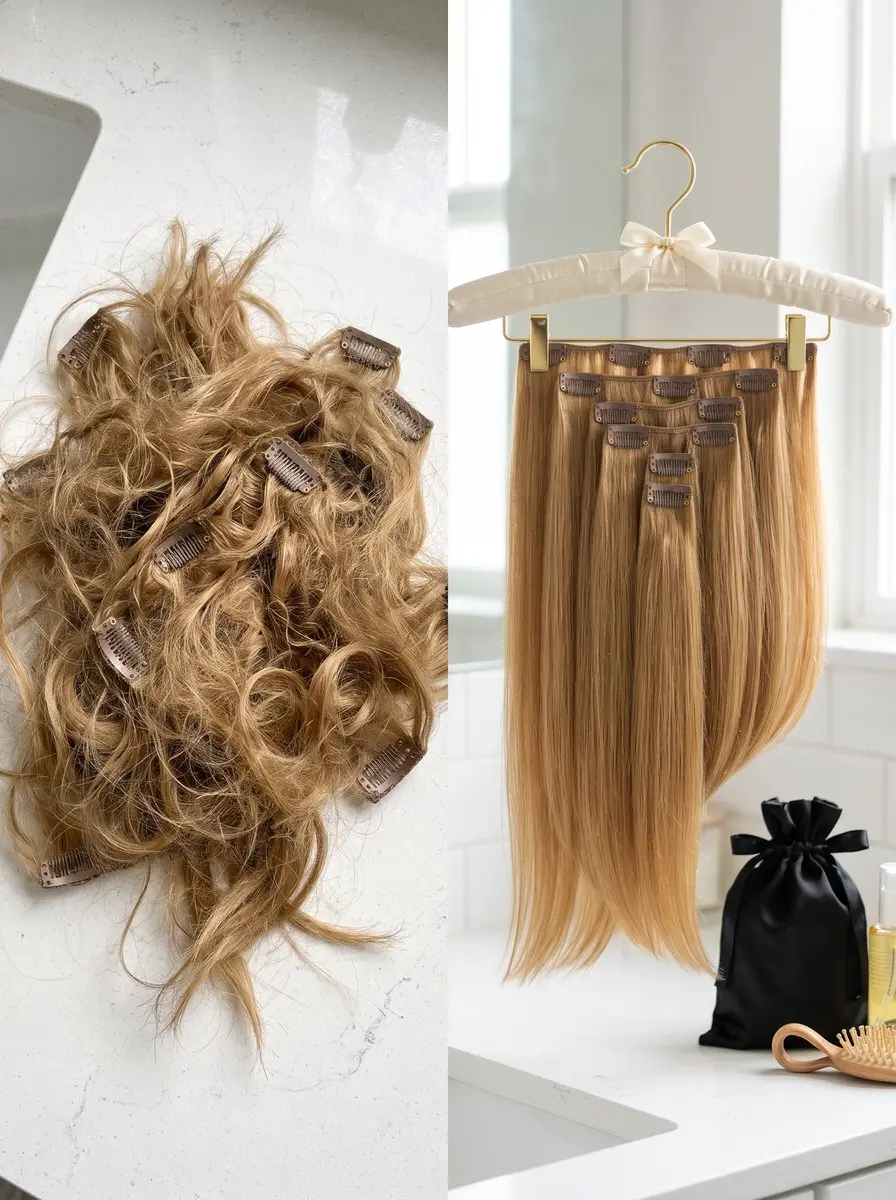
Quick answer To care for clip-in hair extensions, brush them dry from the ends up after every wear, and wash every 10 to 30+ wears, or sooner when they feel stiff. Use lukewarm water and sulfate-free shampoo, condition only the lengths, air dry and store on a hanger or in a silk bag.
Clip-in extensions are the easiest way to add length or fullness without a salon appointment, and they’re a favorite for fine or thinning hair that wants more body.
But a good set is a real investment, and if you don’t know how to care for clip-in hair extensions, it can turn dry, stiff and matted surprisingly fast. The usual mistake is treating the set like the hair on your head: hot water, brushing while wet and conditioner on the clips cause most of the damage.
The routine itself is simpler than it sounds. The hair gets no oil from a scalp, so it needs only an occasional gentle wash, careful brushing and a proper place to live between wears. This guide covers human-hair and synthetic sets: how often to wash, the wash itself, drying, heat limits, storage and travel, and how to fix tangles and shedding wefts.
Time 30-45 minutes hands-on, plus overnight air dryingDifficulty BeginnerSteps 9
Human-Hair vs Synthetic Clip-Ins: What Each Can Take
| Care point | Human hair | Synthetic fiber |
|---|---|---|
| Burn test | Singes to ash, burnt-hair smell | Melts to a hard bead |
| Hot tools | Yes, lowest setting that holds | Only if labeled heat-resistant |
| Blow-dryer | Lowest heat, on damp wefts | Skip it and air dry |
| Lifespan | Longer with gentle care | Shorter; ends frizz sooner |
| Replace when | Ends stay matted after a wash, or wefts thin | Ends stay matted after a wash, or wefts thin |
What You’ll Need
As an Amazon Associate, HairAide earns from qualifying purchases. Product links in this guide are affiliate links: they cost you nothing extra and help keep these tutorials free.
- Sulfate-free shampoo Cleans product buildup off the wefts without stripping hair that has no scalp oils to replace what harsh cleansers remove.
- Extension loop brush Its looped bristles glide through the lengths without snagging the weft or pulling hair out of the track.
- Hair extension hanger Holds the wefts flat and in order for drying and storage so they don’t tangle into each other.
- Silk storage bag A smooth bag cuts friction between wears and keeps the set tidy and tangle-free when you travel.
- Heat protectant spray Shields human-hair or heat-resistant wefts before a blow-dryer, curling iron or flat iron touches them.
Step-by-Step
Step 1 Confirm your fiber type
Before you wash or heat anything, find out whether your set is human hair or synthetic, because the two handle water, heat and products very differently. Start with the box or order page: look for ‘human hair’ or ‘Remy’, as opposed to ‘synthetic’ or ‘heat-resistant’ fiber, and note that synthetic usually has an even, plastic-like high shine while human hair has softer, more natural movement.
If the label is gone and you still can’t tell, snip two or three strands from the inside edge of a weft and burn-test them safely: hold them with tweezers over a sink with some water in it, keep the rest of the set and your own hair well away, and touch only the tips to a lighter flame for a second.
Human hair singes to a fine ash and smells like burnt hair, while synthetic melts into a hard bead and smells like plastic. Write the answer on the box so you only have to test once.
Step 2 Decide when they need a wash
Extensions get no natural oil from a scalp, so they need washing far less often than your own hair, and every wash adds a little wear. Brand advice varies a lot: ColorWow suggests roughly every 10 to 20 wears, while Luxy says every 30 or more.
Turn that range into a rule. If you wear them with little product, aim for the 30-wear end; if you use dry shampoo, hairspray or texture spray, or wear them around smoke or sweat, wash closer to every 10 to 20 wears.
Whatever the count, wash as soon as the hair feels stiff, tangles more than usual or gets harder to style, because those are the signs of buildup.
Step 3 Detangle dry from the ends up
Brush the set while it is completely dry, both after every wear and right before it touches water, because water tightens existing tangles into mats and wet hair stretches and breaks more easily. Lay each weft flat or hold it just below the clips so the brush never tugs on the weft track.
Start on the bottom couple of inches with a loop brush or soft-bristle brush, then work upward in small sections until the brush glides from top to tip without catching. Never brush extensions wet, and keep the bristles off the clips and stitching, where pulling loosens hair from the track.
Step 4 Wash each weft in lukewarm water
Fill a sink or basin with lukewarm water and swirl in a small amount of sulfate-free shampoo, rather than washing the set under a running shower. Lukewarm matters because hot water can loosen the bonding and stitching that hold the weft together, and it dries out the fibers.
Dip one weft at a time, hold it by the top and smooth the lather downward with flat palms in the direction the hair falls, never scrubbing, rubbing or bunching it up. Rinse in clean lukewarm water the same way, top to tip, until the water runs clear and the hair no longer feels slippery.
Step 5 Condition the lengths, not the clips
Smooth conditioner over the mid-lengths and ends only, keeping it well clear of the clips and the weft track. The ends take the most friction and get no oil from a scalp, so they need the moisture most. Conditioner on the attachment point can loosen it and leave a slick residue that lets the clips slide out of your own hair.
Leave it on for a few minutes, then rinse in lukewarm water, top to tip, until the hair feels soft but not coated. If a human-hair set feels dry, use a hair mask on the same mid-lengths-to-ends area every few washes.
Step 6 Blot and air dry flat
Press out the water by sandwiching each weft in a towel and squeezing gently. Never wring, twist or rub it, which roughs up the hair and starts new tangles.
Lay the wefts flat on a dry towel, or hang them from a drying rack or extension hanger, and let them air dry completely; this is what most brands recommend. If a human-hair set has to be ready sooner, use a blow-dryer on its lowest heat setting while the hair is still damp, pointing the airflow down the lengths; synthetic fiber should simply air dry.
Wait until the set is fully dry before brushing, and make sure the weft track is dry too before you pack it away, since a damp track can turn musty.
Step 7 Heat style only heat-safe fiber
Check your fiber before reaching for a hot tool. Human hair can take heat, fiber sold as heat-resistant or heat-friendly can take it up to the temperature its maker lists, and standard synthetic will frizz or melt.
Style the wefts off the head on a hanger, or clipped in so you can curl your own hair and the extensions together for a seamless blend.
Keep the barrel or plates away from the metal clips and the weft track, and use the lowest setting that holds the shape, because extensions have no scalp oils to replace the moisture heat takes out. Let each curl cool before you brush through it so the shape sets, and follow the heat limits in the FAQ below.
Step 8 Store them flat or hanging
After brushing, store the set on an extension hanger, or loosely in a silk or satin bag or its original box. Keep it away from a steamy bathroom and from direct sunlight, which can fade color.
Stack the wefts in the order you clip them in, from the widest back weft to the narrow side pieces, so they don’t tangle into each other and getting ready takes minutes. For travel, pack them the same way in a silk bag or flat case with your brush, in your carry-on rather than crushed in a checked suitcase.
Always take them out before sleep and swimming: pillow friction tangles the lengths and the clips tug at your roots, while chlorine and salt water dry out the fibers.
Step 9 Fix matting and loose wefts
For a mat, mist the knot with a detangling spray and ease it apart with your fingers first, then switch to a wide-tooth comb, working from the bottom of the knot upward. A few loose hairs are normal, especially in the first few wears.
Steady shedding from the weft track often means the brush, conditioner or hot water has been reaching the track, so change the routine before the weft thins. A loose clip can be stitched back on with strong thread, and a stylist who works with extensions can repair a split weft.
Human-hair sets generally outlast synthetic ones, whose ends frizz from friction sooner, but replace either kind when the ends stay dry and matted even after a wash and condition, or when the wefts look visibly thin.
Common Mistakes to Avoid
- Brushing extensions while they’re wet, which stretches the hair and tightens tangles into mats
- Scrubbing wefts in circles or piling them up to shampoo, instead of smoothing the lather downward
- Washing in hot water or getting conditioner on the clips and weft track, which loosens the attachment and makes clips slip
- Sleeping or swimming in clip-ins, so friction, chlorine or salt water tangles and dries out the lengths
- Using a hot tool on standard synthetic fiber that isn’t labeled heat-resistant
- Packing a set away while the weft track is still damp
Pro tip Wash your set the day before you plan to wear it, never the morning of. The weft track holds water long after the lengths feel dry, and only a full night on a rack or towel dries it all the way through.
The Bottom Line
Looked after this way, clip-ins stay soft, move like real hair and blend into your own for much longer. Brush them dry after every wear, wash only when they feel stiff or stop holding a style, condition the lengths and keep everything off the clips. Between wears, store them on a hanger or in a bag, and take them out for sleep and swimming.
See a stylist who works with extensions if a weft keeps shedding, a restitched clip won’t hold, or the set no longer matches your own hair. They can repair wefts, cut the extensions to blend so the ends sit naturally, or match a replacement set. Leave color changes to a pro too, because many human-hair sets have already been processed.
Frequently Asked Questions
How often should you wash clip-in hair extensions?
Far less often than your own hair, since extensions get no oil from a scalp. ColorWow suggests roughly every 10 to 20 wears and Luxy every 30 or more, so wash nearer the lower end if you use a lot of dry shampoo or hairspray. Whatever the count, wash when the hair feels stiff, tangles easily or is harder to style.
Can you use a curling iron or flat iron on clip-in extensions?
Yes on human hair, and on heat-resistant synthetic up to its maker's stated limit; standard synthetic melts. Mist on a heat protectant before any heat, including a blow-dryer on damp wefts. Use irons and wands on completely dry hair only, because ironing wet hair is genuinely damaging. Many human-hair sets are bleached, so stay near 300°F (150°C); only coarse, unprocessed hair needs 355-390°F (180-200°C).
Can you sleep, swim or work out in clip-in extensions?
Take them out before bed and before swimming. Pillow friction tangles the lengths and the clips tug at your roots overnight, while chlorine and salt water dry out the fibers and are hard to rinse from the weft. A workout is fine if the clips sit securely, but sweat counts as buildup, so wash the set sooner.
How long do clip-in hair extensions last?
There is no fixed lifespan: it depends on how often you wear them, how much heat you use and how gently you wash and store them. Human-hair sets generally outlast synthetic ones, which tend to frizz at the ends from friction sooner. Replace a set when the ends stay dry and matted after a wash and condition, or the wefts look visibly thin.
Can you use regular shampoo and conditioner on clip-in extensions?
Use a gentle, sulfate-free shampoo, because extensions have no scalp oils to replace what harsh cleansers strip. Many human-hair sets are color-treated, so a color-safe formula helps them hold their shade. Conditioner and any oils go on the mid-lengths and ends only, never the clips or weft track, where residue makes the clips slip out of your own hair.
Keep Reading
Sources
- How often should you wash hair extensions help.luxyhair.com
- Hair extensions care guide colorwowhair.com
- How to wash luxy hair extensions luxyhair.com
- How to care for your clip in hair extensions perfectlocks.com