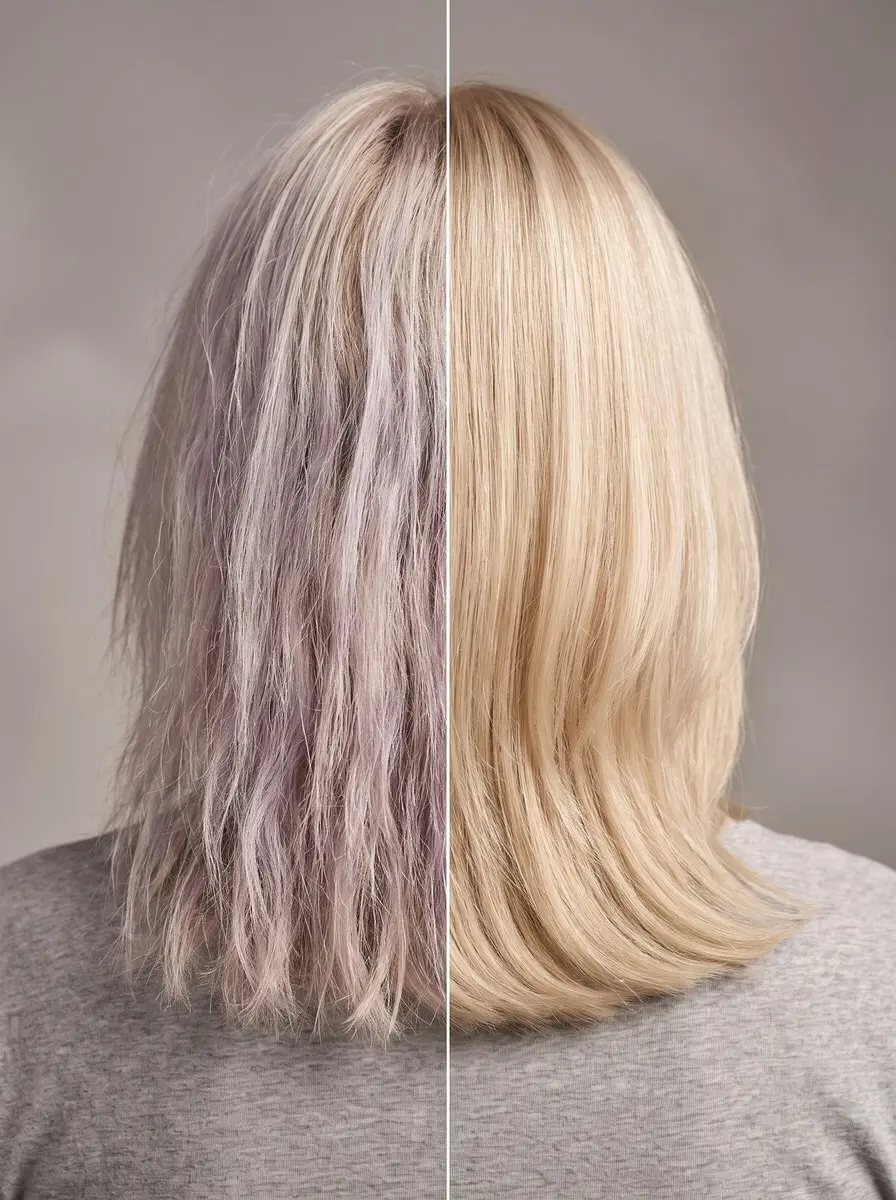
Quick answer To fix purple tint in hair, start with a clarifying shampoo over a few washes, because violet pigment only coats the surface. If it lingers, strand-test a baking-soda-and-shampoo mix, then dish soap, and deep condition afterwards.
You reached for purple shampoo to knock out brass and got lilac instead. Maybe it is a faint grey-violet haze that shows only in daylight, or maybe your ends have turned a clear lavender.
It happens all the time, especially on bleached blonde and silver hair, and it is almost always fixable. Violet pigment from purple shampoos and most toners sits on the outside of the hair rather than inside it, so it is temporary by nature.
This guide works from the gentlest fix to the strongest, and you stop as soon as the tint is gone. Every rung harsher than plain clarifying shampoo gets a strand test first. A word of honesty before you start: beyond a clarifying wash, most home remedies here rest on stylist and reader experience rather than controlled testing. Go slowly and you will lose the purple without losing the condition of your hair.
Time 15-40 minutes per wash, over several washesDifficulty BeginnerSteps 8
Where to Start by Your Purple Tint
| Your situation | Start with | See a stylist if |
|---|---|---|
| Lilac tint from purple shampoo on blonde | Clarifying shampoo over several washes | Hair fails the stretch check |
| Grey-purple cast on silver or white hair | Clarifying shampoo, then baking soda | Tint stays after dish soap |
| Over-toned bleached hair from a purple toner | Clarifying, then baking soda | Hair is fragile or you’re considering a color remover |
| Murky purple on light-brown hair | Clarifying, then switch to blue shampoo | Peroxide would be needed |
| Violet semi-permanent fashion color | Skip the ladder | Always, or before using a color remover |
What You’ll Need
As an Amazon Associate, HairAide earns from qualifying purchases. Product links in this guide are affiliate links: they cost you nothing extra and help keep these tutorials free.
- Clarifying shampoo The gentlest, first-line fix that lifts a surface violet deposit over a few washes.
- Deep conditioning hair mask Puts back the softness and oils that clarifying, baking soda and dish soap strip out.
- Color-safe nourishing shampoo Use it between purple shampoo washes so violet pigment does not build up again.
- Blue toning shampoo Cancels orange in brown hair, where a purple product only adds a murky cast.
- Fine-mist spray bottle Applies the diluted peroxide spritz lightly and evenly to the purple sections only.
Step-by-Step
Step 1 Identify the product and your hair type
Before you strip anything, name the product that turned you purple and your hair type, because together they decide which rung of this ladder you start on.
A purple shampoo or conditioner leaves the lightest deposit and often fades within a few washes, a salon or box toner deposits more and may need the baking soda or dish soap rungs, and a violet fashion color such as a semi-permanent lilac dye is a dye job that belongs with a color remover or a stylist.
Then note your base shade: bleached blonde, silver or white, or light brown. Over-toning comes from a product too strong for your shade, too much of it, too long a leave-on time or high-porosity hair, which grabs violet fast and is why ends turn lilac first; silver strands have no pigment of their own to hide the deposit, and on light brown a purple product looks murky because violet does not cancel orange.
You are done when you can find your row in the quick reference table below and name your starting rung.
Step 2 Check your hair can take stripping
Pull one shed or wet strand gently between your fingers before you try anything stronger than shampoo. A healthy strand stretches a little and springs back. A strand that stretches like gum, stays limp or snaps right away is already fragile, and any stripping method can make the damage worse.
If your hair fails this check, use only the clarifying step below and book a stylist for the rest. Passing means you can move up the ladder, as long as you strand-test each new rung on a hidden section underneath first.
Step 3 Wash with clarifying shampoo first
Clarifying shampoo is the safest first move, and for a purple-shampoo tint it is often the only one you need. It has a stronger cleansing action than everyday shampoo, which loosens the violet deposit and product buildup coating the hair. Lather it through wet hair, leave it on for two or three minutes, rinse and repeat once.
Do this every wash day for three or four washes rather than scrubbing hard in one session, because the tint fades a little each time. You are done when the hair looks neutral in daylight once it is dry, not while it is wet and looks darker.
Step 4 Boost the wash with baking soda
If the purple survives several clarifying washes, stir a spoonful of baking soda into a palmful of clarifying shampoo to make a loose paste. Baking soda is alkaline and mildly abrasive, which helps pull more of a stubborn toner deposit from the surface, but it is also drying.
Strand-test it on a hidden underneath section first, then apply it to the tinted areas only. Leave it on for no more than 30 minutes, checking a strand every five to ten minutes, and rinse as soon as the purple has lifted. Rinse thoroughly and follow with conditioner, because the alkaline mix leaves hair feeling rough.
Step 5 Try one dish soap wash
Dish soap is the next rung up, and it is a one-off, not a routine. It is made to cut grease, so it strips the oils and buildup holding pigment on the hair along with some of the pigment itself.
That same strength leaves hair dry and squeaky, so strand-test it first, use a small amount of a plain, dye-free formula, lather once and rinse well. Do not repeat it on the same day. If one dish soap wash plus clarifying has not shifted the tint, stronger home stripping is unlikely to be worth the damage.
Step 6 Save a peroxide spritz for last
The strongest home option is drugstore 3% hydrogen peroxide mixed one to one with water in a spray bottle. It is also the most damaging rung on this ladder, so strand-test it, mist only the purple sections, and rinse it out in under one minute.
Peroxide is an oxidizer, so it can also lighten hair that has not been bleached, which means light-brown or natural hair may lift unevenly in patches. Skip this step completely if your hair failed the stretch check or is already bleached to a very pale level. Follow immediately with a rich conditioner.
Step 7 Know when to see a stylist
Stop the home ladder and book a colorist if your strand test turned gummy or broke, if the hair is bleached and already fragile, or if the purple is a fashion color that will not budge. The same goes if you are thinking about a color remover or a bleach bath.
Both are real chemical processes, and on over-processed hair a salon can judge the right strength and protect the ends. A colorist can also tone you back to the exact shade you wanted, which home stripping cannot do.
Step 8 Deep condition and prevent a repeat
Every stripping method above removes natural oils, so use a deep conditioning mask once or twice a week for the next few weeks, and no more often than that, so the hair does not turn limp.
Next time, leave purple shampoo on for three to five minutes, use it about once a week, and wash with a nourishing color-safe shampoo between uses. If your problem is orange in brown or brunette hair, switch to blue shampoo, because blue sits opposite orange on the color wheel while violet sits opposite yellow.
Common Mistakes to Avoid
- Jumping straight to dish soap or peroxide before giving clarifying shampoo three or four washes to fade a surface deposit.
- Skipping the strand test, especially on bleached hair, then finding out mid-process that the hair is too fragile for the method.
- Leaving the baking soda mix on for the full 30 minutes without checking, long after the purple has already lifted.
- Judging the tint on wet hair, which looks darker and more violet, and over-stripping hair that would look neutral once dry.
- Going back to daily purple shampoo with long leave-on times as soon as the tint fades, which rebuilds the same cast.
Pro tip Check your tint on dry hair by a window, never wet under bathroom lights: wet hair always looks deeper and more violet, and most over-stripping happens when people chase a purple that has already gone.
The Bottom Line
Most purple tints go with nothing harsher than a few clarifying washes, and the ladder only needs climbing as far as your tint demands: baking soda, then a single dish soap wash, then a quick peroxide spritz as the last home rung. Strand-test each new step, judge the result on dry hair, and follow any stripping with a deep conditioning mask once or twice a week while the hair recovers.
See a colorist if your hair is bleached and fragile, if a strand test turns gummy or breaks, if the purple is a fashion dye, or if you are thinking about a color remover or bleach bath. They can lift the cast safely and tone you to the shade you wanted in the first place.
Frequently Asked Questions
Will purple tint in hair wash out on its own?
Usually, yes. The violet pigment in purple shampoo and most toners only coats the outer layer of the hair, so it fades with regular washing. A light purple-shampoo tint often clears within a few washes, and faster with clarifying shampoo. A strong toner on very porous, bleached hair can take longer, and a violet fashion dye may need a color remover or a stylist.
Is baking soda safe to use on bleached hair?
It can be used, but carefully. Baking soda is alkaline and drying, so bleached hair that is already fragile can feel rougher or snap more easily afterwards. Strand-test it on a hidden section, keep it to 30 minutes at most and check every few minutes, then condition well. If your strand stretches like gum or breaks, skip baking soda and see a stylist.
How do I fix purple tint on gray or silver hair?
Start with clarifying shampoo over three or four washes, because white and silver strands have no pigment of their own to hide even a light violet deposit. If grey-purple remains, strand-test a baking soda and shampoo mix next. To stop it coming back, use purple shampoo about once a week for three to five minutes and wash with a gentle color-safe shampoo in between.
Can I use a color remover to get rid of purple toner?
Color removers are designed for oxidative dyes, so they may lift a demi-permanent toner more easily than a direct-dye fashion color, but results vary. They are a real chemical process, and on bleached or damaged hair the safest choice is to let a colorist decide. If you try one at home, strand-test first and follow the kit's timing exactly.
How do I stop purple shampoo from turning my hair purple again?
Leave purple shampoo on for three to five minutes, use it about once a week, and switch to a nourishing color-safe shampoo between uses. Porous ends grab pigment fastest, so apply it to the brassy areas rather than piling it on the ends. If your hair turns orange rather than yellow, use a blue shampoo instead, because blue cancels orange.
Keep Reading
Sources
- Does purple shampoo damage hair wella.com
- How to remove purple toner from hair curlcentric.com