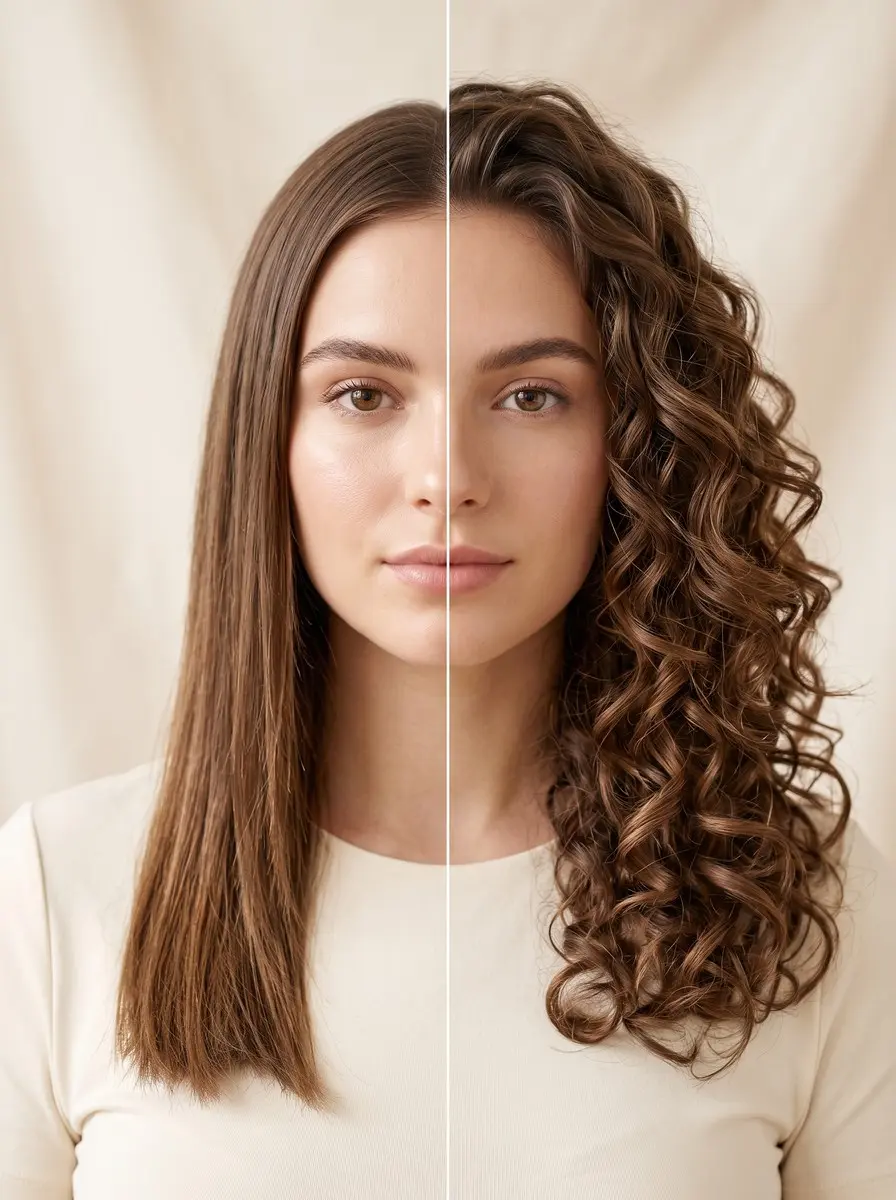
To get heatless curls, apply mousse to clean hair that's 80-90% dry, then wrap it around a robe tie, twist it into small buns, or coil it into bantu knots. Sleep on the set, unwrap only when completely dry, and separate curls with your fingers, not a brush.
Heatless curls really do work. You set your hair before bed, sleep on it, and wake up to bouncy, blowout-style curls with no hot tools involved. If you tried it once and woke up to limp, half-damp waves or a frizzy puff, the method probably wasn’t the problem. How damp your hair was when you set it almost always is.
This guide covers three overnight methods side by side: the robe tie or ribbon wrap, the twist and pin, and small ponytails or bantu knots. It also shows you how to pick the right one for your length and texture. You’ll learn the dampness rule that makes or breaks a set, how to sleep comfortably in one, and how to take your curls down without frizz. You need a few minutes, a setting product and a couple of soft hair ties.
What You’ll Need
- Heatless curling rod or satin robe-tie ribbon (heatless curler) — It’s the soft, thick core you wrap hair around in Method 1, and it shapes big curls without leaving a crease.
- Lightweight mousse or setting lotion (styling mousse) — It gives damp hair a flexible hold so the curl lasts after the set comes out, especially on fine hair.
- Silk or satin bonnet or pillowcase (sleep accessory) — It reduces friction while you sleep, so the set stays in place and you wake up to smooth curls instead of frizz.
- Microfiber hair towel (drying towel) — It soaks up water without roughing up the hair, helping you reach the 80-90% dry mark with less frizz.
- Scrunchies and spiral hair ties (no-crease hair ties) — They hold ends, ponytails and knots in place without denting the finished curls.
As an Amazon Associate, HairAide earns from qualifying purchases. Some links above are affiliate links — they cost you nothing extra and help support free tutorials.
Step-by-Step
-
Start with freshly washed, conditioned hair. Squeeze out the water with a microfiber towel or a cotton T-shirt instead of rubbing, because rubbing roughs up the hair and causes frizz before you’ve even started. While the hair is damp, work a golf-ball-sized amount of lightweight mousse or setting lotion from the mid-lengths to the ends. Use a curl cream instead if your hair is thick or coarse. The product coats each strand with a flexible film that helps the curl hold once the hair dries, which matters most on fine, slippery hair that usually drops its shape. You’re ready when the product is spread evenly and the hair feels lightly tacky, not crunchy or soaked.
-
Let your hair air-dry until it’s 80-90% dry before you set it. This single step decides whether the curls hold. Water temporarily breaks the hydrogen bonds that shape each strand, and they re-form in whatever shape the hair holds as it dries. If you set soaking-wet hair, a tightly coiled section can still be damp in the morning and the curl drops as soon as you release it. Hair that’s already bone-dry has too little moisture left to take a new shape. To test, touch the roots and the underneath layer at the nape: they should feel almost dry, maybe slightly cool, with no wet patches. Thick, dense hair dries slowly inside a tight coil, so set it closer to 90% dry. Fine hair can go in closer to 80%.
-
Choose your method based on your hair’s length and texture before you start sectioning. The robe tie or ribbon wrap suits shoulder-length and longer hair that’s fine to medium and straight to wavy, and it gives big, bouncy, blowout-style curls. The twist and pin suits collarbone-length and longer hair and gives looser, beachy waves. Small ponytails or bantu knots suit chin-length to medium hair and curly, coily or very thick hair, and they give tighter, more defined curls. Whatever the method, bigger sections make looser waves and smaller sections make tighter curls. If you’ve never tried a heatless set, start with the robe tie: it’s the quickest to do and the most comfortable to sleep in.
-
Method 1, the robe tie or ribbon: drape a satin robe tie, soft ribbon or heatless curling rod over the top of your head, centred at the crown, and hold it in place with a claw clip or small scrunchie. Take a 1-2 inch section from the front on one side and wrap it away from your face around the tie. Then pick up the next section below, add it in and wrap the combined hair around again, like a French braid wrapped around a rope, until you reach the nape. Wrap the remaining length right down to the ends, keeping them flat and smooth, and secure them with a scrunchie. Repeat on the other side. Wrapping away from the face makes the curls open up around your features, and the soft, thick tie curves the hair gently enough to avoid a crease. You’re done when each side is snug and flat and the ends are fully tucked.
-
Method 2, the twist and pin: working on damp (not wet) hair, divide it into four to eight sections. Use fewer, larger sections for loose waves and more sections for tighter ones. Twist each section tightly away from your face until it starts to coil back on itself, then wind that rope into a small, flat bun and secure it with bobby pins or a small claw clip. On curly or coily hair, two-strand twists left hanging work the same way and give a classic twist-out. The twist compresses the hair into a spiral that dries in place, so you get an undone, beachy S-wave instead of a uniform ringlet. Keep the buns flat against your head rather than piled up so you can lie on them comfortably.
-
Method 3, ponytails or bantu knots: for the ponytail version, divide your hair into 3-9 small ponytails secured with soft elastics. Use three or four for loose curls on longer hair, and up to nine for tighter curls or very thick hair. Twist the length of each ponytail and coil it around its own elastic, then secure the end with a second tie or a pin. For bantu knots, skip the ponytail: twist a small section from the root, coil it flat around its own base into a knot, and tuck or pin the end underneath. Because each knot is small and anchored at the root, this method gives the most defined, springy curls and works on hair as short as chin length. Thick knots dry slowly, though, so keep the sections small if your hair is dense.
-
Before bed, cover the set with a silk or satin scarf or bonnet, or at least sleep on a silk or satin pillowcase. These smooth fabrics cause less friction than cotton, so the outer layer of hair stays sleek instead of roughing up into frizz. A scarf also stops sections from loosening as you turn over. For comfort, keep the robe tie centred on top of your head so you can sleep on your back or side, and put knots and buns away from the spot where your head rests. Check your hairline too: anything that pulls at your temples is too tight and should be loosened, because repeated tension there can cause breakage and thinning over time.
-
In the morning, make sure the set is completely dry before you take anything down. Squeeze the thickest part of a knot, bun or wrap, and if it feels cool or damp, leave it in longer, because hair released while slightly damp relaxes as it finishes drying loose. Mist the set lightly with a flexible-hold hairspray, then release each section gently in the reverse order you wrapped it, letting the curl uncoil rather than pulling it straight. Separate the curls with your fingers, never a brush, because a brush breaks each curl apart into frizz. Then rake gently at the roots to add lift.
-
Heatless curls usually hold through the day and often into a second day, though fine, straight hair relaxes sooner than thick or naturally wavy hair. To protect them overnight, gather your hair loosely on top of your head in a scrunchie (a ‘pineapple’) or wrap it dry around the robe tie again, and sleep on satin. On day two, re-wrap only the sections that have dropped. Mist them with water until they’re barely damp, not wet, twist or wrap them for an hour or two while you get ready, and unwrap once they’re completely dry. For frizz, smooth on a drop of lightweight oil or cream warmed between your fingertips instead of adding more water, which would loosen the curl.
Common Mistakes to Avoid
- Setting soaking-wet hair: sections that are still damp in the morning relax the moment you release them, so let your hair reach 80-90% dry first.
- Taking the set down before it’s completely dry, so the curls straighten as they finish drying loose.
- Brushing or combing the curls out, which breaks each curl apart into frizz. Separate them with your fingers instead.
- Making sections too thick for how dense your hair is, so the centre of each twist or knot is still wet in the morning.
- Securing the ends with tight, thin elastics that leave dents, or wrapping so tightly at the hairline that it pulls at your temples.
Pro Tip
Separate each curl only once or twice with your fingers. Every split doubles the number of curls and softens their definition, so stop early for polished curls and keep going only if you want full, fluffy volume.
Frequently Asked Questions
How long do heatless curls last?
Heatless curls usually hold through the day and often into a second day. Fine, straight or very slippery hair tends to relax faster than thick or naturally wavy hair. Setting mousse, a light mist of flexible-hold hairspray and sleeping on silk or satin all help them last longer, and you can revive dropped sections by re-wrapping them for an hour or two.
Should my hair be wet or dry for heatless curls?
Slightly damp: set at 80-90% dry and leave it in until completely dry. Soaking-wet hair often won't dry through overnight, and bone-dry hair won't take a new shape. Use a heat protectant before any heat: a blow-dryer on low can finish a still-damp set, and a curling or flat iron goes on completely dry hair only, up to about 150C/300F for fine or bleached hair or 180-200C/355-390F for coarse hair.
Can you get heatless curls on short hair?
Yes, as long as your hair is roughly chin length or longer, because each section needs to wrap around at least once to hold a curl. Bantu knots and small ponytails suit short hair because each section is small and anchored at the root. The robe tie needs about shoulder-length hair to wrap fully, so save it for longer lengths.
Are heatless curls bad for your hair?
Heatless curls are one of the gentlest ways to curl hair because they skip hot tools entirely. The real risks are tension and friction: tight elastics or wraps that pull at the hairline night after night can cause breakage and thinning over time. Keep the set snug but not tight, use soft ties, move where the knots sit, and sleep on silk or satin.
Why do my heatless curls turn out frizzy?
Frizz usually comes from one of three things: unwrapping before the hair is fully dry, brushing the curls out, or friction from a cotton pillowcase overnight. Leave the set in until every section is dry, separate the curls with your fingers only, and sleep in a silk or satin scarf or bonnet. A small amount of lightweight oil on your fingertips smooths any flyaways.
You Might Also Like
- 20 shaggy lob ideas for medium-length hair to show off your curls
- 20 shaggy lob wedding hairstyles to wear with soft curls
- how to tone brassy hair at home
- do a root touch-up at home
- textured fringe hairstyles
- curly pixie cuts for thick hair
Once you’ve found the method that suits your length and texture, heatless curls become a quick bedtime habit. Set your hair at 80-90% dry, sleep on satin, unwrap only when it’s completely dry, and separate the curls with your fingers. Refresh any fallen sections with a quick re-wrap, and redo the full set after each wash.
If your hair won’t hold a curl for more than an hour, or you want a defined, long-lasting curl for a big event, book a stylist. They can cut in layers that help curls sit and hold their shape, or create a professional set that lasts. Until then, you can have bouncy curls without heat whenever you want them.
Sources
- Success depends on dampness level going in and full drying before unwrapping — the standard guidance is hair should be 80-90% dry when set and fully dry before takedown. teleties.com
- The ponytail method divides hair into 3-9 small ponytails each wrapped around its own tie; the twist method uses damp (not wet) hair twisted in small sections. luxyhair.com
- Fingers, not a brush, should be used to comb out overnight curls afterward to avoid frizz. blissy.com