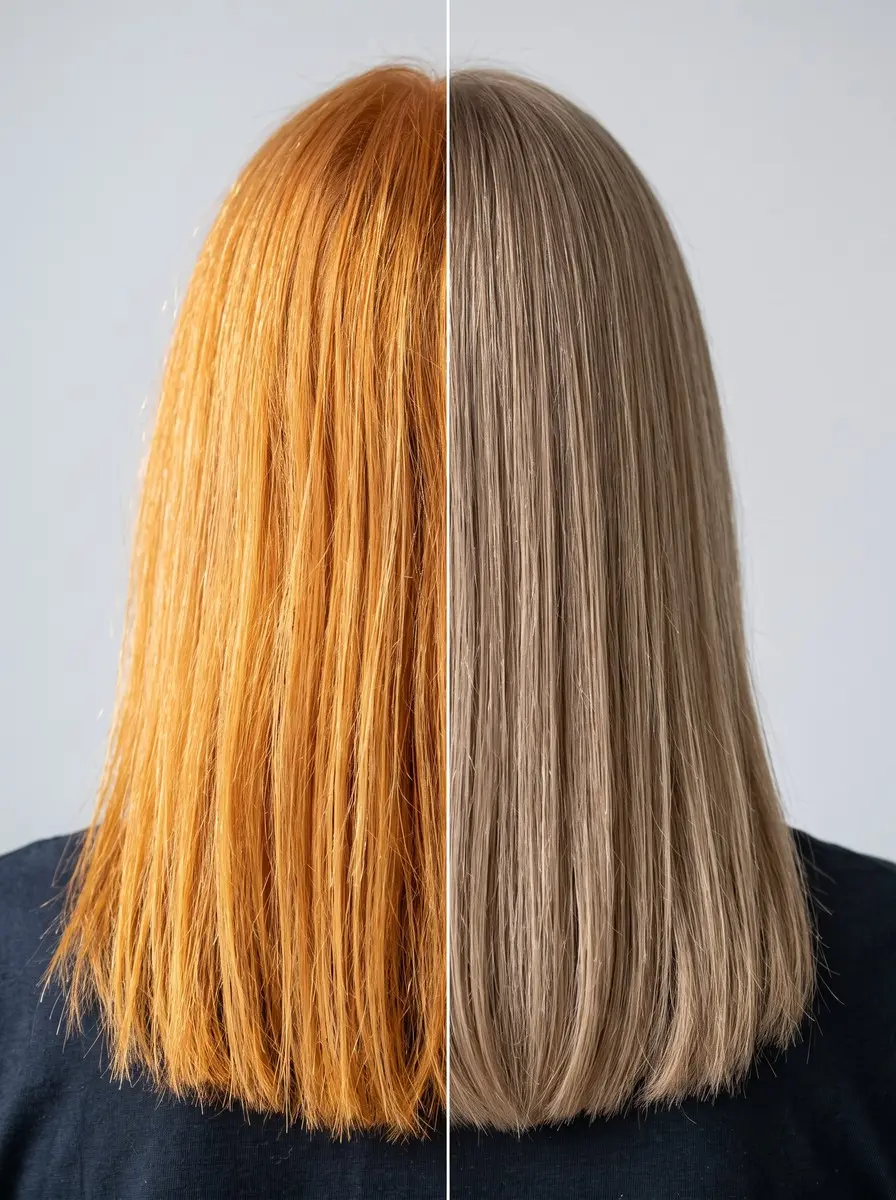
Quick answer To fix orange hair after bleaching, match the toner to the shade. Use blue-based toner for bright orange, blue-violet for yellow-orange and blue-green for red-orange, never violet alone. Blue shampoo handles mild orange, demi-permanent toner handles strong orange, and re-lighten only healthy hair.
You lightened dark hair at home and rinsed it. Instead of blonde, you got something closer to a traffic cone. The bleach didn’t fail. That orange is the warm pigment every dark shade passes through on its way to lighter. Bleach breaks down the darker pigments first, so somewhere between level 6 and level 8 the hair shows red-orange, orange or yellow-orange.
To fix orange hair, you first need to know which of those you have, because each one needs a different toner. That’s also why the purple shampoo in your shower usually makes things worse. This guide starts with diagnosis. First you read your level from the color.
Then you match it to blue, blue-violet or blue-green toner. Last, you decide whether to tone now, lighten again or give your hair a few weeks off. Most of it takes under an hour at home, as long as you strand test first and watch the timer.
Time 30-60 minutes, plus a strand testDifficulty IntermediateSteps 8
Toner by Color and Level
| What you see | Likely level | Toner to use |
|---|---|---|
| Red-orange (copper penny) | Level 6 | Blue-green / teal |
| Bright orange | Level 7 | Blue-based (.1 / A) |
| Yellow-orange (gold) | Level 8 | Blue-violet (BV / .12) |
| Yellow | Level 9+ | Violet |
What You’ll Need
As an Amazon Associate, HairAide earns from qualifying purchases. Product links in this guide are affiliate links: they cost you nothing extra and help keep these tutorials free.
- Blue toning shampoo It’s the gentlest way to tone down mild orange and keep it from coming back between toner sessions.
- Demi-permanent blue-based toner with its matching developer It’s the corrective step for true orange, adding enough blue pigment in one sitting to neutralize level 6-8 warmth.
- Bond-building treatment It reduces breakage on brittle bleached hair before toning and during the 2-4 week wait before another lift.
- Tint brush, mixing bowl and nitrile gloves set Accurate mixing and full saturation are what keep a toner result even instead of patchy.
- Sulfate-free color-protecting shampoo and conditioner Gentler cleansers strip less of the toner on your off days, so the orange returns more slowly.
Step-by-Step
Step 1 Read your level from the color
Look at your hair while it’s dry, in daylight by a window rather than under a warm bathroom bulb, and name the color honestly. Red-orange like a copper penny means you stopped around level 6. Bright orange means about level 7, yellow-orange or gold means about level 8, and plain yellow means level 9 or lighter.
This works because bleach breaks down the darker pigments first, so the warmth left behind shows how far you lifted. Check roots, mid-lengths and ends separately, since home bleaching rarely lifts evenly, and stop when each zone has a color name and a level.
Step 2 Match the toner to the orange
Toning works on the color wheel: the shade opposite your warmth cancels it. Blue cancels orange, so a blue-based toner (the .1 or A series in many ranges) suits level 7 orange. Blue-violet (BV or .12) suits level 8 yellow-orange, and blue-green or teal cancels red-orange at level 6.
Violet only cancels yellow, which is why a violet toner or purple shampoo on bright orange tends to look muddy or brown instead of blonde. Read the tone family on the label as well as the number, because numbering differs between brands.
Step 3 Decide whether to tone, lift or wait
Toner only adds color; it cannot make hair lighter. Toning level 7 orange gives you a soft, neutral dark blonde, so if that’s close to what you wanted, tone now. If you want a pale or icy blonde, you’ll need to bleach again first, but only if your hair passes a stretch test: wet a few strands and pull gently.
Strands that spring back can usually take another round; strands that stretch like gum or snap cannot. In that case, tone to make the color wearable, use a bond builder in the meantime, and wait 2-4 weeks before bleaching again.
Step 4 Choose shampoo or demi-permanent toner
Choose the product’s strength by how orange your hair is. For mild orange, meaning a light brassy-orange tinge, a blue toning shampoo is the gentlest fix. Use it once or twice a week instead of your usual shampoo and leave it on for the time on the bottle.
For true orange, use a demi-permanent blue-based toner, because it puts down far more pigment in one sitting than a shampoo can. The trade-off is that demi toners can leave hair dull, muddy or green-ashy if left on too long, so the next steps are about controlling it.
Step 5 Prep the hair and strand test
If your hair feels brittle, rough or straw-like, use a bond-building or protein treatment a day or two before toning, as brand guides recommend. It reduces breakage when the hair goes through another chemical treatment. Next, mix a small amount of toner exactly to the brand’s ratio, using the developer or processing solution it specifies.
Apply it to a damp, hidden section at the nape, time it, rinse it and let it dry before judging, because wet hair looks darker and cooler than it will dry. Note the minute the orange turned neutral and whether it tipped toward gray or green: that’s your timing for the full head.
Step 6 Apply to towel-dried hair
Shampoo once and skip conditioner, so nothing sits between the toner and the hair. Then towel-dry until the hair is damp but not dripping, because extra water dilutes the toner and makes the result patchy.
Wear gloves, divide the hair into four sections, and do the most orange zones first, soaking every strand. Leave the most porous ends until last, because porous hair absorbs pigment fastest and over-tones first. You’re done when every section is fully coated, with no dry patches when you part through it.
Step 7 Check every five minutes and rinse
Start a timer when the first section is coated, and check every five minutes by wiping a strand clean with a damp paper towel. Rinse as soon as the orange looks neutral beige, even if the box allows longer. The box time is a maximum, not a target, and leaving toner on too long is what turns hair green-ash, gray or muddy.
Your strand-test time tells you roughly when to expect it, and once you’ve rinsed until the water runs clear, follow with the kit’s conditioner or a rich mask. If you do over-tone, one or two clarifying washes will usually fade a demi-permanent toner back.
Step 8 Keep the orange from coming back
Demi-permanent toner fades a little with every wash, and as it fades the orange underneath comes back, usually within four to six weeks. Use a blue toning shampoo once or twice a week and a sulfate-free, color-safe shampoo on other wash days, since gentler cleansers strip less of the added pigment.
Wash less often, condition every time, and add a weekly mask plus a bond-building treatment as its label directs to keep breakage down on freshly bleached lengths. When orange starts creeping back, tone again with the formula and timing that worked rather than reaching for bleach.
Common Mistakes to Avoid
- Using purple shampoo or a violet toner on bright orange, which turns it muddy brown instead of blonde.
- Treating the box time as a target and leaving toner on until the hair goes green-ash or gray.
- Expecting toner to lighten: toning level 7 orange gives a neutral dark blonde, not platinum.
- Bleaching again within days on hair that stretches like gum when wet, instead of waiting 2-4 weeks with a bond builder.
- Putting one blue formula over the whole head when the roots are yellow and the lengths are orange, which turns the yellow roots green.
- Judging the result while the hair is still wet, when it looks darker and cooler than it will dry.
Pro tip Hair rarely lightens evenly at home, so mix two bowls: blue for the orange lengths and violet or blue-violet for roots that went yellow. Blue on yellow turns green, and one formula on hair at two different levels is the most common cause of a patchy result.
The Bottom Line
Fixing orange after bleaching comes down to diagnosis more than products. Read the level, pick blue, blue-violet or blue-green to match it, and rinse as soon as the orange turns neutral. Demi-permanent toner fades in about four to six weeks. Plan to tone again with the formula that worked, and use blue shampoo once or twice a week in between.
Book a colorist if your hair started very dark, has old box dye on it, or stretches and snaps when wet. If you heat-style while it recovers, use a heat protectant first. Keep irons at about 150°C/300°F on bleached hair, well below the 180-200°C/355-390°F that coarse, unbleached hair can take, and use them only on completely dry hair.
Frequently Asked Questions
Why does purple shampoo make orange hair look worse?
Purple, or violet, sits opposite yellow on the color wheel, so it cancels yellow but not orange. On bright orange it layers a violet cast over the warmth, which reads muddy or brownish rather than blonde. For orange, use a blue-pigmented shampoo or a blue-based toner, and save purple products for hair that has lifted to yellow.
Can toner fix orange hair without bleaching again?
Yes, if you're happy with a slightly darker result. A blue-based toner neutralizes orange at the level you're already at, so level 7 orange becomes a soft, neutral dark blonde. Toner can't lighten hair, though. If you want pale or platinum blonde, you'll need to bleach again once your hair is healthy enough to take it.
How long should I wait before bleaching orange hair again?
Brand guides suggest waiting about 2-4 weeks between lightening sessions, with a bond-building or protein treatment in between. Do a stretch test first. Wet strands that spring back can usually take another round, but strands that stretch like gum or snap need a colorist, not more bleach. Tone in the meantime so the orange is wearable while you wait.
What should I do if my hair turned green or gray after toning?
A green or gray cast means the toner was left on too long, or blue landed on areas that were already yellow. Demi-permanent toner fades with every wash, so one or two washes with a clarifying shampoo will usually soften it within a few days. If the cast is still there after that, a colorist can balance it with a warm gloss.
When should I see a colorist instead of fixing orange hair at home?
See a pro if your natural hair is very dark, if it has old box dye or henna on it, or if it already feels gummy, snaps when wet or is breaking. Those cases need controlled lightening and a trained eye on how much more the hair can take. Book in too if you're at red-orange and want pale blonde, because that needs several more levels of lift.
Keep Reading
Sources
- 214 how to use blue based toners to fix orange hair uglyducklingcolor.com
- How to fix orange hair us.johnfrieda.com
- How to fix orange hair us.davines.com