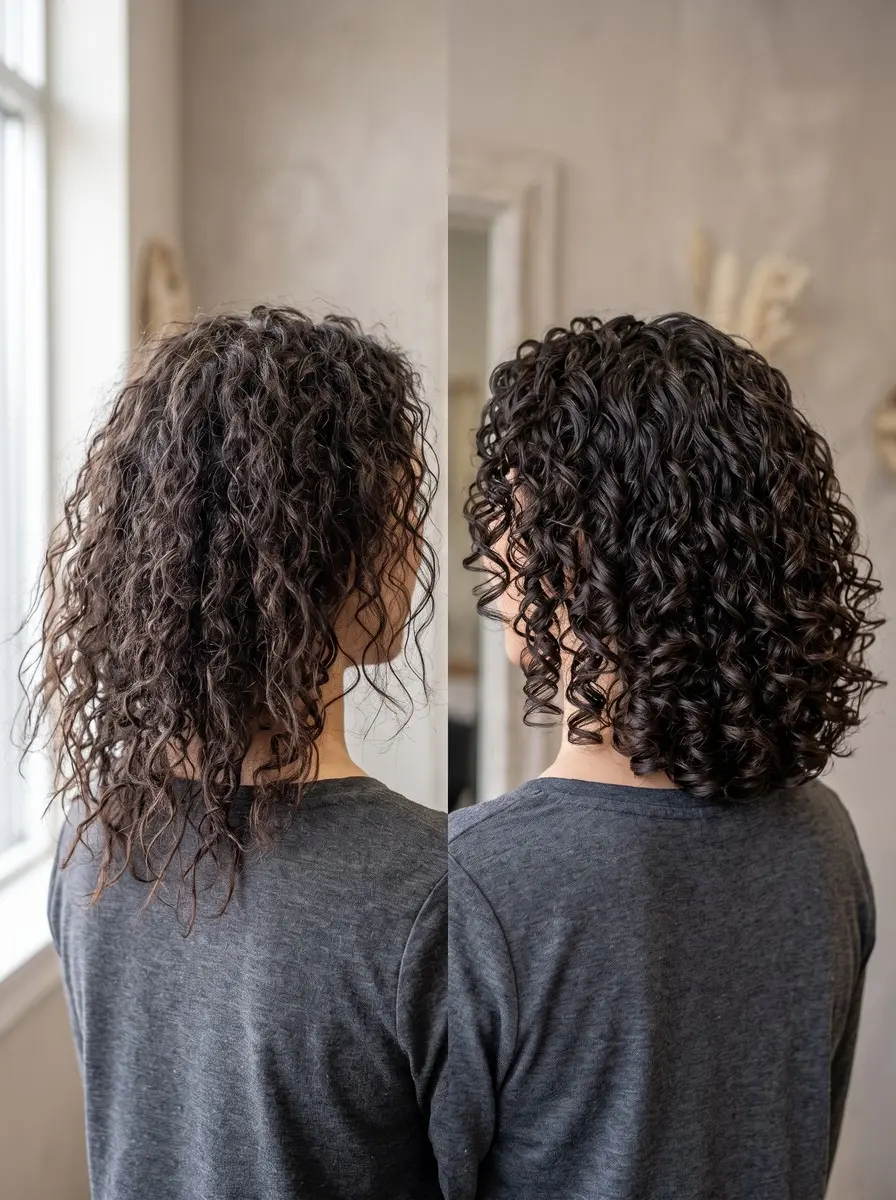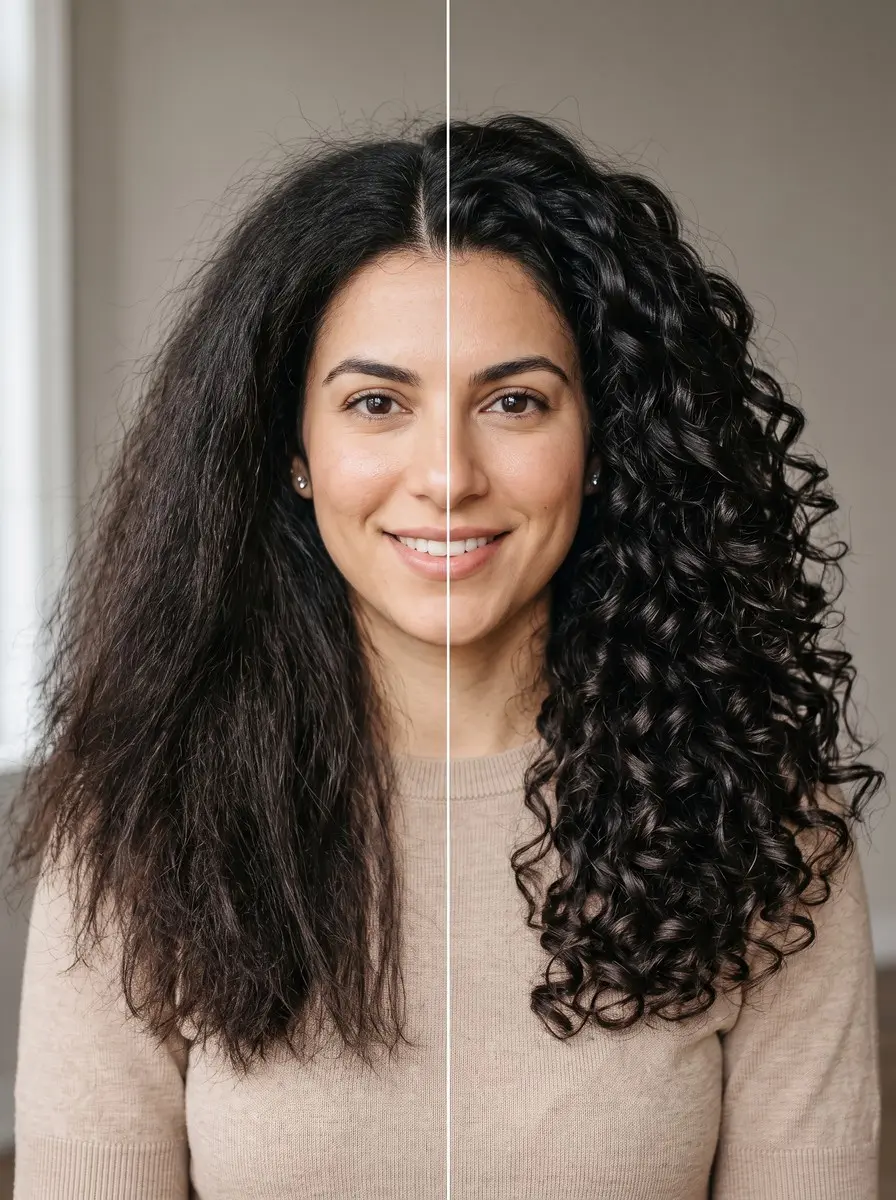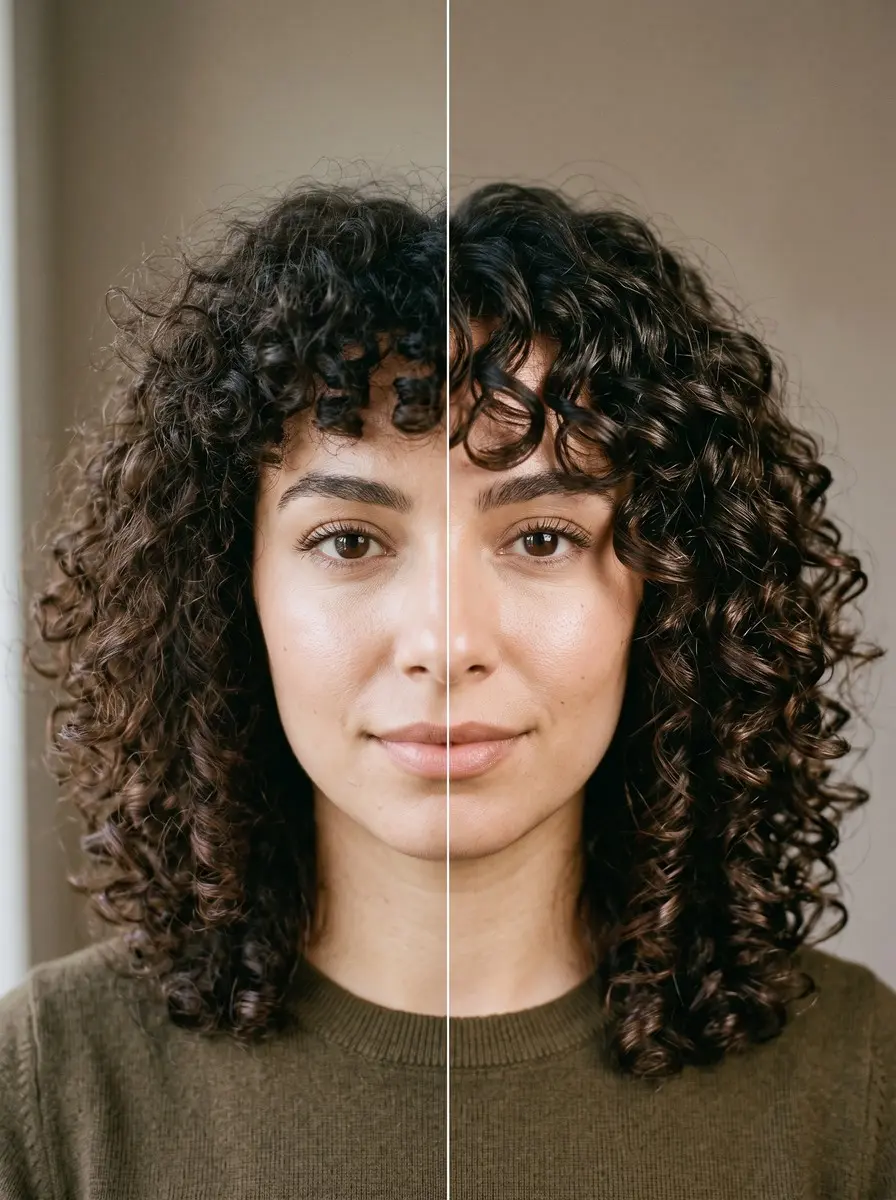
Quick answer To style curtain bangs for curly hair, apply a leave-in and a lightweight curl cream or mousse to damp bangs. Part them away from your face and diffuse on low heat without touching them. Sleep in a satin bonnet, then refresh each morning with water plus leave-in spray.
Curtain bangs look effortless on straight hair: a round brush, a quick blast of air, and they fall into a soft parted swoop. Curly hair doesn’t follow that routine. Shrinkage can pull a fringe an inch or two above where it sat when wet, blow-drying straight fights your pattern, and heavy product glues short curls to your forehead. That’s why so many curly girls give up on bangs after the first frustrating week.
The fix isn’t more effort. It’s a routine built for curls. Below you’ll learn what to ask your stylist before the scissors come out, how to set and diffuse curly curtain bangs on wash day, how to protect them overnight, and how to revive them in two minutes the next morning.
None of it needs salon skills. What you need is the right cut, the right products, and the patience not to touch your bangs while they dry.
Time 15-25 minutes on wash day, 2-3 minutes to refreshDifficulty BeginnerSteps 8
What You’ll Need
As an Amazon Associate, HairAide earns from qualifying purchases. Product links in this guide are affiliate links: they cost you nothing extra and help keep these tutorials free.
- Leave-in conditioner spray with heat protection It moisturizes damp bangs on wash day, protects them under the diffuser, and doubles as the daily refresh mist when you mix it with water.
- Lightweight curl mousse It defines short bang curls without the weight and stiff cast of a heavy gel.
- Bowl diffuser attachment It spreads low-heat, low-airflow drying so fringe curls set in clumps instead of blowing apart into frizz.
- Satin bonnet or satin hair scarf It cuts friction overnight so your bangs need only a quick refresh in the morning.
- Flat duckbill clips They hold each side of the curtain at the root while the curls dry, adding lift without denting them.
Step-by-Step
Step 1 Get a cut that allows for shrinkage
Start with a cut that accounts for shrinkage. Book a stylist who cuts curly hair dry, curl by curl, rather than wet and straight across. Rooted Salon notes that a curtain bang cut wet at the perfect length can spring up an inch or two once it dries.
Ask them to cut longer than your goal and take less at first, since they can always go shorter. Before they pick up the scissors, ask how they account for shrinkage. A confident, specific answer is your cue that you’re in the right chair.
Step 2 Prep damp bangs with leave-in
On wash day, work on damp bangs, not soaking or dry ones. After cleansing and conditioning, blot your bangs with a microfiber towel or cotton T-shirt so they’re damp but not dripping. Then smooth a small amount of leave-in conditioner through them.
If its label lists heat protection, it doubles as your heat protectant for diffusing; if not, mist a light heat protectant over the top. Bangs sit on the face, where oil and touching wear curls down faster than the rest of your hair, so they need moisture most.
The leave-in gives curls slip and weight so the clumps form cleanly instead of separating into frizz. You’re done when every strand feels coated and slippery but not greasy.
Step 3 Layer on a light curl product
Layer a lightweight curl cream or mousse over the leave-in, using about a pea-sized amount of cream or a golf-ball-sized puff of mousse for the fringe alone. Scrunch it upward toward the roots so it encourages the curl instead of dragging it straight.
Skip heavy gels here. Short bang curls have little length to carry weight, so a thick gel pulls them flat, leaves a stiff cast right at eye level, and makes them stick to your forehead.
Light hold keeps the bounce that makes curtain bangs look like curtains. You’re done when the curls look evenly coated, with clumps starting to form and no white residue left on the surface.
Step 4 Set the curtain shape while wet
Set the curtain shape while the bangs are still wet, because curls dry in whatever position you leave them. Find your center or slightly off-center part and direct each side of the fringe down and away from your face toward your cheekbones.
For extra lift, clip each side loosely at the root with a flat duckbill clip, placed so the clip doesn’t crease the curl itself. You’re done when the bangs already read as two soft panels framing your face, even though they’re wet.
Step 5 Diffuse on low heat and airflow
Diffuse on low heat and low airflow. Cup the curly fringe gently in the diffuser bowl, hold it for 30 to 60 seconds, and release without shaking or scrunching mid-dry. High airflow blows short curls apart and creates frizz.
Low heat dries them steadily so the clumps hold their shape. Don’t touch your bangs while they dry, since every touch breaks a clump. Stop once they’re about 80 to 90 percent dry and let the rest air-dry. They’re finished when the curls feel firm and slightly set.
Step 6 Finish the dry shape
Once the bangs are completely dry, remove the duckbill clips and finish the shape. If your mousse or cream left a light crunch, scrunch it out gently with a drop of lightweight oil on your palms. Lift the roots at the part with your fingertips so the curtain opens away from your forehead.
Pull apart only the few larger clumps that look heavy, and never use a brush on dry curls. Brushing breaks the clumps into frizz that won’t settle until your next wash. You’re done when the bangs move softly yet keep defined curls.
Step 7 Protect your bangs overnight
Protect your bangs that first night and every night after with a satin scarf or bonnet. Cotton pillowcases absorb moisture and create friction, which roughs up short curls and flattens them into odd shapes by morning.
Before you cover up, gently push the fringe up and back, or secure each side loosely toward the crown with a snag-free claw clip or a couple of bobby pins placed away from the curls, so they aren’t crushed against your forehead.
Satin lets hair glide instead of rubbing, so your curl clumps survive the night mostly intact. The payoff is a faster, lighter refresh in the morning, often just a quick mist and scrunch.
Step 8 Refresh bangs between washes
Each morning between washes, refresh instead of restyling. Mist your bangs until they’re evenly damp with plain water or a water-and-leave-in spray, scrunch gently, and reposition each side away from your face.
The water lets flattened curls spring back into their clumps, and the leave-in adds back the moisture that friction and humidity pulled out. Let them air-dry or give them a minute under the diffuser on low.
Curly bangs need this daily reset far more than the rest of your curls do, since they’re the part that gets flattened, touched and slept on most. Then repeat the satin routine that night, and the cycle keeps them bouncy until your next wash day.
Common Mistakes to Avoid
- Cutting curly bangs wet or straight across, at home or in the salon. They shrink up an inch or two once dry and land far shorter than planned.
- Taking a lot of length off at once. With curly bangs, start long and take small amounts, because you can’t undo shrinkage.
- Using a heavy gel on the fringe. Short curls can’t carry the weight, so they go flat, stiff, and stuck to the forehead.
- Touching, scrunching, or shaking your bangs while they dry. This breaks the curl clumps and is the fastest route to frizz.
- Brushing or combing dry curly bangs to tame them. This turns defined curls into a puff that stays until the next wash.
- Sleeping on cotton with the fringe pressed against the pillow. You’ll wake up to bent, flattened curls that need a full restyle.
Pro tip Before your cut, style your hair as usual, then arrive with it dry and unrefreshed. A curl specialist can then see where your curls actually land and cut to that position, instead of guessing how much you’ll shrink.
The Bottom Line
Curly curtain bangs look their best when you work with your curls, not against them. Start with a dry, curl-by-curl cut that leaves room for shrinkage. On wash day, apply a leave-in and a light cream or mousse to damp bangs, set the shape, and diffuse on low without touching. After that, a satin bonnet at night and a quick mist and scrunch each morning keep them bouncy for days.
Plan on a fringe trim every four to eight weeks, depending on your curls and how soon the shape starts to drop. If your bangs spring up much shorter than expected, or your curls are tight and you’re nervous about the first cut, see a stylist who specializes in curly hair. Getting the shrinkage right is the one part of this routine you can’t fix at home.
Frequently Asked Questions
How much do curly curtain bangs shrink when they dry?
Rooted Salon says a curtain bang cut wet at the perfect length can spring up an inch or two once dry. The tighter your curl pattern, the more shrinkage to expect. That's why curly bangs should be cut dry, curl by curl, and longer than your goal length. A stylist can always take more off later.
How often should curly curtain bangs be trimmed?
Sources disagree. Rooted Salon says bangs need attention roughly every four to six weeks, while CurlyNikki suggests trimming every six to eight, so together they give a four-to-eight-week window. Hair grows at a steady half inch a month, so let shape be your cue: when curls start sitting in your eyes and the curtain stops parting cleanly, book a trim.
Do I need heat protectant when diffusing curly bangs?
Yes. A diffuser still uses heat, even on the low setting, so apply a heat protectant to damp bangs before you diffuse. Many curl leave-ins include heat protection, so check the label; if yours does, it can do both jobs and you don't need an extra product.
Can I get curtain bangs if I have tight curls or coils?
Yes, but keep them longer than you think. CurlyNikki advises that tight curls keep bangs longer. Tighter curl patterns generally shrink more, so a fringe cut to brow length can spring well above it. Book a curl specialist who cuts dry and ask how they'll handle your shrinkage. The result should frame your cheekbones rather than sit on your forehead.
Can I cut curly curtain bangs myself at home?
It's risky, because shrinkage makes curly bangs hard to judge in the mirror, and a cut can't be undone. If you must, work on completely dry, styled hair, snip one curl at a time, and take far less than feels right. For the first cut, go to a curl specialist.
Keep Reading
Sources
- Curtain bangs for curly hair curlynikki.com
- Curtain bangs curly fine hair rootedsalons.com