Quick answer To go from relaxed to natural hair, stop relaxing and either cut off the relaxed hair at once (the big chop) or grow out, trimming the ends gradually. Deep condition weekly, detangle gently at the line of demarcation and wear curly sets or protective styles that blend both textures.
Going from relaxed to natural hair begins with the easy part: putting down the relaxer. The hard part is the months that follow, when curly or coily new growth meets straight, chemically processed lengths and the join starts snapping on wash day. Much of the breakage blamed on going natural happens right there, and most of it is preventable with gentler handling and a steady routine.
This guide starts with the big decision, a big chop or a long transition, weighed against your hair’s condition, your length goals and how much styling you want to do.
Then it covers the care plan that keeps the weak point intact: moisture and protein, detangling, trims, and the curly sets and protective styles that blend two textures so you aren’t fighting your reflection for a year. None of it needs weekly salon visits. It needs patience, a wide-tooth comb and a gentle hand.
Time Big chop: one cut; transition: 12+ monthsDifficulty IntermediateSteps 9
Big Chop vs Long Transition
| Factor | Big chop | Long transition |
|---|---|---|
| Textures to manage | One, from day one | Two, until the final cut |
| Starting length | A short TWA | Your current length |
| Routine | Simpler | Weekly sets, trims, careful detangling |
| Weak join to protect | None | Yes, the line of demarcation |
| Often suits | Breaking or overprocessed ends | Length goals, happy to set styles |
| Fully natural in | One cut | Often a year or longer |
What You’ll Need
As an Amazon Associate, HairAide earns from qualifying purchases. Product links in this guide are affiliate links: they cost you nothing extra and help keep these tutorials free.
- Satin bonnet or silk pillowcase Lets the two textures glide overnight instead of rubbing and knotting against cotton, protecting the line of demarcation and preserving curly sets.
- Sulfate-free shampoo Cleans the scalp on wash day without stripping moisture from dry new growth and the fragile relaxed ends.
- Sectioning clips Optional: hold detangled sections out of the way on wash day and keep any Bantu knot that starts to unwind in place while it dries.
- Slippery detangling conditioner Gives the slip that lets curly new growth and straight relaxed ends separate without snapping on wash day and at protective-style takedown.
- Wide-tooth comb Its widely spaced teeth work through knots after finger-detangling without dragging on the weak join.
- Moisturizing deep conditioner Replaces the moisture curly new growth loses quickly, used once a week.
- Protein treatment Temporarily reinforces the chemically weakened relaxed lengths every four to six weeks to reduce breakage.
- Leave-in conditioner Keeps the line of demarcation and ends moisturized between washes and is the base for every curly set.
- Flexi rods Optional: curl the straight relaxed ends to match the new growth in a flexi rod set or at the tips of twists and braids.
- Heat protectant Optional: only needed if you straighten for an occasion, applied before the flat iron touches the hair.
- Ceramic flat iron with adjustable temperature Optional: only for an occasional straight style; an adjustable dial lets you keep fragile transitioning hair at the low end of the heat range.
Step-by-Step
Step 1 Choose big chop or long transition
Decide this first, because it shapes every step that follows. The big chop cuts off all the relaxed hair at once and leaves a short TWA (teeny weeny afro): one texture from day one, a much simpler routine and no weak join to protect, though it takes real mental preparation to go that short overnight.
A long transition keeps your length while the new growth comes in, at the cost of managing two textures, regular trims and more careful styling for a year or longer.
The big chop often suits hair that is already breaking, thin or overprocessed at the ends; a transition suits you if length matters and you’re happy to set curly styles each week.
Step 2 Stop relaxing and set a timeline
Book no more relaxer touch-ups, and skip texturizers too, since they are milder relaxers that still permanently loosen the curl. Write down the date of your last relaxer: hair grows at about half an inch a month, so you’ll have roughly an inch and a half of new growth by month three and about six inches after a year.
Around that first inch or two is usually when the textures start to clash, so plan to switch to curly sets and protective styles then rather than reaching for heat.
Knowing your numbers also tells you how many trims you need and roughly when the last relaxed ends can go. Take a photo at the same spot each month, because visible progress is what keeps you going on a frustrating wash day.
Step 3 Protect the line of demarcation
The line of demarcation is where your natural new growth meets the relaxed hair, and it is the weakest point on every strand: the relaxed side is chemically weakened, and the abrupt change in texture concentrates stress right at the join.
Treat it gently every day, not just on wash day. Skip tight ponytails, tight braids and anything that pulls the hair taut, and avoid combing or brushing it dry between washes.
At night, sleep in a satin bonnet or on a silk pillowcase so the two textures glide instead of rubbing and knotting against cotton. Short broken pieces on your sink or pillow are the sign the join is under too much strain.
Step 4 Detangle only when soaked in conditioner
Detangle on wash day only, after a gentle sulfate-free shampoo, with hair soaked and coated in a slippery conditioner, because the slip lets coily new growth and straight ends separate instead of locking together.
Split the hair into four to eight sections and twist or clip each one out of the way. Work one section at a time with your fingers first, then a wide-tooth comb, starting at the ends and moving up, and hold the hair firmly just above the spot you’re combing so the pull stops at your fingers instead of reaching the join.
Add more conditioner the moment the comb drags. A section is done when the comb glides from root to tip without catching; twist it back up and move on.
Step 5 Balance moisture and protein
Two textures need two kinds of support: the curly new growth tends to feel dry quickly, while the relaxed lengths are chemically weakened and benefit from protein.
Deep condition with a moisturizing deep conditioner every week, leaving it on for the time the label gives, and use a protein treatment every four to six weeks, since protein temporarily reinforces weakened, porous strands and reduces breakage. Between washes, smooth a leave-in conditioner onto the line of demarcation and the ends every two or three days.
Read how your hair behaves: strands that feel mushy and stretch far without bouncing back usually want protein, while stiff, straw-like hair that snaps without stretching wants more moisture and less protein.
Step 6 Set curly styles that blend textures
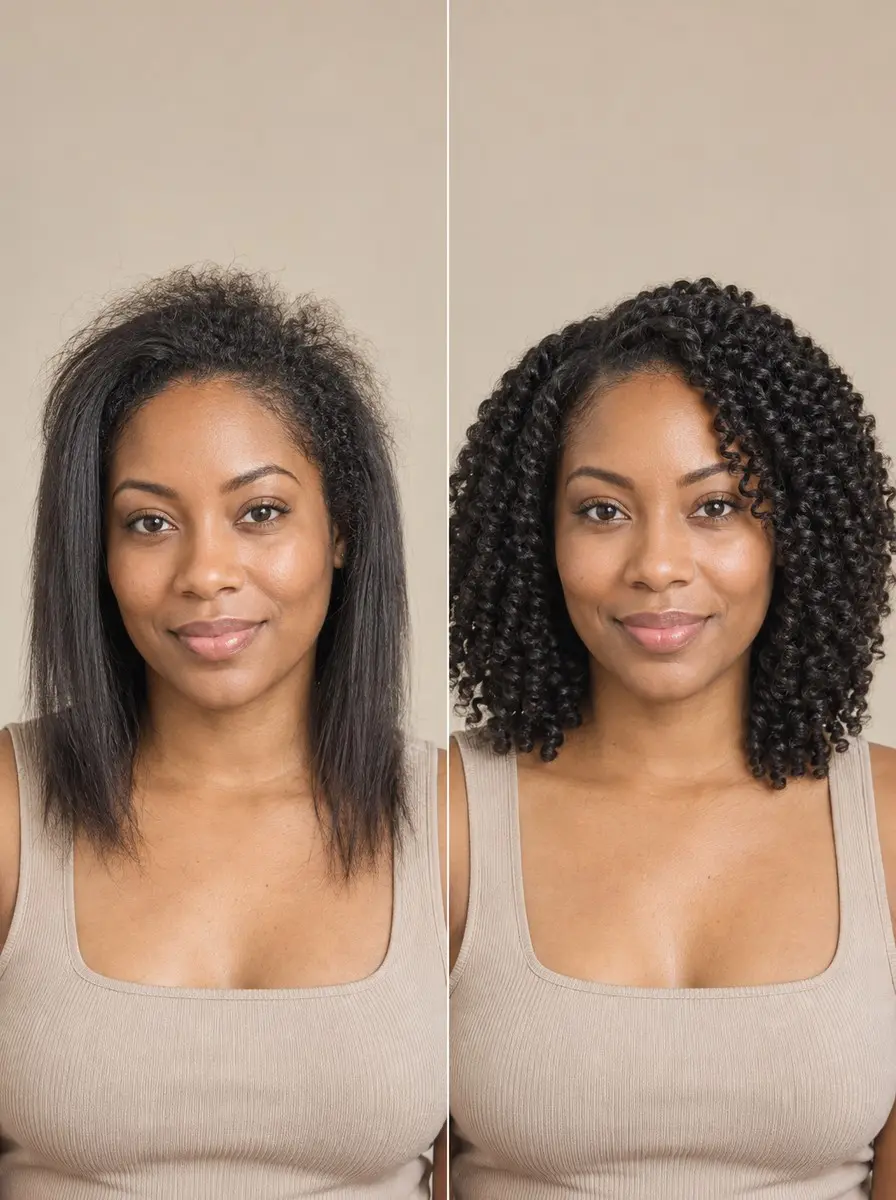
Curly sets are the easiest way to make two textures look like one, because they press a curl into the straight relaxed ends to match the new growth and hide the line of demarcation.
On damp, detangled hair smoothed with leave-in conditioner, do a braid-out, twist-out, Bantu knot-out or flexi rod set, rolling or twisting all the way to the tips, since the relaxed ends are the part that drops a curl first; if a Bantu knot starts to unwind, hold it with a small clip. Let the set dry completely, overnight or longer, before you unravel it; damp hair unravels into frizz and the ends straighten.
Straight styles work against you, because matching the roots to the ends means straightening the new growth with heat. A set is right when the ends hold their curl as well as the roots, and it usually lasts several days if you loosely twist it at night and sleep in your satin bonnet.
Step 7 Rotate in low-tension protective styles
Protective styles tuck the ends away and cut down daily combing, which gives the fragile join a rest, especially in the months when blending is hardest. Choose low-tension options such as loose two-strand twists, cornrows or a braider-installed style, and ask your braider not to pull the hairline or the line of demarcation tight.
Take them down within about six to eight weeks, detangling the shed hair gently with conditioner, and give your hair a wash, deep condition and trim before the next install.
Keep heat to a minimum during the transition too, since protective styles and curly sets can carry you through without a flat iron. Soreness, small bumps or tightness at the hairline mean the style is too tight and should come out early, because constant tension can lead to traction hair loss.
Step 8 Trim the relaxed ends regularly
Book a trim every 6 to 8 weeks, because relaxed ends grow thin and split, and split ends can slowly travel up the strand and damage the new growth you’re protecting.
How much you cut sets your pace: hair grows about an inch every two months, so taking an inch every eight weeks holds your overall length steady while the natural share grows, and taking a quarter to half an inch lets length keep building while the relaxed ends shrink more gradually.
Ask for the trim on stretched hair, such as a fresh braid-out, so the stylist can see where the ends thin out. The cue that you’re trimming enough is ends that feel smooth rather than rough, with no visible splits or tangled knots at the tips.
Step 9 Make the final cut with a pro
When your new growth reaches your goal length, or the relaxed ends are down to a few thin inches, cut the last of them off in one go.
Book a stylist who specializes in textured hair for this cut, since cutting on stretched or dry hair lets them see exactly where your curl pattern ends and shape the natural hair so it falls evenly as it shrinks.
See one sooner if you’re losing hair in clumps, breakage keeps getting worse despite gentler handling, or your hairline or crown is thinning, and see a dermatologist for scalp soreness or bald patches. After the final cut your routine simplifies: one texture, one set of products and no weak join to protect.
Common Mistakes to Avoid
- Combing or brushing dry hair, which snags the curly new growth and snaps the strand at the line of demarcation.
- Skipping trims to protect length, so thin, split relaxed ends keep tangling with and tearing into the new growth.
- Wearing tight ponytails, buns or braids that pull on the hairline and the weak join between the two textures.
- Straightening the roots every week to match the relaxed ends, which can permanently loosen your new curl pattern.
- Using a heavy protein treatment every wash, which leaves hair stiff and brittle enough to snap instead of stretch.
Pro tip Set the relaxed ends tighter than the roots: finish each twist or braid by winding the last inch or two around a small flexi rod. Relaxed hair has no curl of its own to fall back on, so a tighter set at the tips is what makes it match your new growth instead of dropping straight by day two.
The Bottom Line
A transition succeeds on the boring things done consistently: no relaxer, gentle wet detangling, weekly deep conditioning with protein every four to six weeks, trims every 6 to 8 weeks, and curly sets or protective styles that keep you from fighting the line of demarcation. Whether you big chop now or cut the last relaxed ends in a year, you finish with one texture and a routine you understand.
Once the relaxed hair is gone, keep the habits that worked, since natural hair still needs moisture, gentle detangling and regular trims to hold its shape. If breakage keeps climbing, your hairline thins or you can’t tell where the relaxed hair ends, book a stylist who specializes in textured hair; a single consultation can save months of guesswork.
Frequently Asked Questions
How long does it take to transition from relaxed to natural hair?
It depends on how much natural length you want before the relaxed ends go. Hair grows about half an inch a month, so six inches of new growth takes roughly a year, and many transitions run a year or longer. A big chop gets you to fully natural hair in one cut, but you start with a short TWA.
Can relaxed hair go back to natural without cutting it?
No. A relaxer permanently straightens every strand it touches, and no product, treatment or wash routine restores the original curl to that hair. Only the new growth from your scalp is natural, so the relaxed lengths have to be cut off eventually, either all at once with a big chop or gradually through regular trims.
Why does my hair break where the relaxed and natural hair meet?
That spot, the line of demarcation, is the weakest point on the strand. The relaxed side has been chemically weakened, and the abrupt switch from curly to straight concentrates stress where the two textures join, so dry combing, tight styles and rough towel-drying snap it there. Detangle only with plenty of conditioner, keep styles loose and trim the relaxed ends regularly.
Can I straighten my hair while transitioning?
You can on occasion, but keep it rare: frequent high heat can permanently loosen your new curl pattern, and repeated passes further weaken the fragile relaxed lengths. If you do, apply a heat protectant first, run irons over completely dry hair only, never wet, and stay at or below about 300°F (150°C) on fine or fragile hair, with 355-390°F (180-200°C) the ceiling even for coarse hair.
How often should I trim my hair while transitioning?
Every 6 to 8 weeks is a common rhythm. Hair grows about an inch every two months, so trimming an inch every eight weeks holds your length steady while the relaxed portion shrinks; trimming a quarter to half an inch keeps length building but stretches the transition out. Trim sooner if the ends feel rough, split or tangle into knots, because split ends can travel up the strand.
Keep Reading
Sources
- Should you big chop or transition mielleorganics.com
- Your guide to transitioning chemically relaxed hair behindthechair.com