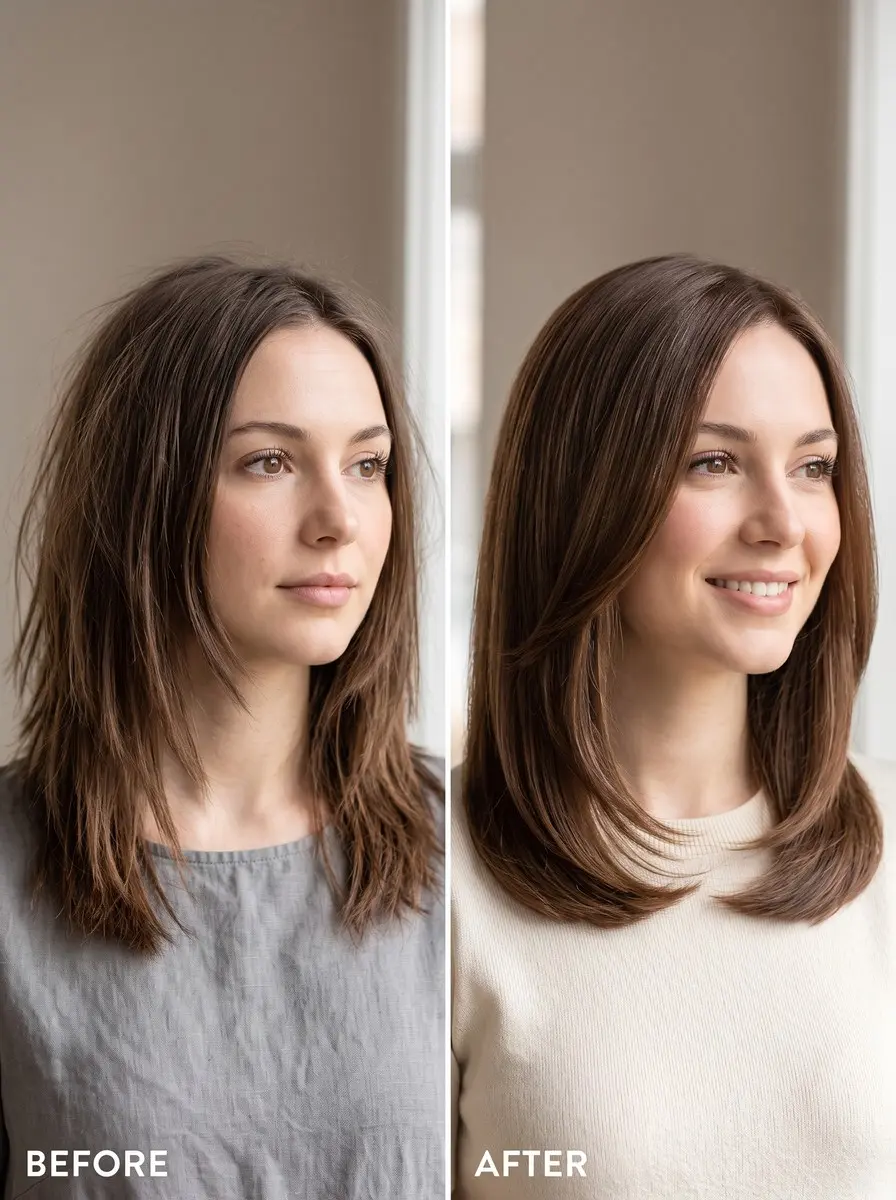
Curtain bangs work on thin hair when the triangle section starts further back toward the crown than feels natural. The fringe should end between the cheekbone and jaw, and the rest of the cut should use light supportive layers, not thinning. Add root lift or dry shampoo.
Curtain bangs for thin hair make a lot of women nervous. The worry is that a fringe will look sparse at the front and take volume from everything else. Cut badly, that is exactly what happens: a fringe taken from too small a section splits into thin, stringy pieces within hours, and the sides lose the hair it borrowed. The soft, parted fringe stays on salon mood boards because it frames the face without the commitment of a blunt bang. On fine hair, though, it only works when it is cut with density in mind.
Cut well, the same fringe makes fine hair look fuller. It comes down to three choices: how far back the triangle section starts, where the length stops, and whether the rest of the cut gets supportive layers or thinning. Below are 20 curtain bangs for thin hair, from wispy and baby fringes to crown-deep sweeps, blunt lobs, a long pixie and dry-cut curls. Each one tells you exactly what to ask for in the salon chair and the upkeep to expect.
1. Crown-Deep Triangle Curtain Bangs

Hover on images and discover how pinning can transform your collection of favorites!
Start here: every other cut on this list builds on this one. The triangle section starts further back toward the crown than looks right, so the fringe gets enough strands to look full instead of stringy. It suits straight or slightly wavy fine hair and works with most face shapes. Ask your stylist to take the section deeper toward the crown, keep it narrow at the temples so the sides stay full, and cut to cheekbone length. Expect a trim every four to six weeks as the sweep softens.
2. Long Pixie with Cheekbone Curtain Bangs

Hover on images and discover how pinning can transform your collection of favorites!
A short crop lets fine strands stand up on their own instead of hanging flat, and a curtain fringe at the cheekbone softens the pixie so it looks grown-in rather than severe. It suits fine straight or slightly wavy hair and oval or heart-shaped faces. Ask for a long pixie with extra length through the crown and front, a neat tapered nape, and a center-parted fringe from a deep triangle ending at the cheekbone. A pixie loses its shape quickly, so book trims every four to six weeks.
3. Jaw-Grazing Sweeping Curtain Bangs

Hover on images and discover how pinning can transform your collection of favorites!
Longer pieces that finish at the jaw are the lowest-commitment way into bangs. On fine hair, the extra length adds weight that helps the sweep hold. Many stylists suggest this length for round faces because the ends fall below the cheekbone and draw a vertical line. Ask for a curtain fringe cut from a deep triangle, shortest around the lip line and blending to the jaw. Book a fringe trim every five to six weeks, before the ends disappear into the rest of your hair.
4. Wispy See-Through Curtain Bangs

Hover on images and discover how pinning can transform your collection of favorites!
If a solid fringe feels like too much, wispy curtain bangs use fewer strands for an airy veil. On fine hair they still need a proper triangle, or they vanish by lunchtime. They suit anyone trying bangs for the first time and look soft on oval and long faces. Ask for a see-through curtain fringe, point-cut rather than thinned, with the section still reaching back from the hairline. A spritz of texturising spray on dry hair gives the pieces grip. Trim every four to six weeks.
5. Baby Curtain Bangs with a Deeper Section

Hover on images and discover how pinning can transform your collection of favorites!
Baby curtain bangs sit shorter, around the outer edge of the brow. They are the riskiest version for fine hair, because short, light pieces can flip up or split apart. The fix is density: ask your stylist for a deeper section than usual and a slightly longer center so the fringe can arc. It suits confident dressers with oval or heart-shaped faces. Plan on trims closer to every four weeks, since a short fringe loses its shape faster than a longer one.
6. Piecey Texturized Curtain Bangs

Hover on images and discover how pinning can transform your collection of favorites!
Piecey bangs are separated on purpose, so fine hair’s tendency to split becomes the look rather than the problem. They suit straight fine hair with an undone, lived-in style and pair well with a lob or shoulder-length cut. Ask for a curtain fringe at cheekbone-to-jaw length with point-cut ends and no razor thinning, which can leave the ends too sparse. Once dry, twist the fringe with a pea-sized dab of texture paste. Refresh the roots with dry shampoo on day two.
7. Curtain Bangs with a Blunt Collarbone Lob

Hover on images and discover how pinning can transform your collection of favorites!
A blunt perimeter keeps as much weight as possible at the ends, so the lengths look thick even though the fringe borrowed hair from the front. It works on fine straight hair at any age and adds width at the collarbone, which many stylists use to balance longer faces. Ask for a one-length lob at the collarbone and a curtain fringe from a deep triangle, with only a few face-framing pieces. Book a fringe trim about every five weeks and the full lob when the ends start looking wispy.
8. Chin-Length Bob with Curtain Bangs

Hover on images and discover how pinning can transform your collection of favorites!
A chin-length bob packs every strand into a short, dense shape, and a curtain fringe that meets it at the cheekbone makes the whole cut look deliberate. It suits fine straight hair and heart or oval faces. Round faces may prefer the fringe ending lower, toward the jaw. Ask for a blunt bob with minimal graduation and a center-parted fringe blended into the front corners. A bob loses its line within about six to eight weeks, so book the bob and fringe trims together.
9. Shoulder-Length Cut with Supportive Long Layers

Hover on images and discover how pinning can transform your collection of favorites!
Layers go wrong on fine hair when they remove weight. Supportive layers are cut long and placed only around the face and crown, so they build shape instead. Paired with a curtain fringe, they add movement without hollowing out the ends. It suits shoulder-length fine hair with a little natural wave. Ask for long, light layers starting below the chin, no interior thinning, and a fringe blended into the first layer. Round-brush the crown while damp for lift, and trim every six to eight weeks.
10. Off-Center Curtain Sweep

Hover on images and discover how pinning can transform your collection of favorites!
Moving the part an inch off center puts more of the fringe on one side, which instantly looks fuller than a split center part on fine strands. It suits square and oval faces, where the asymmetry softens angles, and it stays forgiving as the fringe grows. Ask for a curtain fringe from a deep triangle, cut so it balances whether you wear the part centered or slightly to the side. Switching sides of the part adds root lift. Trim every five to six weeks.
11. Face-Framing Ribbon Layers into Curtain Bangs

Hover on images and discover how pinning can transform your collection of favorites!
Here the fringe doesn’t stop at the jaw. It flows into a few long, ribbon-like face-framing pieces that fall to the collarbone. On fine hair this makes one continuous line that looks intentional even on day three. Like the jaw-grazing sweep, that long vertical line is a favourite of stylists for round and oval faces, and it helps anyone growing out an old fringe. Ask for a curtain fringe at cheekbone-to-jaw length with two or three long pieces cascading from it, cut with minimal weight removed. Trim the front about every six weeks as the shape softens.
12. Air-Dried Wavy Curtain Bangs

Hover on images and discover how pinning can transform your collection of favorites!
Fine wavy hair already has texture, so a curtain fringe can air-dry into soft S-bends that add visual volume. It suits wavy, low-density hair and a relaxed daily routine. Ask for the fringe cut slightly longer than your target length, since waves pull it up, and for point-cutting instead of thinning. Scrunch a light mousse through damp hair, then clip each side of the fringe away from your face with a flat clip until dry for lift at the root. Trim every five to six weeks.
13. Fine Curly Curtain Bangs Cut Dry

Hover on images and discover how pinning can transform your collection of favorites!
Fine curls shrink and separate differently from strand to strand, so these bangs should be cut dry, curl by curl, to see where each piece will land. The deeper triangle matters even more here, because a skimpy section leaves you with a few lonely spirals. It suits fine, low-density curly hair, from loose waves to springy curls. Ask a curl-trained stylist for dry-cut curtain bangs that sit between cheekbone and jaw once curled. Refresh with a water-and-leave-in mist, and trim about every six weeks.
14. Babylight-Dimension Curtain Bangs

Hover on images and discover how pinning can transform your collection of favorites!
Colour changes how density looks. Fine babylights woven through the fringe create light and shadow that make thin strands look like more hair. It suits fine blonde, light-brown or bronde hair, with a toner chosen to match your preference for warm or cool. Ask for a curtain fringe from a deep triangle, then for fine babylights at the part and through the bangs instead of chunky panels. Plan on a gloss every six to eight weeks and a fringe trim every four to six.
15. Half-Up Curtain Bangs

Hover on images and discover how pinning can transform your collection of favorites!
Pulling the crown back into a small clip or tie lifts the roots, and the curtain fringe keeps the face framed, so the look reads styled instead of flat. It suits fine hair on day two or three, when a full down style starts to collapse. Ask your stylist for a curtain fringe long enough to stay out of your eyes when the rest is up, somewhere between cheekbone and jaw. Lightly tease the crown before clipping and add dry shampoo at the part. Trim every five weeks.
16. Roller-Set Bouncy Curtain Bangs

Hover on images and discover how pinning can transform your collection of favorites!
Setting the fringe on one large Velcro roller while it cools gives fine bangs a rounded, lifted bend that lasts longer than brushing alone. It suits straight fine hair that falls flat within an hour of styling. Ask for a curtain fringe cut to the lower cheekbone so there is enough length to wrap around the roller. Blow-dry the fringe while damp with a small round brush, roll it up and let it cool for ten minutes before releasing. Trim every four to six weeks.
17. Bardot-Inspired Fuller Curtain Fringe

Hover on images and discover how pinning can transform your collection of favorites!
A Bardot fringe is fuller and longer through the center than a standard curtain bang, and it parts only slightly, so it frames the brows. On fine hair it only works with a generous triangle section, which is exactly why it looks so lush. It suits oval and long faces and a retro, glamorous mood. Ask for a deep triangle that stays narrow at the temples, grazing the brow at center and angling down to the cheekbone. Trim every four to five weeks to keep the shape.
18. Long One-Length Hair with Curtain Bangs

Hover on images and discover how pinning can transform your collection of favorites!
Long fine hair can look sparse at the ends. Keeping the perimeter blunt and one length preserves thickness, while a curtain fringe adds the shape the lengths lack. It suits fine straight hair that falls past the shoulders. Ask for a blunt perimeter with no long layers, plus a curtain fringe from a deep triangle that stays narrow so it doesn’t take hair from the sides. Tucking and sweeping keeps styling easy. Trim the fringe every five to six weeks and the ends when they start looking wispy.
19. Sleek High Ponytail with Curtain Bangs

Hover on images and discover how pinning can transform your collection of favorites!
A tight ponytail pulls fine hair flat against the head and can look severe. A curtain fringe left out at the front softens it and frames the face. It suits fine straight or wavy hair and anyone who wears their hair up for work or the gym. Ask for a fringe that falls between cheekbone and lip line with everything else pulled back, from a triangle kept narrow at the temples so the sides of the ponytail stay full. Dust dry shampoo at the crown before tying for grip and lift. Trim every five to six weeks.
20. Soft Shag-Lite with Curtain Bangs

Hover on images and discover how pinning can transform your collection of favorites!
A classic shag removes a lot of interior weight, which can hollow out fine hair. This softer version keeps short layers only at the crown for lift and leaves the ends full, with the curtain fringe blending into it. It suits fine wavy or straight hair and oval or round faces, where the crown height adds length. Ask for a soft shag with crown layers for height, no interior thinning, and a nearly blunt perimeter at the collarbone. Spray root lift into damp roots, and trim every six to eight weeks.
You Might Also Like
- curtain bangs for round faces
- curtain bangs for long faces
- airy octopus haircuts for thin hair
- how to do a round brush blowout
- how to tame fine hair frizz without weighing it down
The rules for curtain bangs on thin hair are short. Take the triangle section further back than feels natural and keep it narrow at the temples. Stop the length between the cheekbone and the jaw. Ask for layers that build shape, never thinning shears through the interior. Plan on a fringe trim every four to six weeks, when the sweep starts to flatten and lose its shape.
One habit adds more volume than any product: blow-dry the fringe first, while the rest of your hair is still damp. Brush it side to side as it dries so the roots can’t set flat, then roll it outward on a small round brush. Mist on a heat protectant before the dryer. If you ever finish with a flat iron, use it only on completely dry hair and keep it around 150C/300F.
Frequently Asked Questions
Do curtain bangs make thin hair look thinner?
They can if the fringe is cut from too small a section. That leaves thin, stringy pieces and visible gaps at the hairline. When the triangle starts further back toward the crown and stays narrow at the temples, curtain bangs usually make fine hair look fuller by adding shape and movement at the front.
How big should the bang section be for fine hair?
Deeper than it looks like it should be. Stylists start the triangle further back toward the crown so the fringe has enough strands to look dense. They keep its base narrow at the temples so the sides aren't left sparse. If your bangs split into a few separate pieces within an hour, the section was probably too small.
How do you style curtain bangs on fine hair for more volume?
Focus on the roots, not the ends. Apply a root-lifting spray or light mousse to the damp fringe, blow-dry it before the rest of your hair and roll it outward on a small round brush or a Velcro roller. Once it is dry, mist texturising spray through the lengths and dust dry shampoo at the part so the pieces don't separate.
How often do curtain bangs on thin hair need a trim?
Every four to six weeks. As the fringe gets longer it loses its sweep and starts to lie flat or fall into your eyes, and on fine hair that shows quickly. Many salons offer quick fringe trims between full cuts. Rinsing the fringe more often than the rest of your hair keeps it from looking greasy and separated.
Are curtain bangs a lasting classic or a passing trend?
They are closer to a classic. Soft, center-parted fringes have come back for decades, from Sixties and Seventies icons to today's salon mood boards, because they frame the face and blend into face-framing layers as they grow out. That flexibility makes them a lower-risk choice for fine hair than a heavy blunt fringe.
Sources
- Rooted Salon says a curtain bang triangle on fine hair has to start further back than it looks like it should for enough density, and bangs look thin and stringy when the section is too small. Supporting layers must build shape, not thin the hair further, and bangs need attention every four to six weeks. rootedsalons.com
- John Frieda recommends keeping a fine-hair curtain fringe cheekbone-to-jaw length, with light layers for movement and fullness and a round brush, blow-dry or texturising spray for volume. johnfrieda.com
- Coco & Eve says thin hair should have bangs cut deeper toward the crown for volume, and styled with root-lifting spray or dry shampoo. It recommends trims every 5-6 weeks. cocoandeve.com