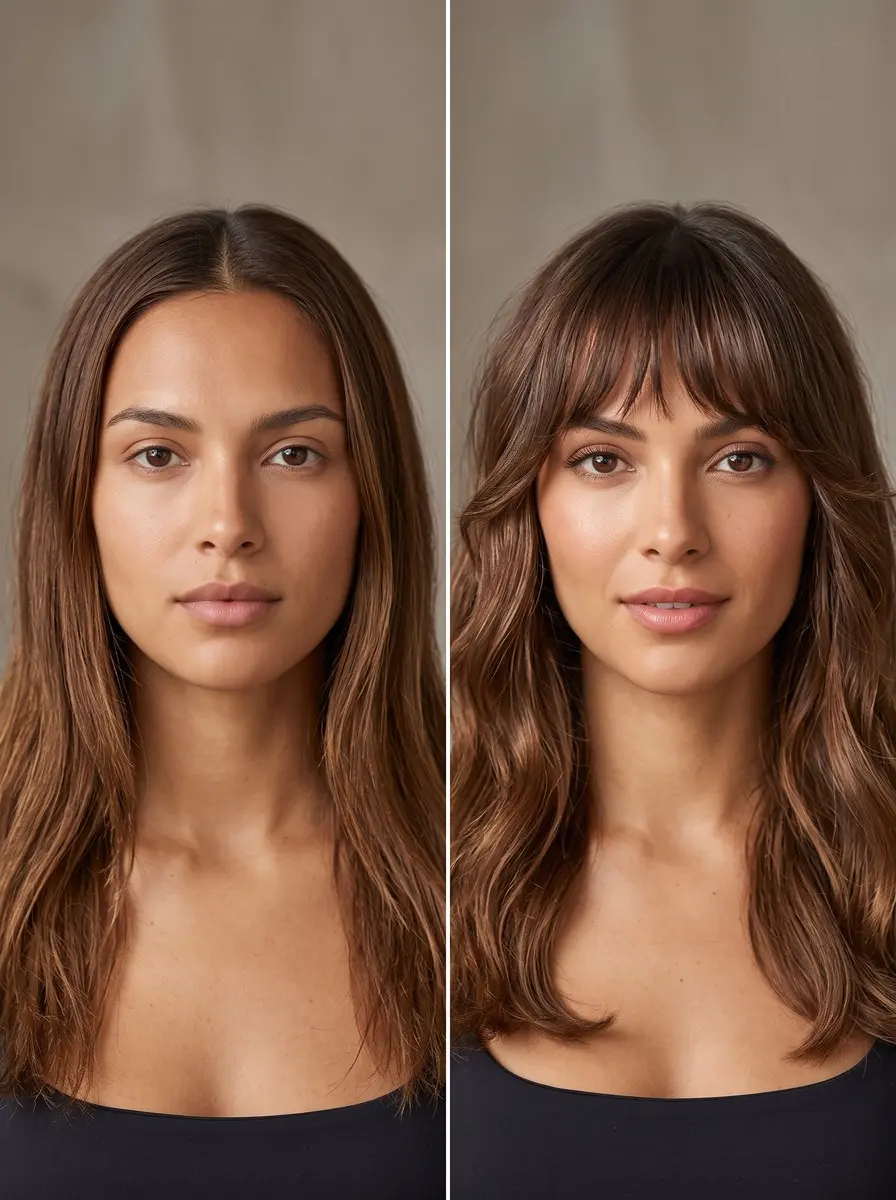
To get bottleneck bangs, ask your stylist for a short, straight centre section about 2cm wide that curves longer around the eyes and blends into cheekbone-length layers, then style it daily with root-lift spray, a round-brush blow-dry and a soft outward bend at the sides.
Bottleneck bangs are the fringe for anyone who wants the softness of curtain bangs without quite so much forehead on show. The shape borrows its name from the neck of a bottle: a short, straight centre that widens and lengthens as it curves around the eyes, ending in pieces that skim the cheekbones and melt into your layers. It is heavier and more blended than a curtain bang, and far more forgiving than a blunt fringe.
The catch is that not every stylist knows the name, and a loose translation can leave you with a choppy straight fringe you never asked for. This guide takes you through deciding whether the cut suits your hair, testing for a cowlick, briefing your stylist in plain words, styling it at home in a few minutes, and growing it out without an awkward phase.
What You’ll Need
- Root-lift spray (volumizing root spray) — Gives the short centre grip and lift at the base so it curves instead of lying flat against the forehead.
- Small round brush (1-1.25 inch barrel) — Its tight barrel rolls the short side pieces outward into the bottleneck curve during the blow-dry.
- Large foam rollers (heatless setting rollers) — One roller sets a straight fringe into a curve overnight with no extra heat.
- Mini flat iron (half-inch plates) — Small plates reach the short pieces close to the face to add the outward bend at the cheekbones.
- Heat protectant spray — Bangs are the most-styled hair on your head, so they need protection every time a dryer or iron touches them.
As an Amazon Associate, HairAide earns from qualifying purchases. Some links above are affiliate links — they cost you nothing extra and help support free tutorials.
Step-by-Step
-
Confirm a bottleneck is the fringe you want, because it is easily confused with curtain bangs in photos. A bottleneck is shortest in the centre, where a section roughly 2cm wide is cut straight, then it lengthens around the eyes and is longest along the cheekbones, blending into your side layers. Side by side: curtain bangs are shorter, fluffier and part open, so more forehead shows; bottleneck bangs are heavier, cover more forehead and blend more seamlessly into the rest of the cut. Getting this right first matters because the two are cut and dried differently, and knowing which one you have saves weeks of fighting it.
-
Tune the cut to your hair type, since the same shape behaves very differently on different textures. Fine or thin hair needs a thicker bang section taken further back from the hairline, otherwise the centre looks sparse; thick hair benefits from the stylist cutting into the fringe to remove bulk, so it curves instead of sitting like a shelf. Straight hair takes the most styling effort because it has no natural bend to follow, wavy hair often falls into the curve on its own, and curly hair should be cut dry and left longer to allow for shrinkage. Length and angle also adapt it to most face shapes: stylists commonly let the side pieces fall a little below the cheekbone on rounder faces to draw the eye down, and stop them right at the cheekbone on longer faces to add width, which are useful starting points rather than rules.
-
Test for a cowlick before you commit, because the centre of a bottleneck has to lie flat and a strong cowlick there can flip it up or split it into a gap. Wet your front hairline, comb everything straight forward over your forehead, and let it air-dry without touching it. If one spot lifts, swirls or parts on its own, that is your cowlick, so note exactly where it sits and tell your stylist. A mild one can be tamed by leaving the centre slightly longer, since the extra weight holds it down, but a strong cowlick at the dead centre is a good reason to choose a longer, side-swept fringe instead.
-
Brief your stylist by describing the shape rather than relying on the name, since many salons don’t use the term ‘bottleneck bangs’. Try: ‘I’d like a fringe with a short centre about 2cm wide that lands around my brow line, curves longer around my eyes and blends into face-framing pieces that skim my cheekbones, angled to suit my face, with a soft, choppy edge rather than a blunt line.’ Bring two or three photos showing the fringe from the front and the side, plus one of what you don’t want, such as a blunt fringe or very open curtain bangs. Finally, ask the stylist to start longer than the photo and take more off at a follow-up trim, because length can always be removed but never put back.
-
Blow-dry the shape in while the fringe is still damp. Water temporarily breaks the hydrogen bonds that hold your hair’s shape, and they re-form in whatever position the hair dries in, so styling after the bangs have air-dried flat is an uphill battle. Towel-blot the fringe, mist a root-lift spray at the base, and dry the centre first, pointing the airflow down and brushing the roots side to side to neutralise any cowlick, then use a small round brush to roll each longer side piece up and away from your face so it curves toward the cheekbone. Finish with the cool-shot button and stop only when the fringe is fully dry and cool to the touch, because leftover damp is what makes it drop by midday.
-
Add a soft outward bend at the sides if they fall straight after drying, so the fringe reads as a curve rather than two flat panels. Clamp a flat iron or a large-barrel curling iron near the middle of each side piece, turn it away from your face and glide it off the ends, then give the centre a slight bend under so it doesn’t flick up. The outward turn is what creates the bottleneck silhouette, narrow at the centre and opening out as it reaches the cheekbones. Keep the bend loose rather than ringleted, and rake it through with your fingers once it has cooled so it blends into your layers.
-
Set very straight hair overnight on a foam roller, because straight fringes lose their curve fastest and a heatless set is the easiest fix. At night, on dry or barely misted bangs, roll the whole fringe up and back onto a single large foam roller and secure it; the soft foam is comfortable enough to sleep on. In the morning, unroll it, shake out the roots and push the side pieces outward with your fingers. Because the hair spent hours drying and cooling in a curved position, the bend usually outlasts a rushed morning blow-dry.
-
Wear it with a bun or ponytail, which is where bottleneck bangs really earn their keep, because the longer side pieces frame your face the way loose layers normally would. Before tying your hair back, section off the fringe and the cheekbone pieces so they stay out, secure the rest, and let the front fall into its curve. On second day, wet only the fringe at the sink and re-dry it in a couple of minutes instead of washing everything, since bangs pick up oil from your forehead first; a little dry shampoo at the fringe roots can buy another day. For a sleeker finish, tuck the longest side pieces behind your ears and leave just the centre and eye-length pieces out.
-
Plan your trims and your grow-out before you need them. Hair grows at a steady rate of roughly 1.25cm (half an inch) a month, and on a fringe this short you notice it quickly: as the centre drops past your brows into your lashes, the curve flattens and the shape loses its definition. There is no official trim schedule, but many people find a fringe-only tidy every four to six weeks keeps the centre out of their eyes, so book it when the shape starts looking more curtain than bottleneck rather than on a fixed date; many salons offer quick fringe trims between full cuts. When you are ready to grow it out, the good news is that the shape is already graduated, so it moves naturally into curtain bangs and then face-framing layers without a blunt, awkward stage.
Common Mistakes to Avoid
- Asking for ‘bottleneck bangs’ by name without photos or a description, and walking out with a blunt straight fringe or wide-open curtain bangs instead.
- Cutting the centre to its final length on the first visit: a centre that ends up too short flips up and can’t be fixed until it grows back.
- Letting the fringe air-dry and then trying to restyle it; once it has dried flat or split at a cowlick, you have to re-wet it to reset the shape.
- Skipping the cowlick test and placing the short centre right on top of a strong cowlick.
- Trimming your own centre while it’s wet, which leaves it shorter than you aimed for once it dries and springs up.
Pro Tip
Ask your stylist to finish the fringe dry, after blow-drying it the way you’ll actually wear it. Cutting a bottleneck dry shows the cowlick, the natural fall and the true length of the curve before the scissors commit.
Frequently Asked Questions
What is the difference between bottleneck bangs and curtain bangs?
Bottleneck bangs have a short, straight centre about 2cm wide that curves longer around the eyes and is longest at the cheekbones, blending into your layers. Curtain bangs are shorter, fluffier and part open at the centre, so they show more forehead. Bottleneck bangs are heavier, cover more of the forehead and look more blended into the haircut.
Do bottleneck bangs work on fine or thin hair?
Yes, with one adjustment: ask for a thicker bang section taken further back from the hairline so the centre doesn't look sparse. Keep the edge soft but avoid heavy thinning, which makes fine bangs look see-through. A root-lift spray and a quick round-brush blow-dry add the body that holds the curve.
How often do bottleneck bangs need a trim?
There is no fixed rule. Hair grows about 1.25cm (half an inch) a month, so the centre reaches the lashes and the curve flattens fairly quickly; many people book a fringe-only trim every four to six weeks. The best cue is the shape itself: trim when it starts looking more like curtain bangs than a bottleneck.
Do I have to use heat to style bottleneck bangs every day?
No. Straight hair can be set overnight on a large foam roller, and wavy hair often falls into the curve with a quick blow-dry. When you do use heat, mist a heat protectant onto damp bangs before blow-drying, and use a flat or curling iron only on completely dry hair, at up to about 150C/300F for fine or bleached hair and 180-200C/355-390F for coarse hair.
Are bottleneck bangs a lasting classic or a passing trend?
The name is a recent social-media label, but the shape is a variation on the softly graduated, face-framing fringe stylists have cut for decades. Because it blends into layers and grows out into curtain bangs, it is a low-risk way to try a fringe, and it keeps looking current even if the label fades.
You Might Also Like
- 15 types of bangs to compare before you commit
- 20 puff-proof curtain bang ideas for thick hair
- 20 volume-building curtain bang ideas for thin hair
- how to grow out bangs, stage by stage
- how to blow-dry curtain bangs
- styling a fringe on curly hair
- how to make a blowout last longer
- how to fix a bad haircut
Done right, bottleneck bangs give you a soft, face-framing fringe that covers more forehead than curtain bangs and blends into the rest of your cut, styled in a few minutes with a round brush or an overnight roller. The shape is forgiving, too: a centre that is a little long simply reads as softer.
Plan a fringe-only trim whenever the centre starts reaching your lashes and the curve flattens, and let the side pieces grow into curtain bangs when you’re ready to move on. See a stylist rather than reaching for the scissors if a cowlick keeps splitting the centre or you want to change the angle for your face; those adjustments are best made dry, in the chair.
Sources
- Bottleneck bangs are shortest at the centre, lengthen around the eyes and are longest along the cheekbones. They are softer than a straight fringe and differ from the shorter, bouncier, fluffier curtain bangs. stylist.co.uk
- Educator Imy Chowdhary compares the shape to a Coke bottle: the centre is cut straight at roughly 2cm wide, then curves outward. Varying the length and angle lets it suit nearly every face shape. elle.com.sg