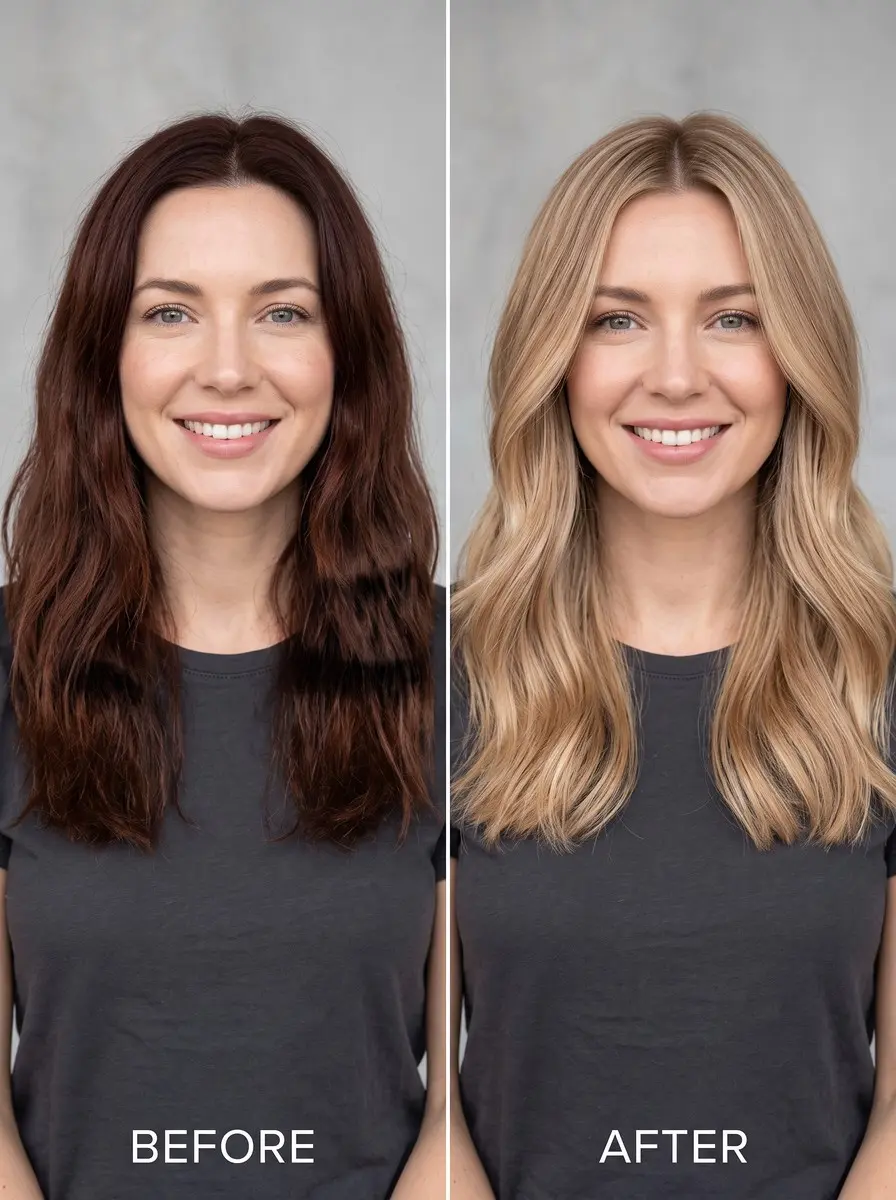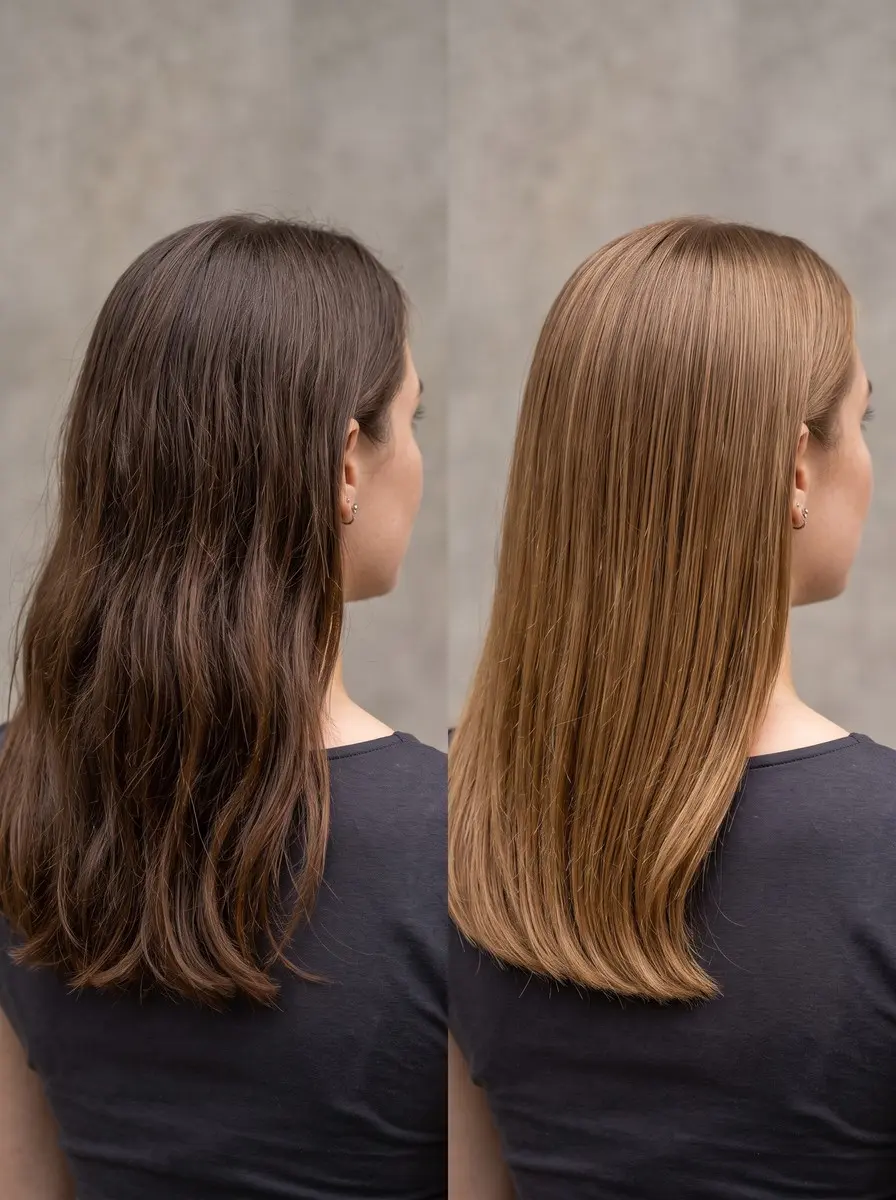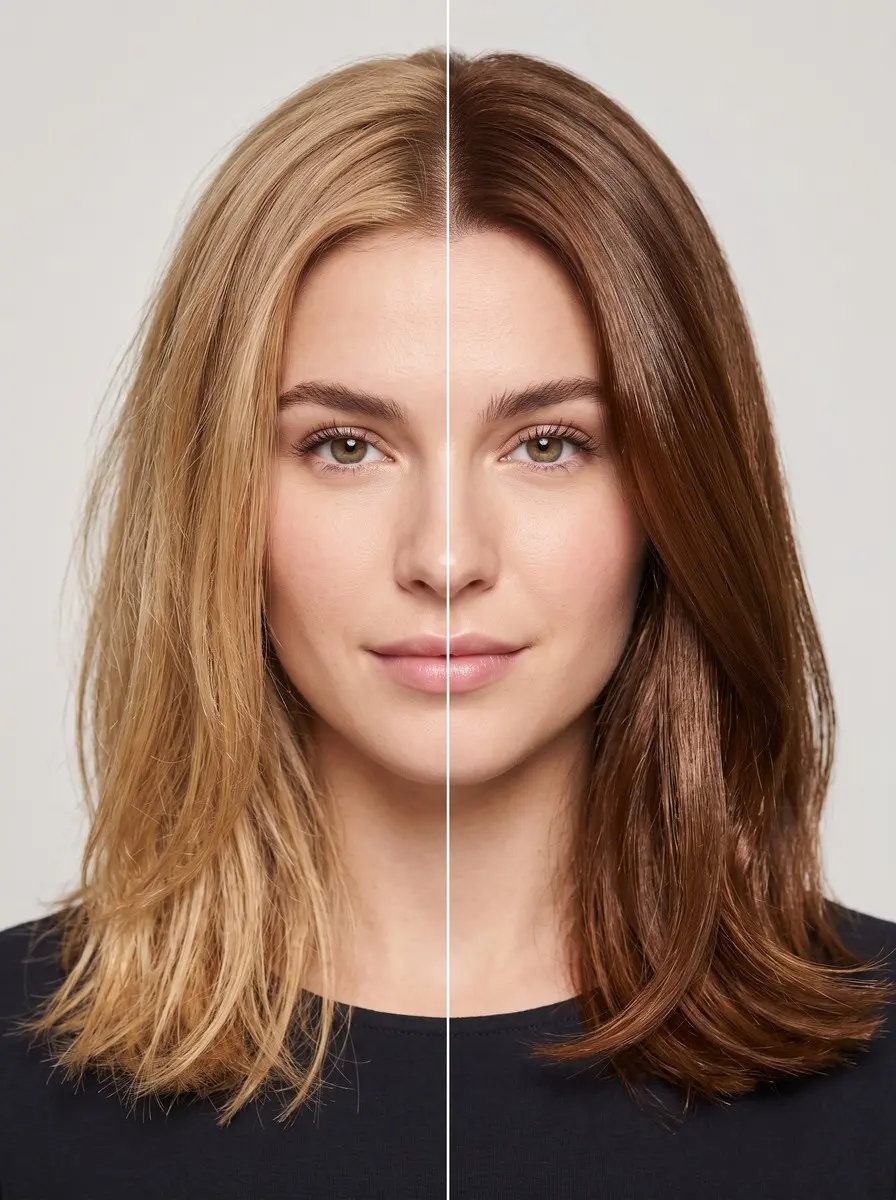
Quick answer To dye blonde hair brown, pick a warm or neutral brown no more than two levels darker, patch test 48 hours ahead, then strand test. On light or lightened blonde, fill first, usually with a red or gold shade, so the brown doesn't turn green or gray.
Going from blonde to brown looks like the easy direction: no bleach, no lift, just deposit. Then the box shade you picked comes out flat, gray or, worst of all, faintly green. That isn’t bad luck. Blonde hair, and lightened blonde most of all, has little of the red and gold pigment that brown dye relies on underneath, so a cool brown has nothing warm to balance it.
The fix is to plan for that missing warmth before you mix anything. This guide shows you how to dye blonde hair brown at home: check your hair’s condition, keep the jump to one or two levels, choose a warm brown or fill first, and test on your skin and on a strand so nothing surprises you.
Done in that order, a rich, even brown is very achievable, and you’ll know exactly when a salon is the better call.
Time 2-3 hours, plus a 48-hour patch test beforehandDifficulty IntermediateSteps 9
Warm Brown, Fill or Salon: Which Route Fits
| Your blonde | Jump to target | Route |
|---|---|---|
| Dark or golden blonde | One to two levels | A warm brown alone is often enough |
| Light or lightened blonde | One to two levels | Usually fill first, then the brown |
| Any blonde | More than two levels | Salon |
| Heavily bleached, gummy or patchy | Any | Salon |
What You’ll Need
As an Amazon Associate, HairAide earns from qualifying purchases. Product links in this guide are affiliate links: they cost you nothing extra and help keep these tutorials free.
- Madison Reed Radiant Hair Color in a warm brown shade A golden or warm brown brings back the warmth blonde hair is missing, which keeps the result from going gray or green.
- ESalon custom hair color The formula is matched to your starting blonde and your target, which helps when you’re unsure which brown to buy.
- Copper or golden semi-permanent hair color Puts back the red-gold pigment that light or lightened blonde lacks before the brown goes on.
- Tint brush, mixing bowl and sectioning clips Clean sections and brush application give the even saturation that prevents patchy, banded brown.
- Blue shampoo for brunettes Blue cancels the orange tones that show as brown fades, keeping the color from going brassy between dye jobs.
Step-by-Step
Step 1 Assess your blonde and its condition
Look closely at the hair you’re about to dye before you buy anything. Damaged, over-bleached lengths grab color fast and unevenly, and that is one of the main reasons brown turns out muddy or patchy.
Wet a strand and gently stretch it: healthy hair stretches a little and springs back, while hair that feels gummy, keeps stretching or snaps is over-processed. Check for bands of different blondes from old highlights or regrowth too, because each band will take the brown differently. If your lengths are gummy, breaking or heavily bleached, stop here and book a colorist.
Step 2 Keep the jump to two levels
Place your current blonde and your target brown on the 1-10 level scale colorists use, where 1 is black and 10 is the lightest blonde. Most box dyes show the level as the first number of the shade code.
At home, go no more than one to two levels darker in a session: the bigger the jump, the more missing warm pigment the brown has to cover and the more likely it is to turn gray or green.
Also keep the target within one to two shades of your natural root color, as The Zoe Report advises, so regrowth blends in instead of showing as a stripe. If the gap is larger, such as platinum to chocolate, book a salon, because the lighter you start, the longer the route to brown.
Step 3 Choose a warm or neutral brown
Blonde hair has little red or gold pigment, and that missing warmth is why brown dye can come out flat, gray or even green on it. Ash browns are the usual culprit: their cool, blue-leaning base mixes with the yellow in blonde and shows up as a greenish, muddy cast.
Choose a brown described as golden, warm, caramel or chestnut, or a neutral, and skip anything labeled ash or cool for this first application. On dark or golden blonde going one to two levels, a warm brown alone is often enough. Light or lightened blonde usually needs a fill as well, and your strand test will confirm it.
Step 4 Patch test 48 hours ahead
Do a skin allergy test 48 hours before you color, even with a brand you’ve used before, because sensitivity to dye ingredients can develop over time. Prepare a small amount of each product you plan to use, both the filler and the brown, exactly as the instructions describe, and dab it behind your ear or on your inner elbow.
Leave it uncovered and unwashed for the full 48 hours. If you get itching, redness, swelling or burning, don’t use that product, and see a doctor if the reaction is strong.
Step 5 Strand test both routes
While you wait out the patch test, snip two small strands from a hidden spot that’s as light and porous as the rest of your lengths. Color one with the brown alone and the other with the filler followed by the brown, timing each exactly as the box says. Rinse them, let them dry and check them in daylight.
If the brown-only strand looks rich and even, you can skip the fill; if it’s gray, green or flat, the filled strand shows whether filling fixes it. This is how you settle the filler-shade question for your own hair, and it confirms the processing time before you commit your whole head.
Step 6 Fill lightened lengths first
Filling puts back the warm pigment blonde hair is missing, so the brown has something to sit on, much like a base coat under nail polish. Sources disagree on what to fill with.
Madison Reed’s guide uses a red or golden shade such as copper red, while The Zoe Report describes the fill more generally as depositing pigment as a base coat, and some advice favors a dark fill instead. Follow your dye maker’s instructions and whatever your strand test showed.
Apply the filler only to the blonde or lightened lengths, not to a darker natural root, and saturate them evenly. Process for the full time given, rinse until the water runs clear and let your hair dry before the brown goes on, unless the instructions say to apply the brown straight over the filler.
Step 7 Apply the brown in sections
Start with your hair as the box directs, usually dry and unwashed, then divide it into four sections and clip them away. Working one quadrant at a time is the simplest way to get even, complete coverage at home.
Apply the brown in thin slices, saturating each from where the color should start down to the ends, and work steadily so the first section doesn’t process much longer than the last.
Leave dry or porous ends until last, because they grab color faster and can go darker than the rest. Use the developer that comes in the kit, or 10 volume if you’re mixing salon color yourself: going darker needs deposit, not lift.
Step 8 Rinse, condition and judge the color
Rinse as soon as the timer ends. Leaving the dye on longer won’t make the brown last, and it can push porous sections darker or muddier. Rinse until the water runs clear, then use the conditioner that came with the color, which is made for freshly colored hair.
Wait until your hair is completely dry and look at it in daylight before you judge the shade, since wet hair looks darker. If it’s too dark, clarifying washes or a color remover can bring it back; if it’s green, see a stylist rather than piling more dye on top.
Step 9 Keep the brown from fading
Brown fades fastest on lightened, porous hair, and as it fades, warm or brassy tones start to show through. Wash less often and use a sulfate-free, color-safe shampoo, since every wash takes a little pigment with it.
When orange brassiness creeps in, a blue shampoo neutralizes it, because blue sits opposite orange on the color wheel. When the brown loses depth, refresh it with a demi-permanent gloss in the same shade rather than putting permanent color over the lengths again, which builds up darker each time.
Common Mistakes to Avoid
- Choosing an ash or cool brown for light blonde hair: its blue-leaning base mixes with the yellow and comes out greenish or gray.
- Jumping more than two levels darker in one session, which leaves the brown flat or muddy instead of rich.
- Skipping the strand test on highlighted or lightened hair, where porous sections can grab the dye and go darker or patchy.
- Putting filler on a darker natural root as well as the blonde lengths, so the root ends up warmer or darker than the rest.
- Judging the color while your hair is still wet, when it looks darker than it really is.
- Trying to fix a green cast by adding more brown on top instead of seeing a stylist.
Pro tip If you’re torn between two browns, choose the lighter one. Lightened hair tends to soak up more pigment and come out darker than the box shows, and going a shade deeper later is far easier than lifting brown back out.
The Bottom Line
Going from blonde to brown comes down to three decisions: keep the jump small, give the brown a warm or filled base, and run a strand test that proves both before your whole head is committed. Expect the brown to fade faster on lightened lengths. Plan a same-shade gloss when it loses depth, and keep a blue shampoo on hand for brassiness.
See a colorist instead if your hair is heavily bleached, gummy or patchy, if you want to go more than two levels darker, or if the result turns green. A pro can correct green with a counter-tone and build depth in stages without stacking dye on damaged hair. If the color simply came out too dark, start with gentle fixes before you reach for anything stronger.
Frequently Asked Questions
Why did my blonde hair turn green when I dyed it brown?
Blonde hair has little red or gold pigment, so a brown with a cool, ash base mixes with the remaining yellow and looks green or gray. It's most likely on light or lightened blonde and when going more than two levels darker. Don't add more brown on top. A stylist can correct it with a red-based formula, since red sits opposite green on the color wheel.
Do I need to fill my hair before dyeing it brown?
Not always. Dark or golden blonde going one to two levels darker often takes a warm brown on its own. Light or lightened blonde usually needs a fill, most often a red or gold shade, though sources disagree and some favor a dark fill. A strand test with and without the filler shows which your hair needs.
How many levels darker can I safely go at home?
Keep it to one to two levels darker in a session, and keep the target within one to two shades of your natural root so regrowth blends in. Bigger jumps, like platinum to chocolate brown, are more likely to turn gray, green or muddy. They're better handled by a colorist, who can fill and build up the brown in stages.
Should I use semi, demi or permanent dye to go from blonde to brown?
Demi-permanent is the lower-commitment first choice: it deposits color without lifting and fades gradually, so a shade you dislike won't stay for good. Permanent is the pick for lasting results or gray coverage. Semi-permanent works well as a filler but fades fastest, so it rarely holds a brown for long on lightened hair.
How long does brown dye last on blonde hair?
Permanent brown stays until it grows out, though its tone fades with washing, while demi-permanent fades gradually and washes out over time. Both fade faster on lightened, porous hair. Fewer washes, a sulfate-free shampoo and a blue shampoo for brassiness keep it richer for longer, and a gloss can refresh the tone between full applications.
Keep Reading
Sources
- How to dye hair brown at home madison-reed.com
- How to dye hair from blonde to brown thezoereport.com